





Discover why 120x240cm porcelain slabs are the top choice for Moscow’s elite lobbies. Explore the aesthetics, engineering, and status symbolism driving this massive trend in luxury architecture.
The Silent Statement at Your Feet
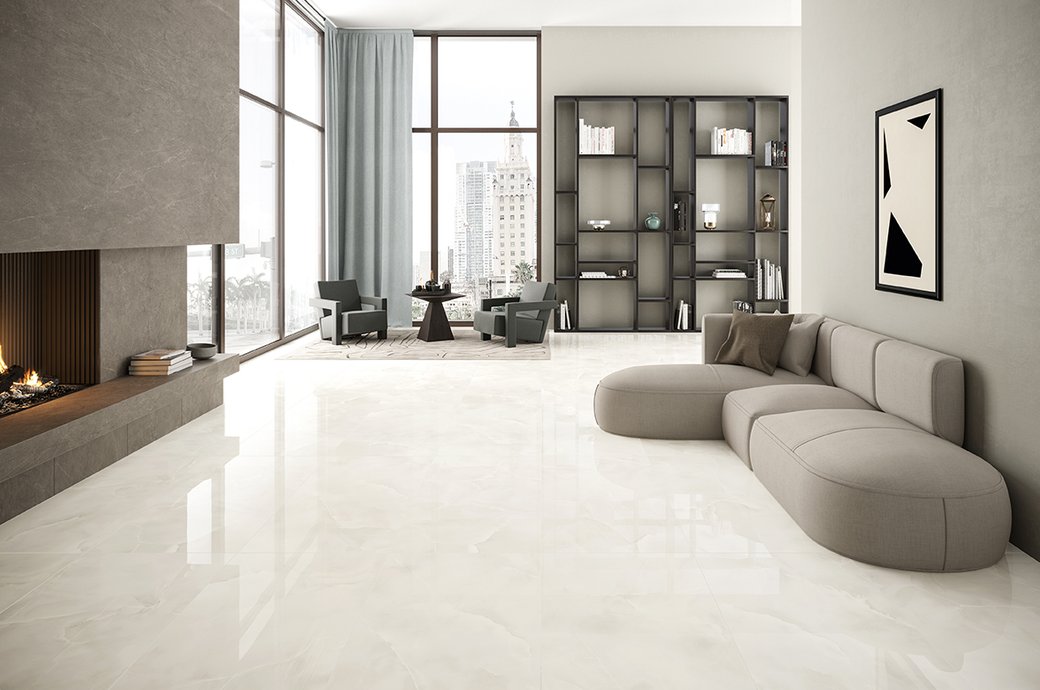
Step into any premium residential building along the Moskva River or within the prestigious “Golden Mile” of Ostozhenka. Before you even reach the concierge, before the scent of expensive leather in the lounge hits you, your eyes—and your feet—have already received the message. You are standing on a surface that is deliberately, unapologetically grand. More often than not, that surface is a single, seamless expanse of 120x240cm porcelain stoneware.
Why this specific format? In a city where architectural statements are measured in scale—from the Seven Sisters skyscrapers to the modern glass towers of Moscow City—size matters. Yet, in the world of interior design, bigger isn’t just better; it is a language. A language of power, of resources, of uncompromising quality.
The typical 60x60cm tile, reliable as it is, can no longer speak this language. Its gridded pattern whispers “practicality,” but the 120x240cm slab declares “luxury.” It is a format that refuses to be broken into pieces, demanding to be seen as a whole.
This article dissects the reign of the 120×240 slab in Moscow’s luxury lobbies. We will explore the engineering challenges it overcomes, the aesthetic psychology it leverages, and why, in the competitive world of high-end real estate, this specific dimension has become the undisputed king of the entryway. If you are an architect, a developer, or simply a connoisseur of fine design, understanding this trend is essential to decoding contemporary luxury in the Russian capital.
The Psychology of Scale: First Impressions and Spatial Dominance
The human brain is wired to interpret scale as a signifier of importance. A vast, unbroken surface suggests grandeur, stability, and permanence. In a luxury lobby, this psychological trigger is the first box that must be checked.
Eliminating Visual Noise
Standard tiles, by their nature, create a grid. This grid, composed of multiple grout lines, generates “visual noise.” It chops the floor into small, digestible pieces. While this can create a cozy, textured feel in a small bathroom, it is the enemy of monumentality.
-
The Grid Effect: A lobby paved with 60×60 tiles presents the eye with a repetitive pattern. The brain counts the tiles, subconsciously noting the modularity. The space feels measured, contained, and ultimately, smaller.
-
The Slab Effect: A floor laid with 120×240 slabs minimizes grout lines by up to 75% compared to smaller formats. This near-seamlessness allows the eye to travel freely across the space without interruption. The floor becomes a unified field, a single, powerful gesture rather than a collection of small statements. This optical unification instantly expands the perceived square footage of the lobby.
The Signal of Investment
In the world of Moscow real estate, where a single apartment can cost tens of millions of dollars, every design choice is a signal of investment.
-
Material Cost: Large-format slabs are inherently more expensive to manufacture, transport, and install. They require more advanced pressing technology and greater raw material purity to ensure structural integrity.
-
Logistical Complexity: Getting a 120×240 slab into a building—especially a renovation project in a historic district—requires professional logistics. It signals that the developer or homeowner spared no expense.
-
The Silent Message: When a resident or guest walks into a lobby with massive slabs, they may not know the technical details, but they intuitively understand that this floor was not cheap. It conveys a message of effortless wealth—the ability to command resources to create beauty without compromise.
Statistic: According to a 2024 report by ArchDialog, the use of slabs larger than 120x120cm in the entry lobbies of Moscow’s “Elite” class residential complexes has increased by 210% since 2020, correlating with a 15% premium in perceived property value among potential buyers.
Engineering the Monolith: Technical Superiority of the 120×240 Format
The dominance of the 120×240 slab is not merely aesthetic. It is rooted in superior material science and engineering that makes it uniquely suited to the high-traffic, high-impact environment of a lobby.
The Rise of Porcelain Gres (Klinker)
The 120×240 format is almost exclusively manufactured in Porcelain Gres (Klinker) , not standard ceramic tile. This distinction is critical.
-
Density and Strength: Porcelain is subjected to higher pressing pressures (often exceeding 15,000 tons) and fired at higher temperatures (over 1200°C). This creates an incredibly dense, vitrified body.
-
Structural Integrity: For a 240cm-long slab to resist flexing and breakage underfoot, it must be exceptionally strong. The high-density porcelain ensures the slab can withstand point loads (like a stiletto heel) and heavy foot traffic without cracking.
-
Water Absorption: With an absorption rate below 0.5%, these slabs are virtually impervious. In a Moscow lobby, where snow, slush, and salt are constantly tracked in, this non-porosity prevents staining, freeze-thaw damage, and bacterial growth.
Rectified Edges: The Key to Seamlessness
The “luxury” look of a 120×240 floor is entirely dependent on the precision of its edges. This is where rectification comes into play.
-
What is Rectification? After firing, tiles are cut to exact mathematical dimensions, creating perfectly straight 90-degree angles. A standard tile might have “edge roll” or slight warping, requiring a wide grout line (3-5mm) to hide imperfections.
-
The Tight Joint: A rectified 120×240 slab can be installed with a grout line as thin as 1-2mm. When filled with a color-matched epoxy grout, this joint becomes virtually invisible. The floor no longer looks like “tiles”; it looks like solid stone, resin, or concrete.
The Digital Printing Revolution
The aesthetic possibilities of these massive slabs are a direct result of advancements in digital inkjet printing.
-
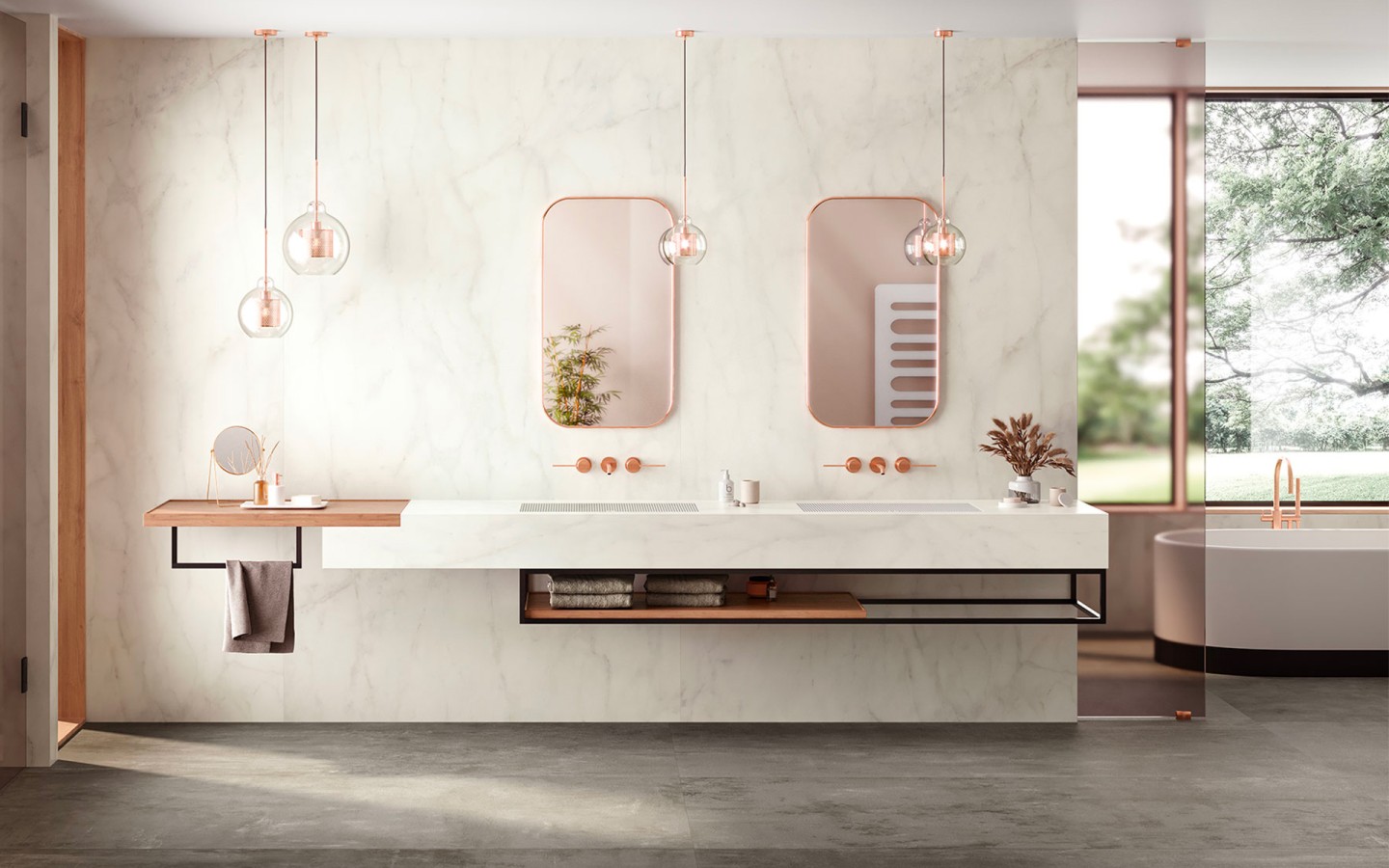
High-Definition Scans: Manufacturers now scan rare marbles (like Calacatta or Statuario), onyx, and exotic stones at microscopic resolutions.
-
True-to-Life Reproduction: These scans are printed onto the slabs with such fidelity that the veining, translucency, and even the subtle color variations are reproduced perfectly.
-
Book-Matching: The 120×240 size is ideal for “book-matching,” where two or more slabs are arranged to create a mirror image of the veining pattern, mimicking the way a large block of stone would be split. This creates a dramatic, artistic focal point in a lobby—a feature impossible to achieve with small tiles.
Aesthetic Trends: What’s Trending on Moscow’s Floors (2025)
The 120×240 slab is a canvas. Here is how Moscow’s top designers are currently painting on it.
The Reign of Marquina and Ultra-Deep Blacks
In a surprising twist, the trend is moving away from safe beiges towards drama.
-
The Look: Polished or lappato (semi-polished) black slabs, often Marquina marble-effect with stark white veining.
-
The Psychology: In a city with grey skies, a dramatic black lobby floor, balanced by bright walls and lighting, creates a sense of sheltered luxury. It feels like walking into a jewelry box.
-
The Challenge: Black shows every speck of dust. However, in a staffed luxury lobby with constant cleaning, this becomes a sign of impeccable service.
The Return of Travertine-Effect
Travertine, with its natural pits and warm, beige tones, is making a massive comeback, but in a modernized format.
-
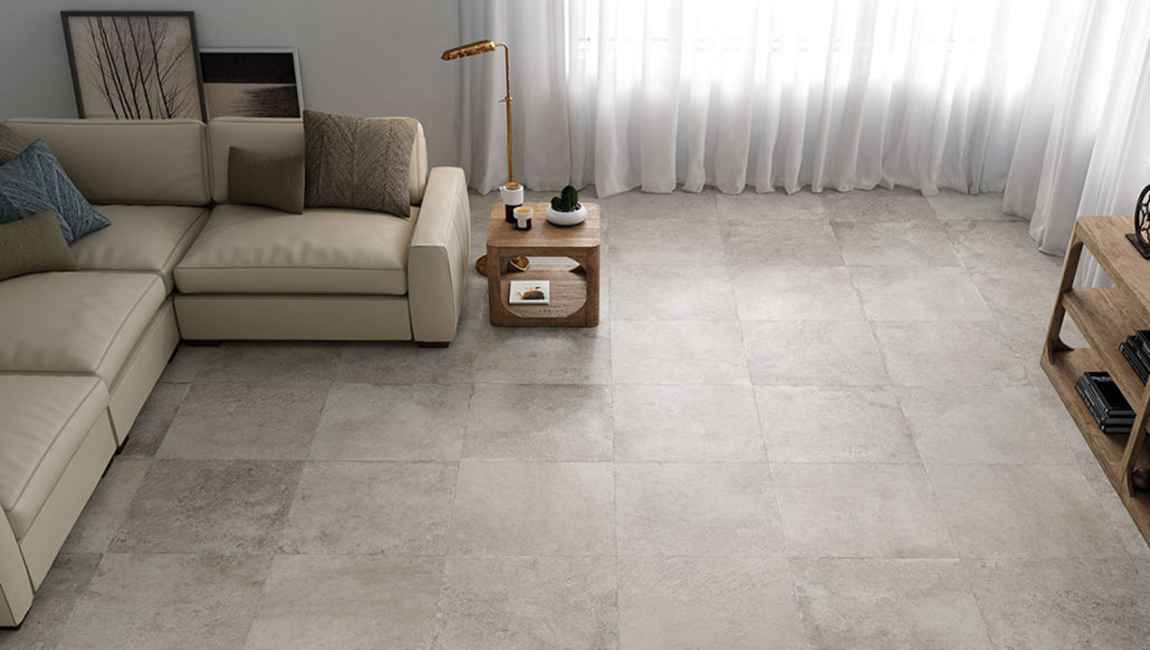
The Look: Large-format slabs that replicate the porous, textured surface of Roman travertine. The 120×240 size allows the natural striations of the stone to flow uninterrupted.
-
The Finish: Typically a matte or “natural” finish. This provides a tactile, organic warmth that contrasts beautifully with the glass and steel of modern architecture.
Concrete and Metal Accents
For the ultra-modern, minimalist lobbies, large-format slabs mimicking poured concrete or oxidized metals are dominating.
-
The Look: Slabs in shades of grey, anthracite, or bronze with the subtle texture of concrete formwork or the patina of weathered steel.
-
The Application: Often used in combination with recessed LED lighting that runs along the minimal grout lines, making the floor look like it is floating.
The Installation Gauntlet: Why Craftsmanship is King
You can buy the most expensive 120×240 slab in the world, but if the installation is poor, it will look like a cheap imitation. The large format is brutally honest—it reveals every mistake.
Subfloor Perfection
Unlike small tiles that can tolerate minor subfloor imperfections, large slabs require a perfectly flat, level, and stable substrate.
-
Self-Leveling Compounds: Installers must use high-quality self-leveling underlayments to create a flawless base.
-
Curing Time: Rushing this step is fatal. Any movement or imperfection in the subfloor will translate to lippage (uneven edges) or cracking in the slab.
The Lippage Fight
Lippage is the number one enemy of the large-format floor. It is the slight difference in height between two adjacent tiles.
-
Why it Happens: Even with rectified edges, slabs can have slight warpage (known as “cupping” or “doming”). If not managed, this creates a lip that catches light, casts a shadow, and ruins the seamless look.
-
The Solution: The Lippage Tuning System (LTS) . This system of clips and wedges pulls the tiles perfectly flush with one another during the curing of the adhesive. It is non-negotiable for a 120×240 installation.
The Weight and Handling Factor
A single 120×240 slab can weigh between 60 and 80 kilograms.
-
Safety: Installation requires heavy-duty suction cup lifters and a team of at least two to three experienced tilers.
-
Cutting: Standard tile cutters won’t work. Installers need heavy-duty bridge saws with water cooling to make precise cuts without chipping the large format.
The Economic Perspective: Cost vs. Value in Moscow Real Estate
Why do developers consistently choose the more expensive 120×240 option? The answer lies in the return on investment.
Breaking Down the Costs
-
Material Cost: A high-quality Italian or Spanish 120×240 slab can cost 3-5 times more per square meter than a standard 60×60 tile.
-
Installation Cost: Due to the need for specialized equipment, LTS systems, and higher-skilled labor, installation costs are typically double.
-
Logistics and Waste: Transporting large slabs is more expensive and fragile. Waste from cutting mistakes is costlier.
The Value Proposition
Despite the higher upfront cost, the format justifies itself.
-
Property Valuation: As noted earlier, lobbies directly impact property valuation. A dated or cheap-looking lobby can devalue apartments by 10-15%. A grand, slabbed lobby is a key selling point.
-
Brand Differentiation: In a saturated market of “premium” buildings, the lobby is the primary differentiator. The 120×240 slab is a physical manifestation of the building’s brand—bold, modern, and uncompromising.
-
Durability and Maintenance: The reduced grout lines mean fewer areas for dirt to collect. The high-density porcelain is scratch and stain resistant. Over the 20-30 year lifecycle of a building, the reduced maintenance and cleaning costs offset the initial investment.
Future Gazing: What Comes After 120×240?
The thirst for size is insatiable. As 120×240 becomes the new standard for luxury, what is next?
The Rise of the Mega-Slabs (160×320 and Beyond)
Manufacturers are already pushing the limits of production technology.
-
The Next Frontier: Slabs measuring 160x320cm and even 120x278cm are becoming more commercially viable.
-
The Implication: These sizes push the concept of seamlessness even further. A lobby floor could consist of just 4 or 5 slabs. However, they introduce new logistical nightmares—they often require cranes for delivery and specialized hoists for installation.
۶mm and 12mm Thinness
Another trend is the bifurcation of thickness.
-
۱۲mm: The standard for high-traffic floors, offering maximum durability and impact resistance.
-
۶mm (Thin Slabs): These are being used for wall cladding and even furniture application (e.g., kitchen islands clad in the same material as the lobby floor). This creates a “total look” where the floor flows up the wall, a technique known as “monolithic design.”
Smart Surfaces
The future will bring interactivity.
-
Integration: We are already seeing prototypes of porcelain slabs with integrated NFC chips for wayfinding or with heating elements laminated directly beneath the thin slab for invisible underfloor heating in lobbies.
The Unspoken Language of Luxury
The dominance of the 120×240 porcelain slab in Moscow’s luxury lobbies is far more than a fleeting design fad. It is a perfect convergence of material science, aesthetic ambition, and socio-economic signaling. It represents a shift from seeing flooring as a mere utility to understanding it as the foundational layer of architectural character.
In a city that has always measured prestige in scale—from the breadth of its boulevards to the height of its spires—it is only natural that this measure would extend to the very ground we walk on. The 120×240 slab reduces the chaos of the grout line, elevating the floor to a work of art. It borrows from the grandeur of nature’s largest stone formations while utilizing cutting-edge technology to surpass their durability.
For the resident, it offers a daily moment of understated awe. For the developer, it is a strategic investment that speaks louder than any brochure. For the architect, it is the ultimate canvas.
As production technologies evolve and formats grow even more ambitious, one thing remains certain: the floor will continue to be a primary language of luxury. And in Moscow, that language is spoken in the bold, seamless dialect of the 120×240 slab.
Ready to make a monumental statement in your next project? Consult with our specification team to explore our exclusive collection of 120×240 porcelain slabs. From classic marble to cutting-edge concrete effects, we bring world-class surfaces to Moscow’s most discerning clients.




نظرات ۰