

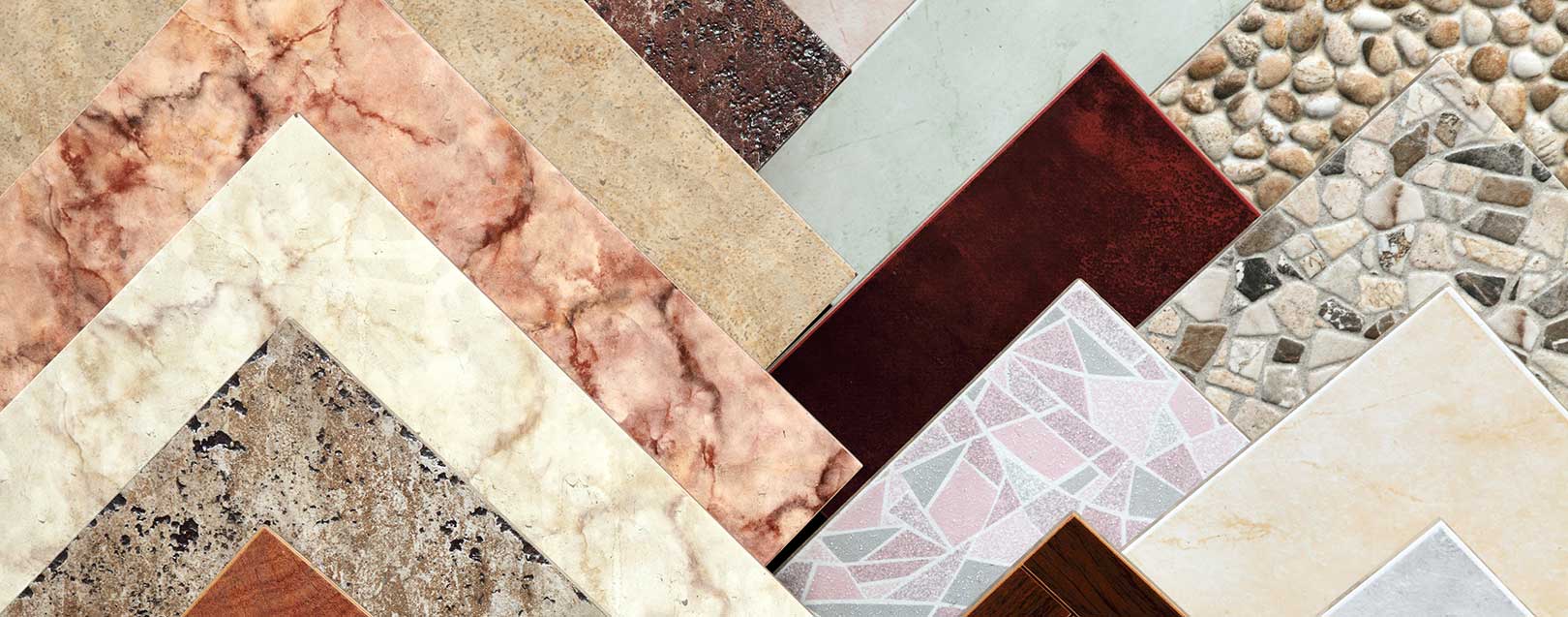

Discover how high-value ceramic tile exports are moving beyond price competition through design, large-format slabs, digital printing, and advanced production. Learn how manufacturers can increase export value and compete in premium construction markets.
Why Ceramic Tile Exports Can No Longer Depend on Price Alone
What happens when several exporters offer almost the same ceramic tile at nearly the same price?
For many years, the answer was simple: the buyer selected the supplier offering the lowest price, acceptable quality, and reliable delivery. This model helped many ceramic tile manufacturers enter international markets, especially in price-sensitive construction and housing projects.
However, the global ceramic tiles market is becoming more sophisticated. According to Grand View Research, the global ceramic tiles market was estimated at approximately USD 226.4 billion in 2025 and is projected to reach about USD 380.6 billion by 2033, representing a compound annual growth rate of 6.6% between 2026 and 2033. Porcelain tiles accounted for 52.4% of the market by revenue in 2025, while Asia Pacific represented 68.9% of the global market.
These numbers reveal an important change. Demand is not disappearing. Instead, competition is becoming more complex.
Construction companies, housing developers, architects, interior designers, distributors, and retail buyers increasingly expect ceramic tiles to provide more than basic functionality. They want distinctive designs, realistic surfaces, larger dimensions, technical performance, reliable quality, and products that can support premium architectural concepts.
This creates an opportunity for tile-producing countries and manufacturers that traditionally compete on price.
The strategic question is no longer:
“How can we export ceramic tiles more cheaply?”
It is:
“How can we export a ceramic tile product with enough design, technology, consistency, and technical value to justify a higher price?”
This article examines how manufacturers can move from price-based competition toward value-based competition. It focuses on three major factors: design, large-format porcelain slabs, and digital printing technology, while also examining the relationship between ceramic tiles, housing, and construction demand.
۱. The Shift from Price Competition to Value Competition
Price remains important in international ceramic tile trade. Importers still calculate landed cost, freight, customs duties, breakage, payment terms, and logistics expenses before selecting a supplier.
However, price alone is becoming a weaker long-term competitive strategy.
A manufacturer that continuously reduces its export price may gain short-term orders, but it can face several structural problems:
- Lower profit margins
- Reduced investment capacity
- Less money for product development
- Pressure on production quality
- Greater sensitivity to energy and transportation costs
- Difficulty establishing a premium brand
- Greater vulnerability to lower-cost competitors
The alternative is to increase the perceived and technical value of the product.
Value competition means the buyer is not simply purchasing square meters of ceramic tiles. The buyer is purchasing a combination of:
- Design identity
- Technical performance
- Surface quality
- Dimensional consistency
- Format diversity
- Production reliability
- Packaging and logistics
- Technical documentation
- Brand credibility
- After-sales support
This distinction is particularly important in housing and construction projects.
A residential developer may initially compare tile prices per square meter. Yet an architect or project owner may also evaluate whether the product can create a coherent visual concept across bathrooms, kitchens, living spaces, facades, hospitality areas, or commercial interiors.
Therefore, the same ceramic tiles can have different economic values depending on how they are designed, presented, specified, and positioned.
Why construction demand creates an opportunity
Ceramic tiles are closely connected to residential construction, commercial construction, renovation, and infrastructure development. Grand View Research identifies urbanization, construction activity, renovation, and demand for aesthetically appealing interiors as major drivers of the global ceramic tiles market.
The commercial segment represented the largest end-use revenue share in 2025, while flooring represented 61.3% of application revenue. These figures demonstrate that ceramic tiles compete not only in traditional housing applications but also in commercial environments where design and durability can have significant economic value.
For exporters, this means market segmentation matters.
Instead of offering one general product catalogue to every country, manufacturers can develop dedicated product strategies for:
- Residential housing
- Luxury housing
- Hotels and hospitality
- Retail stores
- Offices
- Restaurants
- Public buildings
- Healthcare facilities
- Outdoor applications
- High-end architectural projects
The transition from price competition to value competition therefore starts with a simple principle:
Do not sell the same product to every market in the same way.
۲. Design Is Becoming a Major Export Value Driver
Design is one of the strongest tools available to ceramic tile manufacturers seeking higher export value.
In traditional production models, design was sometimes treated as a secondary feature. The manufacturer focused primarily on size, color, technical specifications, and price.
Today, design can determine whether a product is perceived as a commodity or as a premium architectural material.
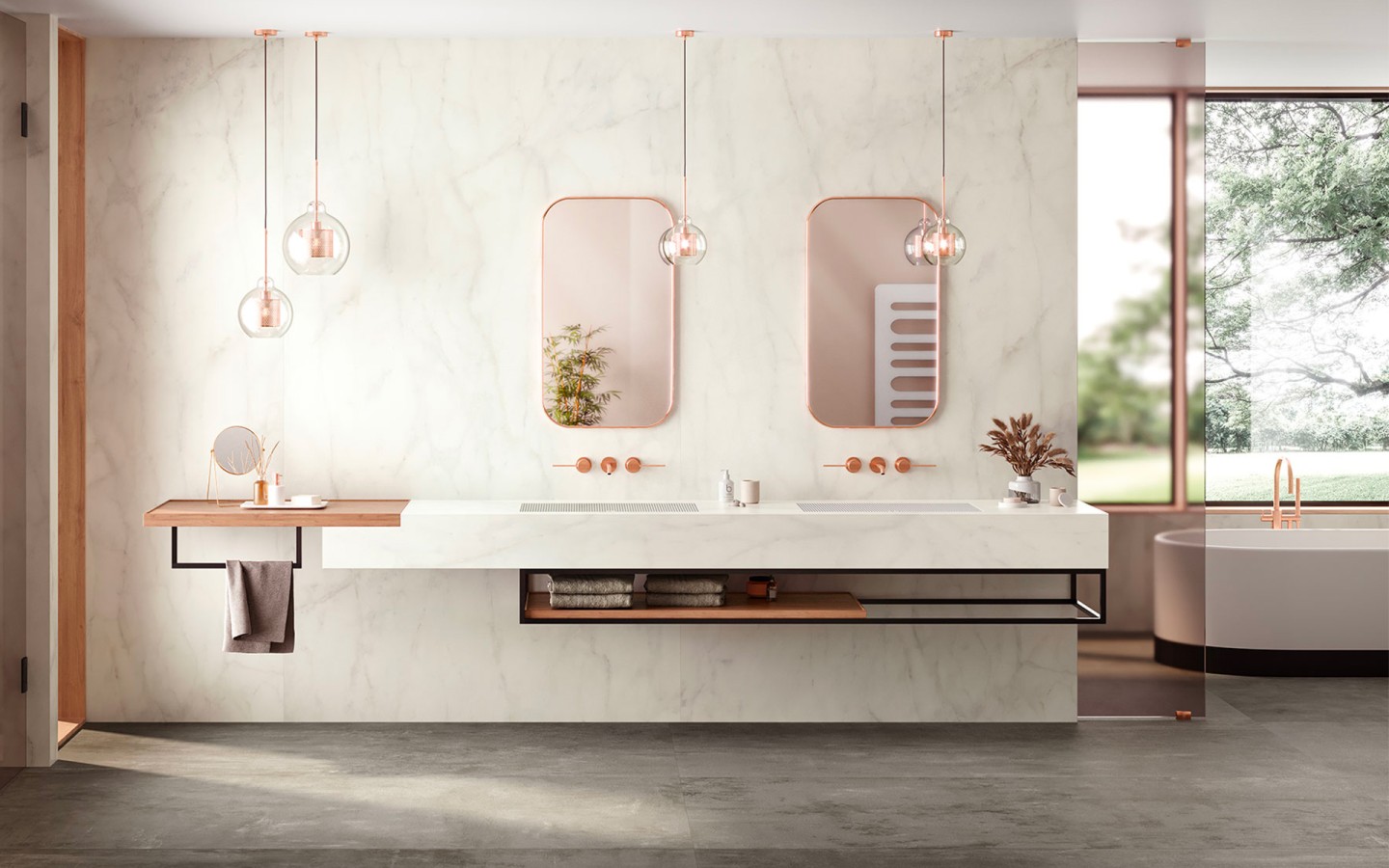
Modern ceramic tiles increasingly reproduce the visual characteristics of:
- Natural marble
- Travertine
- Limestone
- Onyx
- Concrete
- Wood
- Terrazzo
- Metal
- Fabric
- Stone
- Handmade surfaces
Digital technologies have made these reproductions increasingly sophisticated.
The objective is no longer simply to print a pattern on a tile. The objective is to create a coordinated surface where color, texture, gloss, structure, and visual depth work together.
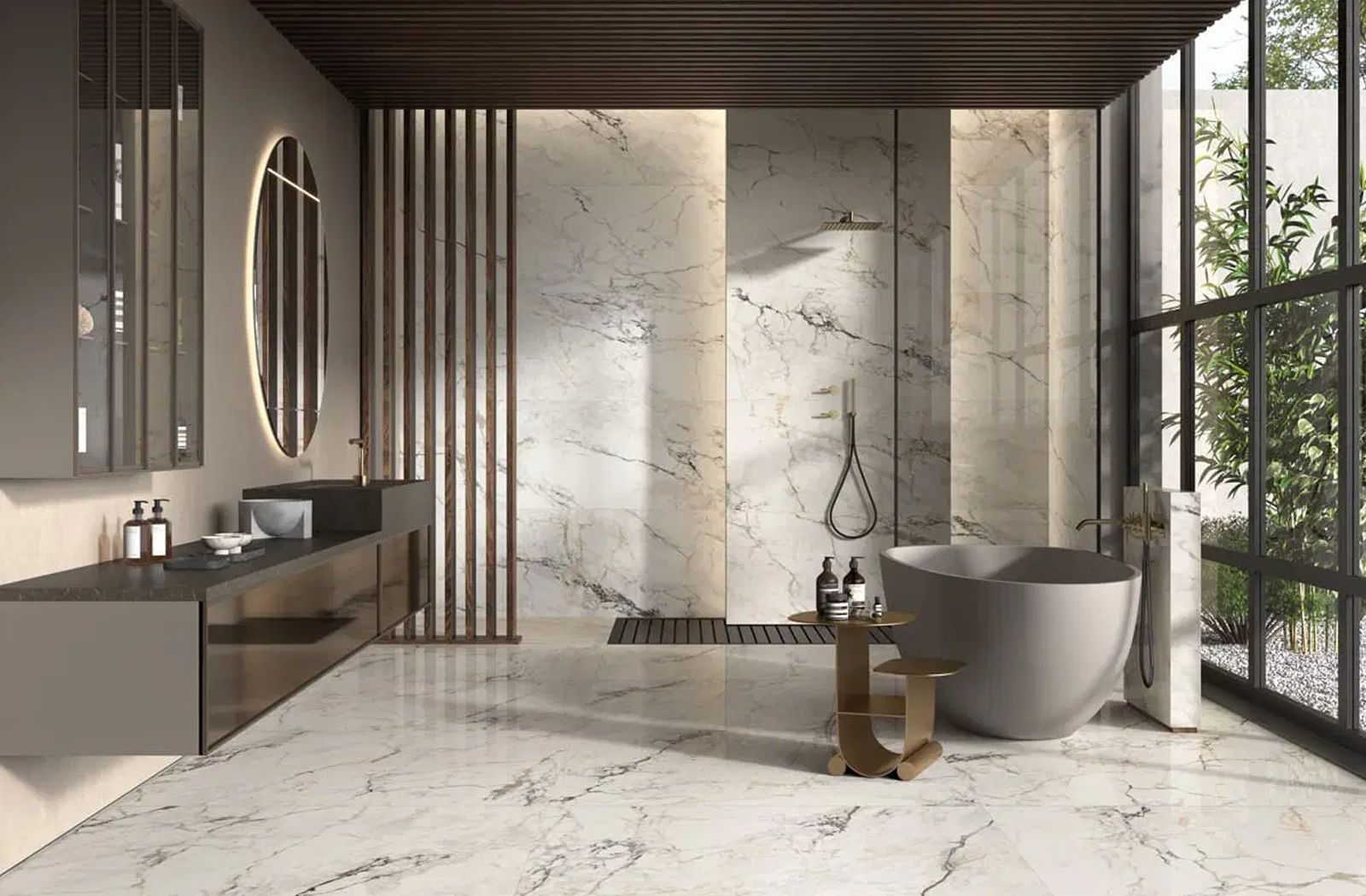
Industry trend reports in 2025 highlighted large-format porcelain surfaces inspired by marble, onyx, and stone, including designs that use advanced digital and layering techniques to create a more luminous and three-dimensional appearance.
This creates an important export opportunity.
Design can create product differentiation
Suppose two manufacturers produce porcelain tiles with similar water absorption, mechanical strength, and dimensions.
Manufacturer A competes mainly on price.
Manufacturer B offers:
- A recognizable collection
- Coordinated wall and floor products
- Multiple surface finishes
- Realistic stone visuals
- Matching large-format slabs
- Professional technical documentation
- High-quality photography
- Architectural application images
- Sample boards
- Digital catalogues
The second manufacturer is not necessarily selling the same economic product.
It is selling a design system.
That distinction can support a higher selling price because distributors and designers have more reasons to select the product beyond cost.
Design trends influencing export products
Several design directions are particularly relevant for premium ceramic tiles:
Natural stone realism:
Marble, limestone, travertine, and onyx effects remain influential because they combine luxury appearance with the functional advantages of ceramic and porcelain.
Large continuous patterns:
Buyers increasingly expect vein continuity across multiple tiles and slabs.
Neutral architectural palettes:
Warm beige, sand, ivory, greige, soft gray, and natural earth tones remain useful for residential and hospitality projects.
Decorative maximalism:
Some premium markets are also moving toward stronger colors, expressive patterns, and statement surfaces.
Mixed finishes:
Combining matte, polished, structured, satin, and semi-gloss effects can increase visual depth.
Material imitation:
Ceramic technology allows manufacturers to reproduce the appearance of materials that may be more expensive, difficult to maintain, or less practical.
The commercial lesson is straightforward:
A tile with a strong design identity can compete on value even when its manufacturing cost is not the lowest in the market.
۳. Large-Format Porcelain Slabs: From Tile to Architectural Surface
One of the most important developments in the ceramic tiles industry is the growing use of large-format porcelain tiles and slabs.
The Tile Association reported in 2025 that large-format porcelain tiles and panels continue to grow in popularity. The association highlighted reduced grout lines, seamless visual effects, continuous surfaces, and flexible architectural applications as important reasons for their appeal.
Large-format porcelain is no longer limited to floors.
Depending on technical specifications and installation systems, large porcelain panels can be used for:
- Walls
- Floors
- Kitchen worktops
- Vanity tops
- Tables
- Feature walls
- Bathroom surfaces
- Retail interiors
- Hospitality projects
- Custom architectural elements
This significantly changes the commercial proposition.
A conventional ceramic tile is often sold as a finishing material.
A large-format porcelain slab can be positioned as an architectural surface solution.
Why large formats can increase export value
Large slabs offer several potential advantages from a design perspective:
- Fewer visible joints
- Greater visual continuity
- More realistic stone reproduction
- Stronger architectural appearance
- Wider design possibilities
- Application across multiple surfaces
- Premium positioning
For exporters, this can create a higher-value product category.
However, large-format production also introduces challenges.
Manufacturers must control:
- Flatness
- Dimensional tolerance
- Surface quality
- Breaking strength
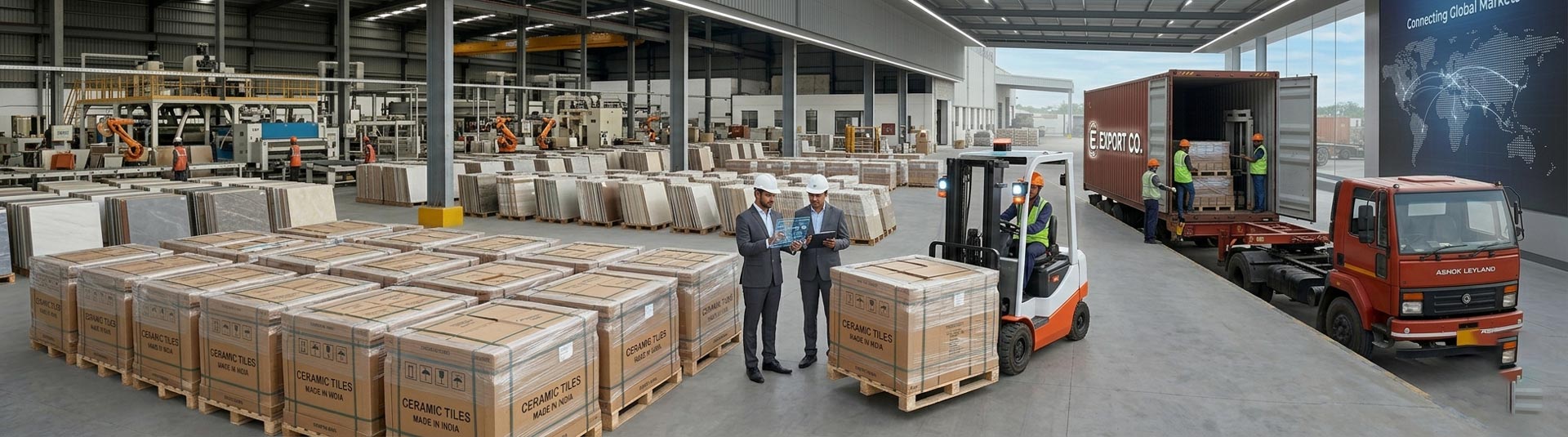
- Packaging
- Handling
- Crating
- Transportation
- Cutting
- Installation requirements
The logistics challenge is particularly important.
A large slab can have a higher selling price per square meter, but it can also be more vulnerable to improper handling. Exporters therefore need to consider the complete supply chain rather than focusing only on factory production.
The Tile Association specifically notes that large-format installations require careful planning around dimensions, access points, transportation, cutting, and installation.
Large slabs and housing design
Large-format porcelain is especially relevant to modern housing.
Open-plan apartments and contemporary villas often favor continuous surfaces and fewer visual interruptions. Large slabs can support this aesthetic.
The same design can potentially be extended from a kitchen backsplash to a countertop, island, bathroom wall, or feature wall.
This creates an opportunity for manufacturers to sell coordinated surface collections rather than individual SKUs.
For example:
Marble-effect collection
۱۲۰ × ۱۲۰ cm floor tile
۱۲۰ × ۲۴۰ cm wall panel
۱۶۰ × ۳۲۰ cm slab
Matching polished surface
Matching matte surface
Coordinated decorative pieces
Such a portfolio provides architects and developers with a more complete design language.
۴. Digital Printing Is Changing the Economics of Ceramic Tile Design
Digital printing is one of the technologies that has fundamentally changed ceramic tile production.
Traditional decorative methods had limitations in terms of flexibility, repeatability, customization, and the number of designs that could be economically produced.
Modern digital inkjet systems allow manufacturers to reproduce highly detailed images and create complex visual effects at industrial scale.
EFI Cretaprint, for example, describes ceramic printing systems designed to support productivity, quality, color management, and higher-value ceramic applications. Modern ceramic printing ecosystems combine printers, ceramic inks, glazes, and software-based color management.
This matters because premium ceramic tiles depend heavily on visual quality.
A buyer may not understand the technical details of an inkjet printing system, but the buyer can immediately see:
- Vein realism
- Color depth
- Pattern variation
- Surface detail
- Design consistency
- Registration accuracy
- Natural appearance
From repetitive patterns to controlled variation
One of the strongest benefits of digital printing is the ability to create controlled visual variation.
Natural stone does not repeat exactly.
Every slab can contain differences in veins, mineral structures, tones, and movement.
Digital technology allows manufacturers to reproduce this concept more convincingly.
This is especially valuable for:
- Marble-effect porcelain
- Onyx-effect surfaces
- Wood-effect tiles
- Natural stone collections
- Decorative walls
- Large-format slabs
Controlled variation can make a ceramic product feel more natural.
Digital printing and customization
Another major opportunity is customization.
Export buyers may request:
- Specific colors
- Specific patterns
- Private-label designs
- Regional preferences
- Hotel project designs
- Brand-specific collections
- Limited collections
Digital printing can make smaller or more flexible production runs more practical than some traditional approaches.
This creates a strategic advantage for exporters.
Instead of asking:
“What is the lowest price we can offer for this tile?”
manufacturers can ask:
“What design or visual solution can we provide that competitors cannot easily reproduce?”
That is the foundation of value-based competition.
۵. Housing and Construction Markets Require Different Tile Strategies
The relationship between ceramic tiles, housing, and construction is direct, but the purchasing criteria vary significantly by project type.
A mass-market housing project may prioritize:
- Price
- Availability
- Standard sizes
- Easy installation
- Basic durability
A luxury residential project may prioritize:
- Design
- Large formats
- Surface realism
- Brand reputation
- Exclusive collections
- Technical consistency
A hotel project may require:
- High durability
- Coordinated design
- Slip resistance
- Easy maintenance
- Large quantities
- Consistent batches
- Reliable delivery
A commercial project may focus on:
- Traffic resistance
- Maintenance
- Fire and technical documentation
- Installation efficiency
- Lifecycle cost
Therefore, export manufacturers should avoid using a single value proposition.
A practical segmentation model
Segment 1: Price-sensitive construction
Main priorities:
- Competitive FOB price
- Standard formats
- Reliable supply
- Acceptable quality
- Simple designs
Segment 2: Mid-market housing
Main priorities:
- Contemporary design
- Competitive pricing
- Multiple sizes
- Good packaging
- Consistent quality
Segment 3: Premium residential
Main priorities:
- Large formats
- Marble and natural stone effects
- Sophisticated finishes
- Design collections
- High-quality presentation
Segment 4: Commercial and hospitality
Main priorities:
- Technical specifications
- Durability
- Safety
- Design coordination
- Project support
Segment 5: Architectural and luxury projects
Main priorities:
- Large slabs
- Custom designs
- High visual realism
- Exclusive collections
- Technical consultancy
This segmentation allows exporters to protect margins.
Instead of competing with every manufacturer in every product category, they can develop specialized product families for specific customers.
۶. How Exporters Can Build a High-Value Ceramic Tile Portfolio
Moving toward value competition requires more than purchasing a digital printer or producing larger tiles.
The entire product strategy must change.
Step 1: Develop collections instead of individual products
A collection should tell a visual story.
For example:
Urban Stone Collection
- ۶۰ × ۱۲۰ cm
- ۱۲۰ × ۱۲۰ cm
- Large slab
- Matte finish
- Polished finish
- Structured finish
- Matching wall surfaces
This approach increases cross-selling opportunities.
Step 2: Create multiple price levels
A manufacturer can create three layers:
Essential:
Reliable ceramic tiles for price-sensitive projects.
Premium:
Improved design, finishes, and technical performance.
Architectural:
Large-format slabs, advanced surfaces, customized designs, and premium packaging.
This allows the company to address different buyers without forcing every customer into the lowest-price category.
Step 3: Invest in visual communication
Premium products require premium presentation.
Export catalogues should include:
- High-resolution product images
- Real interior applications
- Technical specifications
- Available sizes
- Surface finishes
- Packaging information
- Installation guidance
- Certifications
- Recommended applications
For international buyers, professional product information reduces purchasing uncertainty.
Step 4: Sell performance, not only appearance
A premium tile should have measurable technical advantages.
Relevant information may include:
- Water absorption
- Breaking strength
- Abrasion resistance
- Slip resistance
- Chemical resistance
- Frost resistance
- Surface characteristics
- Dimensional tolerance
The exact requirements depend on the destination market and application.
Technical documentation can transform a product from a decorative commodity into a professional construction material.
۷. What Are the Main Obstacles to Higher-Value Ceramic Tile Exports?
The transition from price competition to quality competition is not automatic.
Several barriers can prevent manufacturers from capturing additional value.
Production consistency
A premium design loses value if different production batches show significant differences in shade, caliber, or surface quality.
Consistency is therefore part of the product itself.
Logistics
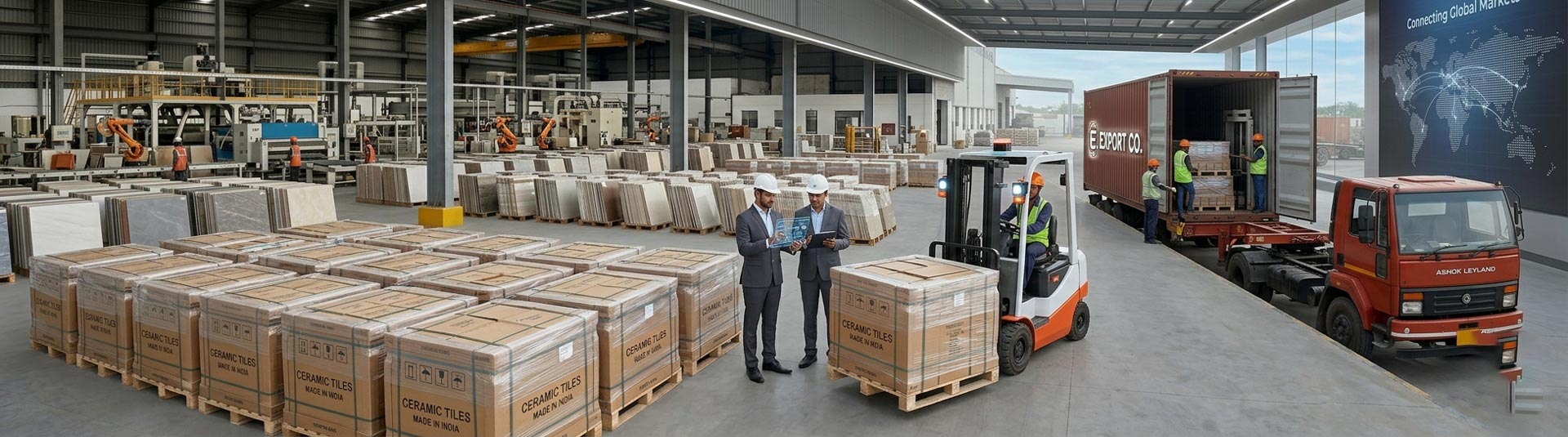
Large-format products require better packaging and handling systems.
Exporters must calculate:
- Breakage risk
- Container loading
- Pallet design
- Crating
- Insurance
- Port handling
- Delivery conditions
Energy and production costs
Ceramic manufacturing is energy-intensive.
Higher energy costs can influence the final export price and reduce the margin available for investment.
Manufacturers therefore need to improve:
- Kiln efficiency
- Production planning
- Waste reduction
- Digital process control
- Inventory management
- Energy monitoring
Market compliance
Different countries can have different requirements concerning technical standards, labeling, safety, sustainability, and product documentation.
An exporter seeking premium customers must understand these requirements before entering the market.
Brand positioning
A manufacturer cannot permanently sell a premium product using only commodity-style communication.
If the product is positioned as architectural or premium, its catalogue, website, packaging, showroom, samples, photography, and sales team should communicate the same level of value.
۸. People Also Ask: Key Questions About High-Value Ceramic Tile Exports
Is design more important than price in ceramic tile exports?
Price remains important, especially in large-volume and price-sensitive construction projects. However, design can become a major differentiator in premium residential, hospitality, commercial, and architectural segments.
The most effective strategy is usually not to eliminate price competition but to create product categories where price is only one purchasing factor.
Why are large-format porcelain slabs becoming popular?
Large formats create fewer grout lines and more continuous visual surfaces. They can also reproduce natural stone patterns across larger areas. Their applications can extend beyond floors and walls to countertops and other architectural surfaces.
How does digital printing increase ceramic tile value?
Digital printing enables detailed patterns, realistic natural-material reproduction, controlled variation, sophisticated color effects, and flexible design development. These capabilities can support differentiated collections and premium product positioning.
Are large-format tiles suitable for housing projects?
Yes, depending on the product specification and installation system. Large-format porcelain can be particularly suitable for contemporary residential interiors, feature walls, kitchens, bathrooms, and other areas where continuous surfaces are desired.
What makes a ceramic tile a premium export product?
Premium positioning typically involves a combination of design, technical performance, dimensional consistency, surface quality, format, packaging, documentation, brand presentation, and service.
No single factor automatically makes a tile premium.
Can manufacturers with lower production costs compete in premium markets?
Yes, provided that lower production costs do not become the only selling proposition.
Lower costs can create room for investment in better designs, digital printing, larger formats, quality control, packaging, product development, and international marketing.
The strategic objective should be to convert cost efficiency into value-added products, rather than simply passing all cost advantages to the buyer through lower prices.
۹. What Will Define Ceramic Tile Exports Between 2026 and 2028?
The next stage of competition is likely to combine manufacturing efficiency with design intelligence.
Several trends deserve attention.
۱. Larger surfaces
Large-format porcelain slabs and panels are likely to remain important in premium architectural applications. The trend toward seamless interiors supports their use in residential and commercial projects.
۲. More realistic natural materials
Advances in digital printing, glazing, surface treatment, and digital decoration will continue improving the visual reproduction of stone, marble, wood, and other materials.
۳. Design personalization
Buyers increasingly expect products that fit specific architectural concepts.
Manufacturers capable of adapting collections quickly may gain an advantage over rigid mass-production models.
۴. Digital product development
The use of digital tools can accelerate:
- Pattern development
- Color testing
- Collection creation
- Visual simulation
- Customer presentations
- Marketing production
۵. Stronger technical positioning
Premium buyers will increasingly expect technical documentation rather than attractive photographs alone.
۶. Sustainability and efficiency
Energy consumption, waste reduction, responsible resource use, packaging efficiency, and product lifecycle considerations will become increasingly relevant to international procurement.
۷. Integration of design and manufacturing
The strongest manufacturers will not treat design, production, marketing, and export sales as separate departments.
Instead, these functions will operate as one product-development system.
A market trend can influence design.
Design can influence production.
Production can influence pricing.
Pricing can influence market positioning.
Market feedback can then influence the next collection.
This creates a continuous product-development cycle.
۱۰. A Practical Roadmap for Exporters Seeking Higher Value
Manufacturers looking to reduce dependence on price competition can use the following roadmap.
Phase 1: Market research
Identify:
- Target countries
- Major importers
- Residential trends
- Construction activity
- Popular formats
- Popular finishes
- Competitive products
- Local price levels
Phase 2: Product gap analysis
Compare your current products with competitors in:
- Design
- Size
- Surface
- Technical performance
- Packaging
- Price
- Catalogue quality
Phase 3: Build differentiated collections
Develop collections around specific market needs rather than simply producing more SKUs.
Phase 4: Expand large-format capabilities
Where economically and technically feasible, develop large-format porcelain products and the supporting logistics required to export them safely.
Phase 5: Improve digital decoration
Evaluate digital printing, glazing, surface effects, color management, and production control according to the company’s target market.
Phase 6: Upgrade international marketing
Create professional:
- English catalogues
- Product data sheets
- Websites
- Sample books
- Project references
- Architectural visuals
- Technical documents
Phase 7: Move from product sales to project sales
Instead of asking distributors to purchase individual products, provide complete solutions.
For example:
Hotel bathroom concept
→ Floor tile
→ Wall tile
→ Large-format slab
→ Decorative surface
→ Technical specification
→ Installation recommendation
→ Packaging solution
This approach increases the potential value of each customer relationship.
Conclusion: The Future Belongs to Value-Creating Ceramic Tile Exports
The international ceramic tiles industry is entering a phase in which low price alone is becoming an increasingly difficult source of sustainable competitive advantage.
Global demand remains substantial. Grand View Research estimates that the ceramic tiles market reached approximately USD 226.4 billion in 2025 and projects it to reach USD 380.6 billion by 2033. At the same time, porcelain tiles, commercial applications, construction activity, renovation, and design innovation continue to shape the industry.
For exporters, this environment creates both pressure and opportunity.
The pressure comes from intense international competition, production costs, logistics, energy consumption, and buyers who can compare suppliers across multiple markets.
The opportunity comes from moving beyond the traditional commodity model.
Design can increase perceived value.
Large-format porcelain can transform tiles into architectural surfaces.
Digital printing can create realistic, differentiated, and flexible designs.
Technical consistency can increase buyer confidence.
Professional branding can strengthen market positioning.
The key is not simply to manufacture more expensive ceramic tiles. The objective is to create products whose additional price is supported by additional value.
Between 2026 and 2028, successful exporters will increasingly need to combine manufacturing efficiency with design capability, technology, market intelligence, and professional international sales.
For manufacturers in cost-competitive production regions, the strategic opportunity is particularly important: production efficiency can provide the foundation, while design, large formats, digital printing, quality control, and service can convert that efficiency into higher-value exports.
The future of ceramic tile exports is therefore not simply about selling more square meters.
It is about selling better-designed square meters, better-engineered surfaces, and complete architectural value.
For exporters seeking sustainable growth, the central question should be:
Are we competing to offer the cheapest tile—or are we creating a product that buyers have a reason to pay more for?


نظرات ۰