

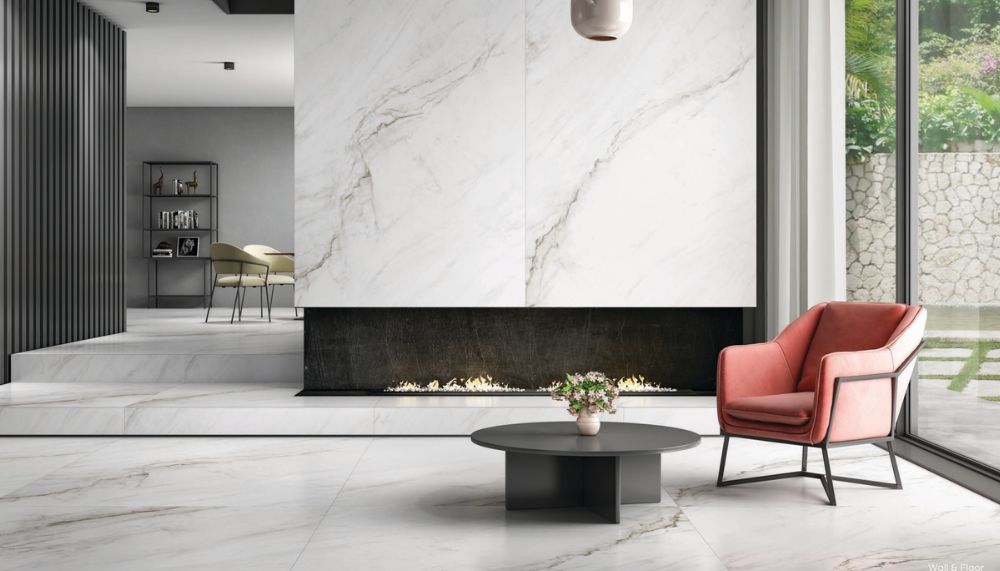

Looking for export-ready porcelain tiles from Iran to Europe? Discover how to evaluate Iranian tile manufacturers, verify EU standards, assess quality, compare suppliers, and manage documentation and shipping before placing your order.
Why European Buyers Are Looking Beyond Traditional Tile Suppliers
Finding a reliable porcelain tile supplier is not simply about comparing prices or choosing attractive designs. For European importers, distributors, wholesalers, construction companies, and architectural firms, the real challenge is identifying a manufacturer that can deliver consistent quality, meet technical requirements, provide reliable documentation, and manage international shipments without unnecessary complications.
Iran has developed a substantial ceramic and porcelain tile manufacturing industry. Its production capabilities, access to raw materials, industrial infrastructure, and competitive manufacturing costs have made Iranian products worth considering for international buyers. However, purchasing from a foreign manufacturer requires more than reviewing an online catalogue or requesting a quotation.
Imagine a European distributor receiving an attractive offer for a container of porcelain tiles from Iran. The designs look impressive, and the quoted price is significantly lower than competing offers. However, after delivery, the distributor discovers differences in dimensions, inconsistent shades, insufficient technical documentation, or damage caused by inadequate packaging. The original price advantage can quickly disappear.
This is why choosing an export-ready supplier is essential.
The European market also demands increasingly detailed information about product performance, traceability, environmental characteristics, and regulatory compliance. According to a 2025 trade analysis based on EU trade data, imports of porcelain tiles from non-EU countries reached approximately €۵۸۴ million in value, representing around 1.8 million tonnes. This indicates substantial opportunities for international manufacturers, alongside strong competition.
Iranian manufacturers can compete in this market, but success depends on selecting the right products and establishing a professional export relationship.
In this guide, we explain how to source export-ready porcelain tiles from Iran, evaluate manufacturers, understand European requirements, compare slab tile options, calculate purchasing costs, and avoid common international sourcing mistakes.
Whether you are purchasing your first container or expanding an established distribution business, these practical steps will help you make a more informed decision.
۱. Why Consider Iran as a Source of Porcelain Tiles for the European Market?
The first question European buyers should ask is not whether Iranian tiles are cheaper. It is whether Iranian manufacturers can offer a competitive combination of quality, design, production capacity, and commercial reliability.
Iran’s ceramic industry has several characteristics that make it an interesting sourcing destination.
۱.۱ Competitive Manufacturing Costs
One of the main attractions of Iranian porcelain tile production is its potential cost advantage.
Several factors contribute to the country’s manufacturing competitiveness:
-
Access to domestic mineral resources and ceramic raw materials.
-
Established manufacturing infrastructure.
-
An experienced workforce in ceramic production.
-
Domestic suppliers of machinery, equipment, and production materials.
-
Manufacturing clusters that support industrial specialization.
-
Experience in producing different tile sizes, finishes, and designs.
These advantages can help manufacturers offer competitive factory prices.
However, buyers should understand that a low ex-works price does not automatically mean a lower final purchasing cost.
European importers must also consider:
-
Inland transportation within Iran.
-
Export handling and customs costs.
-
International freight.
-
Insurance.
-
Import duties and other applicable charges.
-
Customs clearance.
-
Warehousing and distribution expenses.
A professional supplier should provide a transparent quotation that clearly identifies which expenses are included and which remain the buyer’s responsibility.
۱.۲ A Diverse Range of Porcelain Tile Products
Iranian manufacturers produce different categories of ceramic and porcelain products for residential, commercial, and industrial projects.
Common product categories include:
Floor porcelain tiles: Designed for residential buildings, offices, shopping centres, hotels, and commercial environments.
Wall tiles: Available in different colours, decorative patterns, and surface finishes for interior applications.
Full-body porcelain tiles: Products in which the body composition extends through the tile thickness, subject to the manufacturer’s declared product characteristics.
Polished porcelain tiles: Popular for interiors requiring reflective surfaces and marble-inspired aesthetics.
Matt and structured porcelain tiles: Suitable for contemporary architectural projects and applications where surface texture matters.
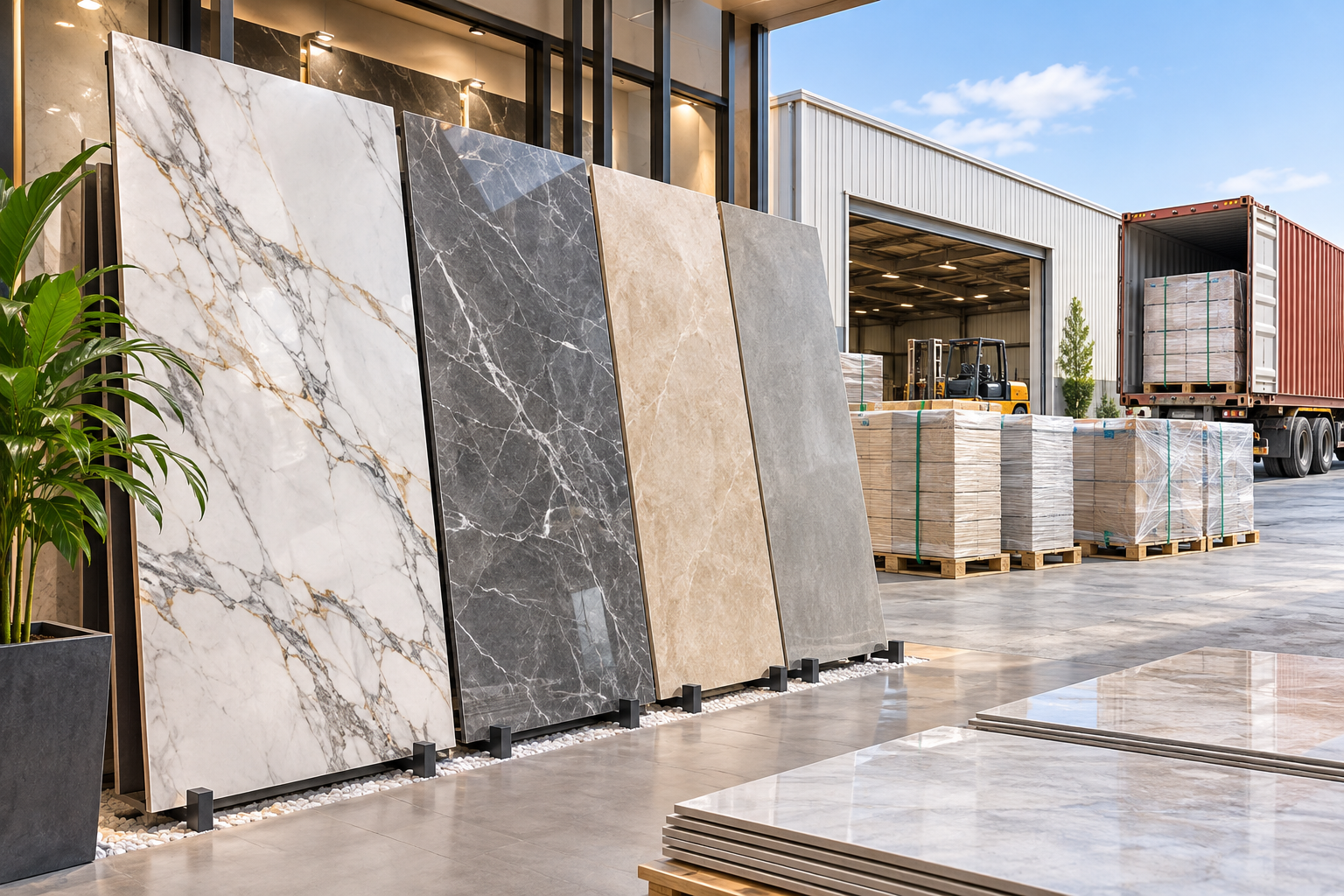
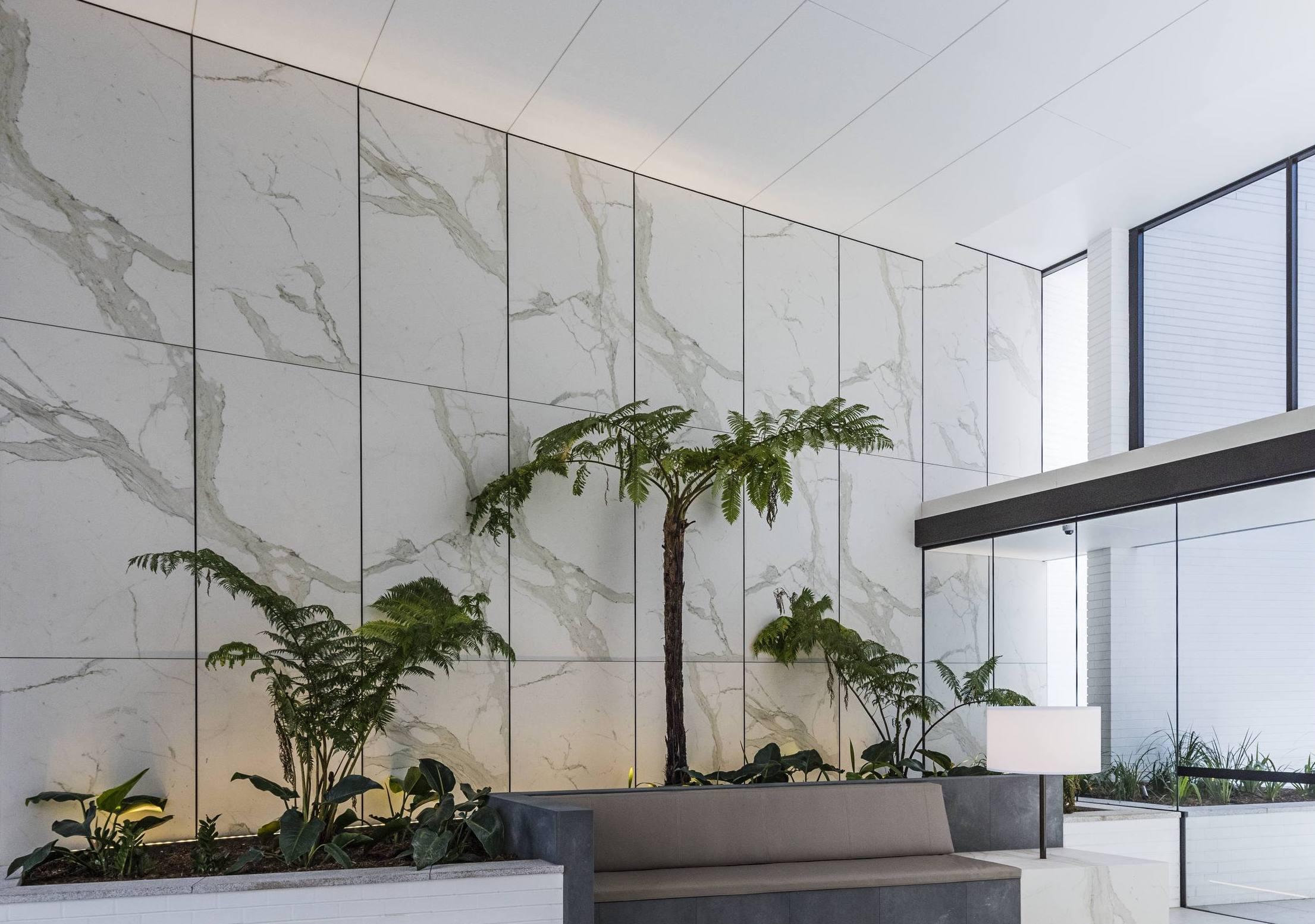
Large-format porcelain slabs: Increasingly relevant for kitchen countertops, bathroom walls, commercial interiors, and architectural surfaces.
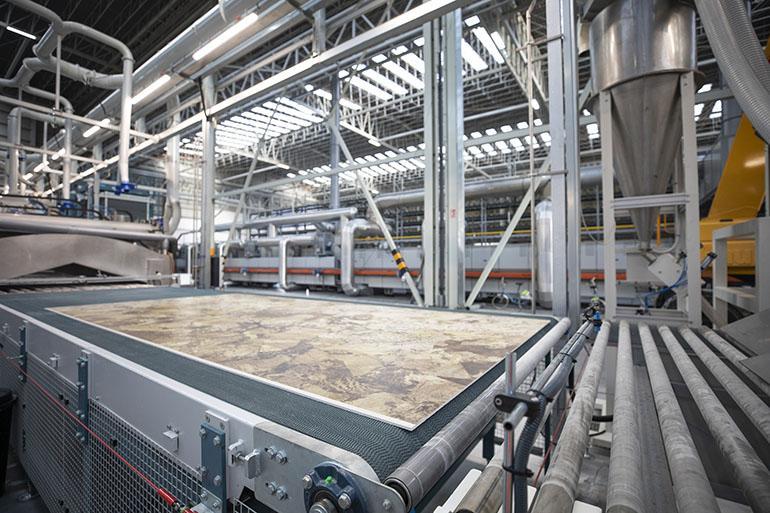
۱.۳ The Growing Importance of Large-Format Slab Tile Products
Large-format porcelain slabs represent an important opportunity for suppliers targeting European architects, interior designers, and construction companies.
Compared with conventional tile formats, slabs can create more continuous visual surfaces and reduce the number of visible joints.
Common applications include:
-
Kitchen countertops.
-
Bathroom walls.
-
Shower enclosures.
-
Reception desks.
-
Commercial wall cladding.
-
Decorative architectural panels.
-
Selected flooring applications.
Available dimensions vary by manufacturer and production technology. Buyers may encounter formats such as 120 × ۲۴۰ cm, 120 × ۲۶۰ cm, and larger custom dimensions.
However, slab purchasing requires additional attention to thickness, flatness, dimensional stability, handling equipment, cutting requirements, and transportation protection.
A manufacturer capable of producing attractive slabs is not necessarily capable of exporting them safely.
۱.۴ Competitive Advantages Must Be Verified
Iranian suppliers should be evaluated against international alternatives, including manufacturers in Italy, Spain, India, Turkey, and other established ceramic-producing countries.
A practical comparison should consider:
| Evaluation factor | What buyers should examine |
|---|---|
| Factory price | Price per square metre and quotation validity |
| Product quality | Technical test results and consistency |
| Design | Range of colours, textures, and finishes |
| Production capacity | Monthly output and available production lines |
| Export experience | Previous international shipments |
| Documentation | Technical files and compliance evidence |
| Logistics | Packaging, loading, and shipping arrangements |
| Communication | Response time and commercial transparency |
The key takeaway: Iran can be a competitive sourcing destination, but buyers should select manufacturers based on verified performance rather than country of origin or price alone.
۲. How to Identify a Reliable Iranian Porcelain Tile Manufacturer
Choosing the right manufacturer is probably the most important step in the entire sourcing process.
A professional factory should be able to demonstrate not only its production capabilities but also its ability to deliver consistent products for international markets.
A company with attractive photographs and a modern website may still lack the operational systems required for successful export transactions.
European buyers should therefore conduct a structured supplier evaluation.
۲.۱ Verify the Manufacturer’s Business Identity
Start by confirming that the company is a genuine manufacturer or an authorized export representative.
Request the following information:
-
Official company name.
-
Registered business address.
-
Manufacturing plant location.
-
Company registration information.
-
Export licence or relevant business authorization, where applicable.
-
Official website and corporate email.
-
Name and position of the export manager.
-
Factory telephone number.
-
References from previous international customers, where available.
If the company claims to manufacture its own products, ask for evidence of its production facilities.
A genuine manufacturer should be comfortable explaining its production process and identifying the factory responsible for the products being offered.
۲.۲ Request a Factory Profile
A factory profile provides an initial understanding of the manufacturer’s industrial capabilities.
A useful factory profile should include:
-
Factory location and establishment date.
-
Total production area.
-
Number of production lines.
-
Main production technologies.
-
Available tile dimensions.
-
Monthly or annual production capacity.
-
Main product categories.
-
Quality control procedures.
-
Export markets and experience.
-
Available technical certificates and test reports.
Production capacity deserves particular attention.
For example, a supplier may offer a large order of 60 × ۱۲۰ cm porcelain tiles. However, the factory may already have production commitments and may not be able to manufacture the required quantity within the agreed delivery period.
Ask whether the requested product is already in regular production or requires a new production schedule.
۲.۳ Examine the Manufacturer’s Export Experience
Export experience is different from domestic manufacturing experience.
A factory may produce excellent tiles for the local market but have limited knowledge of international packaging, shipping documentation, customs procedures, and buyer expectations.
Ask the supplier:
-
Which countries has the company exported to?
-
Has it supplied European customers?
-
Can it provide references from previous buyers?
-
Does it have experience preparing export documentation?
-
Can it arrange container loading and inspection?
-
Does it understand international trade terms such as FOB, CFR, and CIF?
Previous exports do not automatically prove compliance with European regulations. Nevertheless, they provide useful evidence of operational experience.
۲.۴ Evaluate Communication and Commercial Transparency
Communication quality is often an early indicator of how an export relationship will develop.
A reliable supplier should answer technical and commercial questions clearly.
Be cautious when a company:
-
Avoids providing factory information.
-
Changes quotations without explanation.
-
Cannot identify the manufacturer.
-
Refuses to provide technical specifications.
-
Offers unrealistic production deadlines.
-
Requests full payment without reasonable contractual safeguards.
-
Provides inconsistent information about product quality.
Professional suppliers should also distinguish between confirmed information and estimates.
For instance, they should not promise a fixed delivery date before confirming production capacity, packaging availability, and the shipping schedule.
۲.۵ Visit the Factory or Arrange an Independent Inspection
Whenever possible, visit the production facility before placing a large order.
If travelling to Iran is not practical, arrange a live video inspection or appoint an independent inspection company.
During an inspection, examine:
-
Raw material preparation.
-
Pressing equipment.
-
Drying and firing processes.
-
Digital printing systems.
-
Glazing and polishing operations.
-
Sorting and grading.
-
Laboratory testing.
-
Packaging and finished-goods storage.
Pay special attention to how finished products are inspected before packaging.
A manufacturer that follows a documented quality control system is generally better positioned to maintain consistency across repeated shipments.
Practical recommendation: Never make a large purchasing decision based exclusively on catalogue photographs, social media pages, or a supplier’s verbal assurances.
۳. European Standards and Technical Requirements: What Should Buyers Check?
Meeting the technical requirements of the destination market is one of the most important aspects of importing porcelain tiles into Europe.
European buyers need products that perform according to their intended applications and comply with applicable product legislation.
A supplier’s claim that its products are European standard is not enough. Buyers should request verifiable technical documentation.
۳.۱ Understanding EN 14411 and ISO 13006
Two important standards in ceramic tile specifications are EN 14411 and ISO 13006.
ISO 13006:2018 establishes definitions, classifications, characteristics, and marking requirements for ceramic tiles. Its testing procedures are addressed through the ISO 10545 series. The standard was reviewed and confirmed in 2024.
EN 14411 is the European product standard for ceramic tiles.
These standards provide a technical framework for classifying and evaluating products.
Buyers should confirm that the manufacturer’s test reports refer to the appropriate product classification and relevant test methods.
۳.۲ Water Absorption: An Essential Porcelain Tile Characteristic
Water absorption is one of the most important technical characteristics of porcelain tiles.
According to the commonly used ISO 13006 classification, porcelain tiles in Group BIa have water absorption of no more than 0.5%.
Low water absorption is one reason porcelain tiles are suitable for demanding applications.
However, low absorption alone does not guarantee that a tile is suitable for every environment.
Buyers should also evaluate mechanical strength, surface characteristics, installation conditions, and intended use.
For example, a polished porcelain tile may be appropriate for an elegant indoor living area but may not be the best choice for an exposed outdoor walkway where slip resistance is a priority.
۳.۳ Important Technical Tests to Request
A professional supplier should be able to provide relevant test results for the products being offered.
The following table summarizes important characteristics and their commercial significance.
| Technical characteristic | Relevant test area | Why it matters |
|---|---|---|
| Water absorption | ISO 10545-3 | Evaluates water absorption |
| Breaking strength | ISO 10545-4 | Assesses mechanical resistance |
| Abrasion resistance | ISO 10545-6 or -7, depending on product type | Evaluates wear resistance |
| Chemical resistance | ISO 10545-13 | Assesses resistance to chemicals |
| Stain resistance | ISO 10545-14 | Evaluates ease of stain removal |
| Thermal shock resistance | ISO 10545-9 | Relevant to temperature changes |
| Frost resistance | ISO 10545-12 | Important for outdoor exposure |
| Dimensions and surface quality | ISO 10545-2 | Evaluates dimensional characteristics |
| Slip resistance | Appropriate declared test method | Helps assess suitability for walking surfaces |
Not every test applies identically to every product or application.
For example, frost resistance is particularly relevant when tiles are intended for exterior environments exposed to freezing temperatures.
Similarly, slip resistance should be evaluated according to the intended use, applicable regulations, and the test method specified for the project.
۳.۴ CE Marking and the Construction Products Regulation
European buyers must pay particular attention to the Construction Products Regulation (CPR).
The revised Regulation (EU) 2024/3110 entered into force on 7 January 2025, with its main provisions applying from 8 January 2026. However, implementation is phased, and the applicable technical specifications and transitional provisions must be checked for each product category.
Internal Market & SMEs+2
Where a ceramic tile product is covered by the applicable harmonised technical specification, the relevant conformity and performance documentation and CE marking obligations must be followed.
Depending on the applicable regulatory framework and transition status, buyers may encounter:
-
Declaration of Performance (DoP).
-
Declaration of Performance and Conformity (DoPC).
-
CE marking.
-
Technical documentation.
-
Relevant assessment and verification information.
The European Commission explains that CE marking is linked to the applicable harmonised technical specification or European Technical Assessment. It is not simply a voluntary quality logo that manufacturers can apply without the required basis.
Important: A generic certificate stating that a factory follows ISO 9001 does not replace product-specific conformity documentation.
ISO 9001 relates to quality management systems. It does not independently establish that a particular porcelain tile complies with all applicable EU product requirements.
۳.۵ Chemical and Environmental Considerations
European importers should also consider applicable chemical legislation.
Under REACH, certain substances of very high concern (SVHCs) in articles can trigger communication and notification obligations.
For example, relevant obligations may apply when a substance on the Candidate List is present above 0.1% by weight in an article.
Buyers should ask suppliers for relevant material information and evaluate whether additional documentation is required.
Environmental performance is also becoming increasingly important.
Depending on the product, project, and applicable requirements, buyers may request:
-
Environmental Product Declarations (EPDs).
-
Information about energy consumption.
-
Production waste management details.
-
Water consumption information.
-
Recycled material information.
-
Carbon footprint data.
Not every environmental document is automatically mandatory for every tile shipment. However, providing credible environmental information can improve a manufacturer’s position in sustainability-focused construction projects.
۴. How to Evaluate the Quality of Iranian Porcelain Tiles Before Ordering
Technical certificates are important, but they should never replace physical product inspection.
A porcelain tile may meet its declared technical specifications and still fail to meet a buyer’s expectations regarding appearance, dimensions, surface quality, or consistency.
This is particularly important when purchasing products for large commercial projects, where all installed tiles must maintain a consistent appearance.
۴.۱ Request Physical Samples Before Making a Decision
Always request physical samples of the exact product you intend to purchase.
A digital catalogue cannot accurately represent every aspect of a porcelain tile.
Screen settings, lighting conditions, image editing, and photography can change the perceived colour and texture.
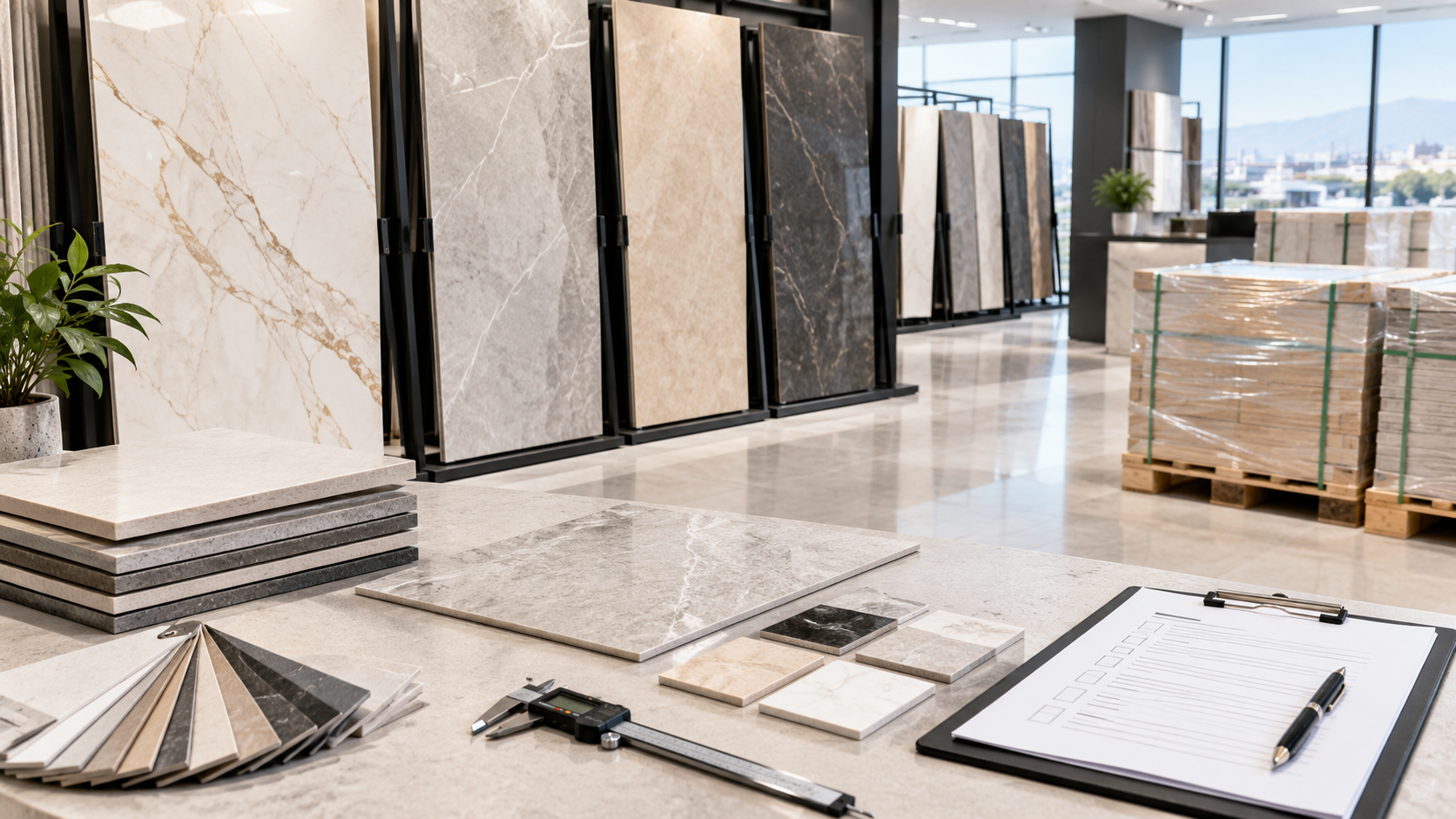
Physical samples allow buyers to examine:
-
Actual colour and shade.
-
Surface texture.
-
Gloss level.
-
Edge finishing.
-
Printed pattern quality.
-
Tile thickness.
-
General manufacturing appearance.
For large-format porcelain slabs, request larger samples whenever possible.
A small sample may not reveal the complete veining pattern or the visual differences across the entire surface.
۴.۲ Check Dimensional Accuracy and Flatness
Dimensional consistency is essential for professional tile installation.
Differences in length, width, thickness, or squareness can create installation difficulties and uneven grout joints.
Ask the manufacturer to provide dimensional inspection results.
Important measurements include:
-
Length and width.
-
Thickness.
-
Straightness of sides.
-
Rectangularity.
-
Surface flatness.
-
Warpage.
For large-format tiles and slab tile products, flatness deserves particular attention.
A large panel with unacceptable deformation may create problems during handling, cutting, and installation.
۴.۳ Examine Surface Quality and Visual Consistency
A reliable manufacturer should maintain acceptable visual quality throughout the production batch.
Inspect samples for:
-
Surface scratches.
-
Pinholes.
-
Glazing defects.
-
Uneven polishing.
-
Printing inconsistencies.
-
Edge chipping.
-
Visible colour variation.
-
Surface contamination.
Buyers should also understand the manufacturer’s shade and calibre classification system.
Shade refers to variations in colour between production batches.
Calibre refers to the actual dimensional category assigned to tiles after manufacturing.
Two tiles with the same nominal dimensions may have slightly different actual measurements.
This is why suppliers should confirm that products within one shipment belong to compatible shade and calibre groups.
۴.۴ Understand Slip Resistance and Application Suitability
The surface finish should match the intended application.
For example:
| Tile finish | Typical application |
|---|---|
| Polished | Interior living spaces and decorative walls |
| Matt | Residential and commercial interiors |
| Structured | Selected outdoor and high-traction applications |
| Satin | Contemporary interior flooring and walls |
| Lappato | Decorative flooring and interior spaces |
| Anti-slip | Applications requiring enhanced slip resistance |
A common purchasing mistake is selecting a product because it looks attractive without evaluating whether its surface is suitable for the intended environment.
For outdoor areas, swimming pool surroundings, bathrooms, and commercial kitchens, buyers should carefully examine relevant slip-resistance data.
The correct test method depends on the destination market and application. A supplier should provide the actual test method and result rather than simply describing a product as anti-slip.
۴.۵ Evaluate Large-Format Slabs Separately
Large-format porcelain slabs require additional quality checks.
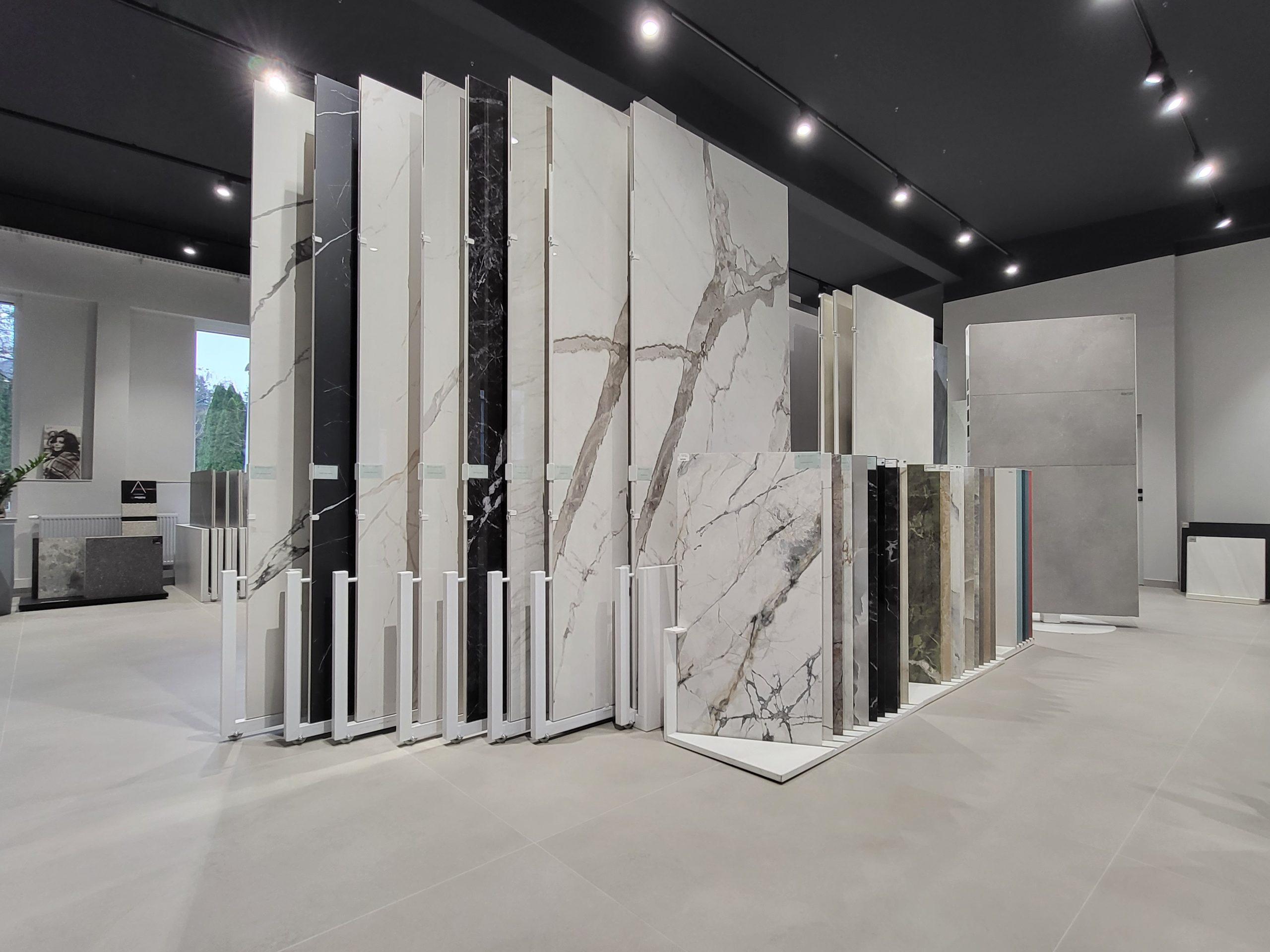
Unlike standard tiles, slabs can be difficult and expensive to replace once damaged.
Inspect the following characteristics:
-
Overall flatness.
-
Thickness consistency.
-
Surface appearance.
-
Pattern continuity.
-
Edge quality.
-
Internal defects.
-
Resistance to handling damage.
-
Suitability for cutting and fabrication.
If the slabs are intended for kitchen countertops, ask about the recommended thickness and fabrication procedures.
If they are intended for wall cladding, confirm the manufacturer’s recommendations for mechanical fixing or adhesive installation.
۴.۶ Arrange Pre-Shipment Quality Inspection
For substantial orders, an independent pre-shipment inspection can reduce purchasing risks.
The inspection should ideally take place after production and before the goods are loaded into containers.
A practical inspection checklist includes:
-
Verification of product codes.
-
Verification of quantities.
-
Sampling from different cartons.
-
Visual inspection.
-
Dimensional checks.
-
Shade and calibre verification.
-
Packaging inspection.
-
Carton labelling.
-
Pallet condition.
-
Loading supervision.
The inspection agreement should clearly define the acceptable quality level and sampling procedure.
Expert tip: Make the approved physical sample part of the purchase agreement. This provides a reference point if disagreements arise after delivery.
۵. Choosing the Right Porcelain Tile Sizes and Slab Tile Formats for European Buyers
Product selection should be based on the target customer and the intended application.
European importers may serve different markets, including residential construction, hospitality, retail, commercial buildings, and luxury architectural projects.
Each segment has different requirements regarding dimensions, aesthetics, technical characteristics, and pricing.
۵.۱ Popular Standard Porcelain Tile Formats
Standard tile dimensions remain important for wholesalers and distributors because they serve a wide range of residential and commercial applications.
Common formats include:
۶۰ × ۶۰ cm
A practical format for residential floors, apartments, offices, and selected commercial interiors.
۶۰ × ۱۲۰ cm
A versatile rectangular format used for contemporary flooring and wall applications.
۸۰ × ۸۰ cm
Suitable for modern residential and commercial projects requiring larger floor surfaces.
۱۰۰ × ۱۰۰ cm
An increasingly relevant option for projects seeking a balanced combination of large-format appearance and manageable installation.
۱۲۰ × ۱۲۰ cm
Suitable for projects that require fewer visible joints and a more continuous surface appearance.
The actual demand for each size varies between European countries and customer segments. Buyers should research local market preferences before committing to a large order.
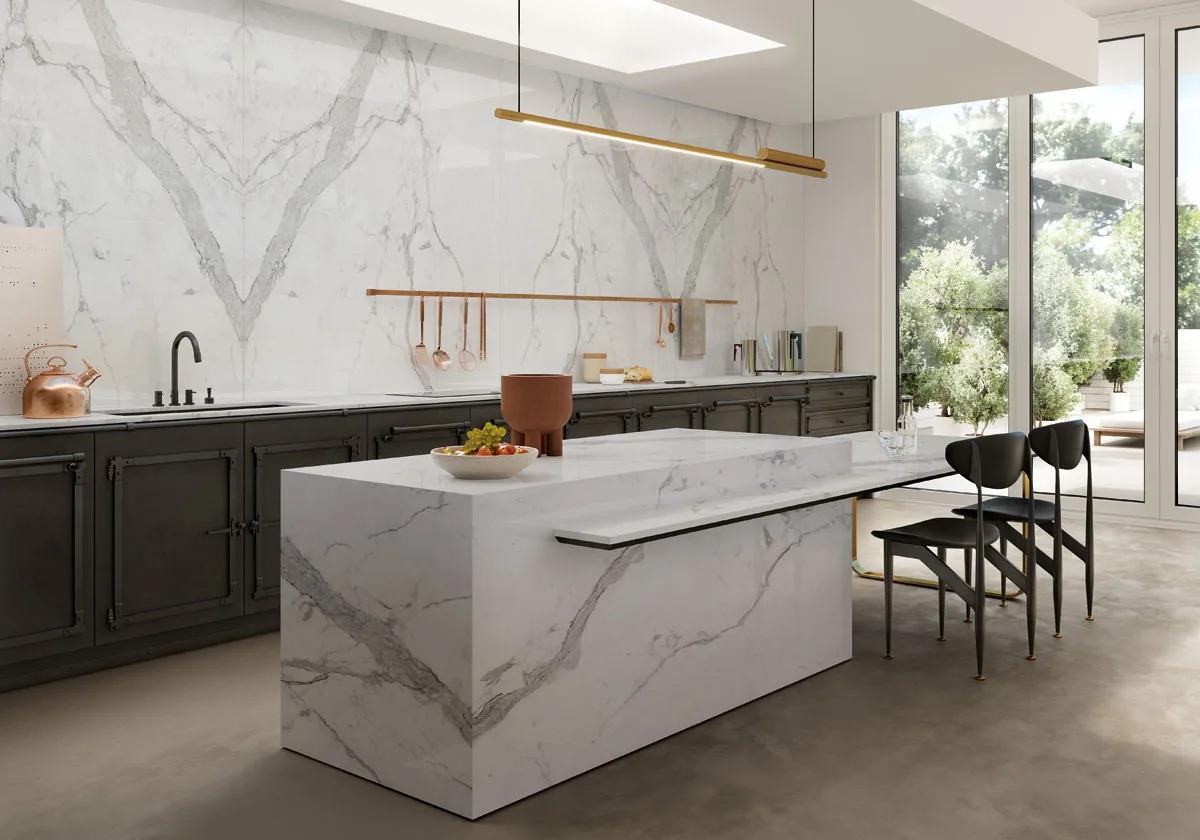
۵.۲ Why Large-Format Porcelain Slabs Are Attracting Attention
Large-format porcelain slabs have become an important product category in contemporary architectural design.
Their popularity is connected to several design and functional advantages.
Fewer visible joints
Large panels can create more continuous surfaces and reduce the number of grout lines.
Natural stone appearance
Modern digital printing technologies can reproduce marble-inspired veins, natural stone textures, and other decorative effects.
Design flexibility
Slabs can be used in several applications, including countertops, wall panels, bathroom surfaces, and furniture elements.
Contemporary aesthetics
Large surfaces are particularly popular in minimalist and modern architectural projects.
However, importers must consider the additional requirements associated with large panels.
These include:
-
Specialized packaging.
-
Appropriate A-frame supports.
-
Professional loading and unloading.
-
Special handling equipment.
-
Fabrication and cutting requirements.
-
Increased transportation risk.
A supplier’s ability to manufacture slabs should therefore be evaluated separately from its ability to export conventional porcelain tiles.
۵.۳ How to Select the Right Product Mix for a European Market
Rather than purchasing only one size or design, importers should consider a balanced product portfolio.
For example, a distributor targeting residential construction might consider:
| Product category | Suggested commercial role |
|---|---|
| ۶۰ × ۶۰ cm | Standard residential flooring |
| ۶۰ × ۱۲۰ cm | Contemporary floors and walls |
| ۱۰۰ × ۱۰۰ cm | Premium residential projects |
| ۱۲۰ × ۱۲۰ cm | Large interior spaces |
| Large-format slabs | Luxury and architectural projects |
This is an illustrative portfolio, not a recommendation for fixed purchasing quantities.
Actual purchasing decisions should depend on local sales data, warehouse capacity, customer preferences, and available production options.
۵.۴ Consider Surface Finishes and Design Trends
European buyers should also evaluate the manufacturer’s design capabilities.
Popular product directions include:
-
White marble-effect porcelain.
-
Beige and warm stone-inspired surfaces.
-
Concrete-look porcelain tiles.
-
Natural limestone effects.
-
Travertine-inspired patterns.
-
Dark marble designs.
-
Textured matt finishes.
-
Minimalist neutral colours.
Digital printing technology has made it possible to produce sophisticated designs with multiple visual variations.
However, attractive printing is only one part of product quality.
The buyer should also assess the depth of the visual design, surface finishing, repeat patterns, and consistency between tiles.
۵.۵ Avoid Overbuying Unfamiliar Products
An attractive new design does not guarantee commercial success.
Before ordering large quantities of an unfamiliar product, consider testing the market with a smaller shipment or mixed product selection.
This approach allows distributors to evaluate:
-
Customer demand.
-
Sales speed.
-
Market pricing.
-
Installation feedback.
-
Product performance.
-
Replacement and after-sales requirements.
A carefully selected product portfolio is often more profitable than purchasing large quantities of products based only on factory discounts.
۶. Pricing, Minimum Order Quantities, and Payment Terms: What Should Buyers Negotiate?
Price negotiations are an essential part of international tile sourcing.
However, experienced buyers understand that the lowest quotation is not necessarily the most economical offer.
The purchasing decision should be based on the total landed cost, product consistency, delivery reliability, and commercial risks.
۶.۱ Understand the Main Pricing Components
When requesting quotations from Iranian porcelain tile manufacturers, ask for detailed pricing information.
A professional quotation should specify:
-
Product description.
-
Product dimensions.
-
Surface finish.
-
Thickness.
-
Grade.
-
Shade and calibre.
-
Price per square metre.
-
Cartons per pallet.
-
Square metres per carton.
-
Pallets per container.
-
Total order quantity.
-
Packaging costs.
-
Loading costs.
-
Delivery terms.
-
Payment conditions.
-
Quotation validity.
A quotation that only states a price per square metre is insufficient for a serious export transaction.
۶.۲ Understand Incoterms Before Comparing Offers
International commercial terms determine the responsibilities of buyers and sellers during transportation.
Three commonly encountered terms are FOB, CFR, and CIF.
FOB – Free on Board
Under FOB, the seller delivers the goods on board the vessel at the agreed port of shipment. The buyer generally arranges and pays for the main sea freight and insurance.
CFR – Cost and Freight
Under CFR, the seller pays the cost of transportation to the named destination port. Risk transfers to the buyer when the goods are placed on board the vessel at the port of shipment.
CIF – Cost, Insurance and Freight
Under CIF, the seller pays for transportation and the required minimum insurance coverage to the named destination port. Risk still transfers when the goods are loaded on board the vessel.
These terms are designed for sea and inland waterway transport.
For other transportation methods, terms such as FCA, CPT, and CIP may be more appropriate.
Always specify the named place or port and the applicable Incoterms edition in the contract.
۶.۳ Calculate the Total Landed Cost
Consider an illustrative example.
A European importer purchases 10,000 square metres of porcelain tiles.
The following figures are hypothetical and are intended only to demonstrate the calculation.
| Cost component | Illustrative amount |
|---|---|
| Product purchase | €۸۰,۰۰۰ |
| Inland transport and export handling | €۳,۰۰۰ |
| International freight | €۷,۰۰۰ |
| Insurance | €۵۰۰ |
| Customs clearance and port-related costs | €۲,۰۰۰ |
| Other applicable import charges | To be confirmed |
| Subtotal before duties and VAT | €۹۲,۵۰۰ |
The indicative subtotal is €۹.۲۵ per square metre before any applicable customs duties, import VAT, and additional destination-specific costs.
The actual landed cost will depend on the destination country, customs classification, shipping route, and commercial arrangements.
Importers should use the EU Access2Markets platform to check applicable tariffs and import requirements using the correct product code and country of origin.
۶.۴ Negotiate Minimum Order Quantities
Minimum Order Quantity (MOQ) refers to the minimum quantity a supplier is willing to manufacture or sell in one order.
MOQ can vary depending on:
-
Tile dimensions.
-
Surface finish.
-
Product design.
-
Production technology.
-
Factory capacity.
-
Stock availability.
-
Packaging requirements.
For standard products, manufacturers may have more flexibility because they are already in regular production.
Special designs, customised colours, and large-format slabs may require higher minimum quantities.
Before confirming an order, ask whether different product codes can be combined in one container.
This can help smaller distributors test several product categories without committing to large quantities of a single design.
۶.۵ Establish Safe and Transparent Payment Terms
Payment terms should be negotiated before production begins.
Common arrangements in international trade include:
-
Advance payment.
-
Partial advance payment and balance before shipment.
-
Documentary collection, where available.
-
Letters of credit, where legally and operationally feasible.
-
Other agreed banking arrangements.
For buyers sourcing from Iran, payment arrangements require particular care.
The EU reinstated nuclear-related economic and financial sanctions against Iran on 29 September 2025. Additional restrictive measures and subsequent amendments have also been introduced. Therefore, the parties must check current sanctions, counterparty status, banking restrictions, and transaction permissibility before entering into a contract or transferring funds.
A payment method should never be selected simply because it appears convenient.
Both parties should obtain appropriate legal and banking advice where necessary.
Important: Never agree to misleading invoices, concealed counterparties, or arrangements designed to circumvent applicable sanctions.
۶.۶ Put All Commercial Agreements in Writing
A professional purchase contract should include:
-
Exact product specifications.
-
Approved samples.
-
Order quantity.
-
Unit price and currency.
-
Production deadline.
-
Inspection requirements.
-
Packaging specifications.
-
Delivery terms.
-
Payment schedule.
-
Required documents.
-
Procedure for handling defective goods.
-
Dispute resolution arrangements.
A detailed contract reduces misunderstandings and creates a clear framework for resolving commercial problems.
۷. Export Documentation, Packaging, and Shipping: Getting Porcelain Tiles Safely from Iran to Europe
Manufacturing a quality product is only the beginning of a successful export transaction.
The goods must also be correctly documented, packaged, transported, and cleared through customs.
This stage is particularly important for porcelain tiles because they are heavy, fragile, and vulnerable to damage during handling.
۷.۱ Essential Export and Import Documents
The exact documentation depends on the transaction, destination country, customs classification, and applicable legal requirements.
However, buyers should discuss the following documents with their suppliers and customs representatives.
| Document | Purpose |
|---|---|
| Commercial Invoice | Shows the transaction value and product details |
| Packing List | Identifies packaging units and quantities |
| Bill of Lading | Evidence of sea transport and shipment details |
| Certificate of Origin | Identifies the declared country of origin |
| Customs Declaration | Supports customs procedures |
| Insurance Certificate | Provides evidence of cargo insurance, when applicable |
| Technical Data Sheet | Provides product specifications |
| Test Reports | Demonstrate tested technical characteristics |
| Applicable DoP or DoPC | Provides required performance and conformity information |
| CE Marking Information | Supports applicable construction-product obligations |
Not every document is required for every shipment.
For example, a certificate of origin may be required by the buyer, customs authority, or a specific trade arrangement, while insurance documentation depends on the contractual terms.
The supplier and importer should prepare a shipment-specific document checklist before production is completed.
۷.۲ Choose the Correct Customs Classification
Ceramic and porcelain tiles fall within Chapter 69 of the Harmonized System.
However, the exact customs classification depends on the product characteristics.
For example, certain porcelain paving, hearth, and wall tiles with water absorption not exceeding 0.5% are classified under CN code 6907 21, subject to the applicable classification rules.
Do not assume that every product described commercially as a porcelain tile automatically falls under the same customs code.
The importer should confirm the correct classification with a qualified customs broker or the relevant customs authority.
This is important because classification affects:
-
Customs duties.
-
Trade statistics.
-
Import restrictions.
-
Customs declarations.
-
Regulatory requirements.
۷.۳ Understand the Importance of Export Packaging
Packaging is one of the most overlooked factors in ceramic tile exports.
Even a technically excellent product can arrive damaged if it is not properly protected.
A professional export packaging system should include:
-
Strong cartons.
-
Suitable internal separators.
-
Protective corner materials.
-
Secure palletization.
-
Stretch wrapping.
-
Appropriate strapping.
-
Moisture protection where required.
-
Clear product labels.
-
Suitable handling instructions.
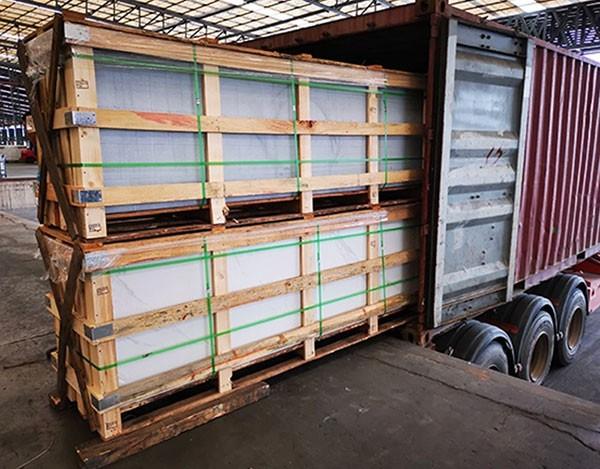
Large-format slabs require more specialized protection.
A-frame packaging systems and reinforced wooden supports are commonly used to transport large panels safely.
۷.۴ Calculate Container Loading Capacity Carefully
Container loading capacity depends on several factors.
These include:
-
Tile dimensions.
-
Product thickness.
-
Weight per square metre.
-
Packaging weight.
-
Pallet dimensions.
-
Container payload limits.
-
Shipping line restrictions.
-
Road transportation weight limits.
Buyers should never calculate container capacity based only on the number of cartons.
The supplier should provide a detailed loading plan showing:
-
Total square metres.
-
Total number of cartons.
-
Total number of pallets.
-
Net product weight.
-
Gross shipment weight.
-
Pallet arrangement.
-
Container type.
-
Estimated loading configuration.
This is particularly important when transporting heavy porcelain tiles.
۷.۵ Reduce the Risk of Damage During Transportation
A proper loading procedure should include:
-
Checking the container’s condition.
-
Ensuring that the floor is clean and dry.
-
Using suitable loading equipment.
-
Securing pallets against movement.
-
Distributing weight appropriately.
-
Photographing the loading process.
-
Recording container and seal numbers.
-
Confirming the final packing list.
Photographic evidence is useful if damage or quantity discrepancies are reported after delivery.
۷.۶ Plan the Shipping Route and Delivery Schedule
Shipping routes from Iran to Europe depend on the destination, available carriers, port conditions, and current restrictions.
Buyers should request quotations from qualified freight forwarders rather than relying exclusively on the manufacturer’s shipping estimate.
Ask for confirmation of:
-
Port of loading.
-
Destination port.
-
Transit route.
-
Estimated transit time.
-
Freight availability.
-
Cargo insurance.
-
Handling costs.
-
Customs clearance arrangements.
Do not confuse estimated transit time with guaranteed delivery time.
Production delays, port congestion, changes in shipping schedules, and regulatory checks may affect the final arrival date.
۸. Common Mistakes to Avoid When Sourcing Porcelain Tiles from Iran
International tile sourcing can create profitable opportunities, but mistakes during supplier selection and purchasing can significantly increase costs.
European importers should understand the most common risks before entering into a commercial agreement.
۸.۱ Choosing a Supplier Based Only on Price
A low quotation may be attractive, particularly when comparing manufacturers from different countries.
However, price alone does not reveal:
-
Product consistency.
-
Technical performance.
-
Manufacturing reliability.
-
Packaging quality.
-
Delivery performance.
-
After-sales support.
A cheaper product that arrives damaged or fails to meet project specifications may become more expensive than a higher-quality alternative.
Always compare quotations based on equivalent specifications.
۸.۲ Ignoring Product Documentation
Some buyers focus on physical appearance and overlook technical documentation.
This can create problems when products are intended for regulated construction applications.
Before placing an order, verify the applicable product requirements and request relevant documentation.
Do not accept generic certificates as substitutes for product-specific evidence.
۸.۳ Failing to Check Shade and Calibre
Differences between production batches can become visible after installation.
This is particularly problematic for large projects involving multiple shipments.
Ask the supplier to confirm:
-
Shade consistency.
-
Calibre classification.
-
Batch identification.
-
Availability of replacement stock.
-
Whether repeat production can match the original order.
Whenever possible, purchase the required quantity for a single project from a controlled production batch.
۸.۴ Overlooking the Importance of Packaging
Poor packaging can result in chipped edges, broken tiles, and damaged slabs.
These problems can create additional costs for transportation, replacement, and customer compensation.
Request packaging photographs and loading videos before shipment.
For large-format products, confirm the type of support frame and handling equipment.
۸.۵ Ignoring Sanctions and Payment Restrictions
Trade with Iran requires additional legal and financial due diligence.
EU sanctions have changed significantly since September 2025, and further amendments were adopted during 2026.
Buyers should screen manufacturers, shareholders, beneficial owners, banks, shipping companies, vessels, and other relevant parties against applicable sanctions lists.
A product’s ordinary commercial nature does not automatically mean every transaction involving its manufacturer, payment channel, or shipping provider is permissible.
Consult qualified sanctions and trade-compliance professionals before proceeding.
۸.۶ Failing to Define Responsibility for Defective Products
A purchase agreement should explain what happens if the goods do not match the approved specifications.
For example:
-
Who pays for independent inspection?
-
What happens if a shipment contains damaged cartons?
-
How are manufacturing defects assessed?
-
What evidence must the buyer provide?
-
Will defective products be replaced or credited?
-
Who bears the associated transportation costs?
These questions should be answered before the goods are shipped.
۹. A Practical Checklist: 15 Questions to Ask an Iranian Porcelain Tile Supplier
Before selecting a manufacturer, European buyers should request clear answers to the following questions.
This checklist can be used when contacting suppliers or evaluating competing quotations.
| No. | Question | Why it matters |
|---|---|---|
| ۱ | Are you the manufacturer or a trading company? | Establishes supplier identity |
| ۲ | Where is your production facility located? | Verifies manufacturing origin |
| ۳ | What is your monthly production capacity? | Evaluates supply capability |
| ۴ | Which porcelain tile sizes do you produce? | Confirms product availability |
| ۵ | Do you manufacture large-format slabs? | Evaluates slab production capabilities |
| ۶ | Can you provide ISO 13006 and relevant EN 14411 test documentation? | Supports technical evaluation |
| ۷ | What is the water absorption rate of your porcelain tiles? | Confirms product classification |
| ۸ | Can you provide independent laboratory test reports? | Verifies product characteristics |
| ۹ | How do you control shade and calibre? | Reduces batch inconsistency |
| ۱۰ | What packaging do you use for export shipments? | Evaluates transportation protection |
| ۱۱ | What is your MOQ? | Helps plan purchasing quantities |
| ۱۲ | How many square metres can you load into a container? | Supports freight planning |
| ۱۳ | Which export documents can you provide? | Clarifies documentation responsibilities |
| ۱۴ | What are your payment and delivery terms? | Establishes commercial responsibilities |
| ۱۵ | Can you arrange an independent pre-shipment inspection? | Reduces purchasing risks |
A manufacturer that answers these questions accurately and provides supporting evidence is generally easier to evaluate than one that relies on promotional statements.
Supplier Evaluation Scorecard
Importers can also use a simple scoring model to compare several manufacturers.
The following model is illustrative and can be adjusted according to purchasing priorities.
| Evaluation category | Suggested weight |
|---|---|
| Product quality and technical compliance | ۲۵% |
| Manufacturing capacity | ۱۵% |
| Export experience | ۱۵% |
| Price competitiveness | ۱۵% |
| Packaging and logistics | ۱۰% |
| Documentation and transparency | ۱۰% |
| Communication and customer service | ۱۰% |
| Total | ۱۰۰% |
For example, a manufacturer offering competitive prices but lacking reliable technical documentation should not automatically receive a high overall score.
This method encourages buyers to consider the entire sourcing process rather than focusing on one attractive commercial factor.
۱۰. People Also Ask: Frequently Asked Questions About Importing Porcelain Tiles from Iran to Europe
European importers often have similar questions when evaluating Iranian tile manufacturers.
The following answers address some of the most important purchasing and regulatory concerns.
Q1. Are Iranian porcelain tiles suitable for the European market?
Yes, Iranian porcelain tiles can be suitable for European applications when their technical characteristics meet the relevant project specifications and applicable EU requirements.
However, suitability must be evaluated at the individual product level.
Buyers should request relevant test reports, verify product classification, assess visual consistency, and confirm the applicable construction-product documentation before importing.
The country of manufacture alone does not establish product compliance.
Q2. How can I find reliable porcelain tile manufacturers in Iran?
Start by researching established manufacturers and requesting their official factory profiles.
Evaluate their production capacity, product range, export experience, technical documentation, and quality control procedures.
Request physical samples and arrange factory inspections or independent pre-shipment inspections before committing to large orders.
Working directly with a verified manufacturer can also improve communication and provide greater transparency regarding production schedules and pricing.
Q3. Do Iranian porcelain tiles need CE marking to enter Europe?
CE marking obligations depend on the applicable European construction-product legislation and the relevant harmonised technical specifications.
Where a product is covered by the applicable harmonised standard, the manufacturer must follow the relevant conformity assessment and documentation requirements.
Buyers should verify the current status of EN 14411 and the transitional arrangements under Regulation (EU) 2024/3110 rather than relying on an outdated certificate.
Q4. What is the difference between porcelain tiles and porcelain slabs?
The main difference is their dimensions and intended applications.
Conventional porcelain tiles are generally manufactured in standard formats for flooring and wall applications.
Porcelain slabs are much larger panels designed for applications such as countertops, wall cladding, bathroom surfaces, and selected architectural elements.
Slabs may offer a more continuous appearance with fewer visible joints, but they require specialized handling, transportation, and installation procedures.
Q5. What documents should I request before importing porcelain tiles?
Depending on the product and transaction, buyers should request:
-
Commercial invoice.
-
Packing list.
-
Certificate of origin, where required.
-
Bill of lading.
-
Relevant customs documentation.
-
Technical data sheets.
-
Laboratory test reports.
-
Applicable Declaration of Performance or Declaration of Performance and Conformity.
-
CE marking information, where applicable.
-
Insurance documentation, where applicable.
The final document list should be confirmed with the destination country’s customs representative and product compliance specialist.
Q6. What is the minimum order quantity for Iranian porcelain tiles?
There is no single MOQ for all Iranian manufacturers.
Minimum quantities depend on the product dimensions, design, finish, factory capacity, and whether the product is available in stock.
Standard production items may have more flexible purchasing conditions than customised designs or large-format slabs.
Importers should ask whether different products can be combined in one container.
Q7. Are Iranian porcelain tiles cheaper than European products?
Iranian manufacturers may offer competitive factory prices because of domestic production resources and manufacturing cost structures.
However, a meaningful comparison must include freight, insurance, customs duties, applicable taxes, handling, and other import expenses.
The final landed cost is more important than the initial factory quotation.
Q8. Can European buyers purchase porcelain slabs directly from Iranian factories?
Yes, provided the manufacturer can supply the required dimensions, quality, technical documentation, packaging, and export arrangements.
Buyers should also verify that the transaction and all involved parties comply with applicable sanctions and financial restrictions.
For large-format slabs, particular attention should be given to packaging systems, loading methods, and cargo insurance.
Q9. How can I check the quality of porcelain tiles before shipment?
Request physical samples, review laboratory test reports, and establish written quality specifications.
For large orders, arrange an independent inspection before shipment.
The inspection should cover product dimensions, surface quality, shade, calibre, quantity, packaging, and loading conditions.
Q10. What should I consider when choosing between standard tiles and large-format slabs?
Consider your target customers, project requirements, warehouse capacity, transportation costs, installation expertise, and local demand.
Standard porcelain tiles are suitable for a broad range of distribution channels.
Large-format slabs offer opportunities in premium architectural and interior design projects but involve additional handling and fabrication requirements.
A balanced product portfolio can help importers serve different customer segments.
۱۱. Future Opportunities: The Outlook for Iranian Porcelain Tile Exports to Europe in 2027–۲۰۲۸
The future of international ceramic trade will increasingly depend on more than manufacturing costs.
Product innovation, environmental performance, digital manufacturing, logistics reliability, and regulatory transparency are likely to become increasingly important competitive factors.
For Iranian manufacturers targeting European buyers, several developments deserve attention.
۱۱.۱ Growing Importance of Sustainable Manufacturing
European construction markets are placing greater emphasis on the environmental performance of building materials.
Manufacturers that can document their energy consumption, production waste, water management, and environmental impact may have an advantage when competing for sustainability-focused projects.
Developing credible Environmental Product Declarations and improving production efficiency can help suppliers respond to these expectations.
۱۱.۲ Expansion of Large-Format Porcelain Slabs
Architectural preferences for continuous surfaces, minimalist interiors, and natural stone-inspired designs create opportunities for manufacturers of large-format porcelain products.
However, investment in advanced production equipment should be accompanied by improvements in quality control and export packaging.
The ability to manufacture large slabs consistently and deliver them without damage can become a meaningful competitive advantage.
۱۱.۳ Greater Demand for Technical Transparency
European buyers increasingly need reliable product information.
Manufacturers should be prepared to provide accurate technical specifications, test reports, product identification, and applicable conformity documentation.
The transition under the revised Construction Products Regulation also makes it important for exporters to monitor changing technical and environmental information requirements.
۱۱.۴ Digital Printing and Design Innovation
Digital printing technology allows manufacturers to develop increasingly sophisticated surface designs.
Marble-inspired products, natural stone effects, concrete textures, and customised decorative surfaces can help suppliers differentiate their products.
In the coming years, manufacturers that combine technological capabilities with a clear understanding of European architectural preferences may be better positioned to develop long-term customer relationships.
۱۱.۵ Building Trust Through Professional Export Services
Product quality alone cannot guarantee successful international business.
European importers also value:
-
Predictable production schedules.
-
Accurate documentation.
-
Transparent quotations.
-
Professional communication.
-
Reliable packaging.
-
Efficient complaint handling.
-
Consistent product availability.
Iranian manufacturers that invest in these areas can strengthen their position in international supply chains.
Conclusion: Building a Reliable Sourcing Partnership from Iran to Europe
Sourcing export-ready porcelain tiles from Iran can create valuable opportunities for European importers, distributors, wholesalers, and construction companies. However, success depends on selecting the right manufacturer and evaluating the entire supply chain before placing an order.
Competitive pricing is an important advantage, but it should never be the only purchasing criterion.
A successful sourcing strategy begins with verifying the manufacturer’s identity, production capacity, export experience, and quality management procedures. Buyers should then examine physical samples, review technical test reports, and confirm that products meet the requirements of their intended applications.
Understanding European product regulations is equally important. Standards such as EN 14411 and ISO 13006 provide essential technical frameworks, while the revised Construction Products Regulation introduces a changing regulatory environment that exporters and importers must monitor.
Commercial planning also deserves careful attention. Buyers should calculate the total landed cost, negotiate transparent payment terms, establish clear contractual responsibilities, and evaluate packaging and shipping arrangements. For Iranian suppliers, checking current sanctions and financial restrictions is an essential part of this process.
Looking ahead to 2027–۲۰۲۸, Iranian manufacturers have opportunities to strengthen their international competitiveness through investment in large-format porcelain slabs, advanced digital printing, sustainable production, and professional export services.
For European buyers, the best supplier is not necessarily the manufacturer offering the lowest price. It is the manufacturer capable of delivering consistent quality, accurate documentation, reliable logistics, and long-term commercial value.
Are you looking for a reliable Iranian porcelain tile supplier for your next European project?
Start by reviewing the manufacturer’s product catalogue, requesting technical specifications, comparing samples, and discussing your purchasing requirements with an experienced export team.
Contact our specialists to explore Iranian porcelain tiles, large-format slabs, available designs, export specifications, and customised sourcing solutions for your European market.
A successful import begins with the right supplier—and the right supplier is one you can verify, trust, and work with over the long term.


نظرات ۰