



Discover why large-format porcelain tile and slab tile make projects feel more luxurious and seamless: fewer grout lines, calmer surfaces, better light. Learn the design logic, specs and costs, then plan your next project.
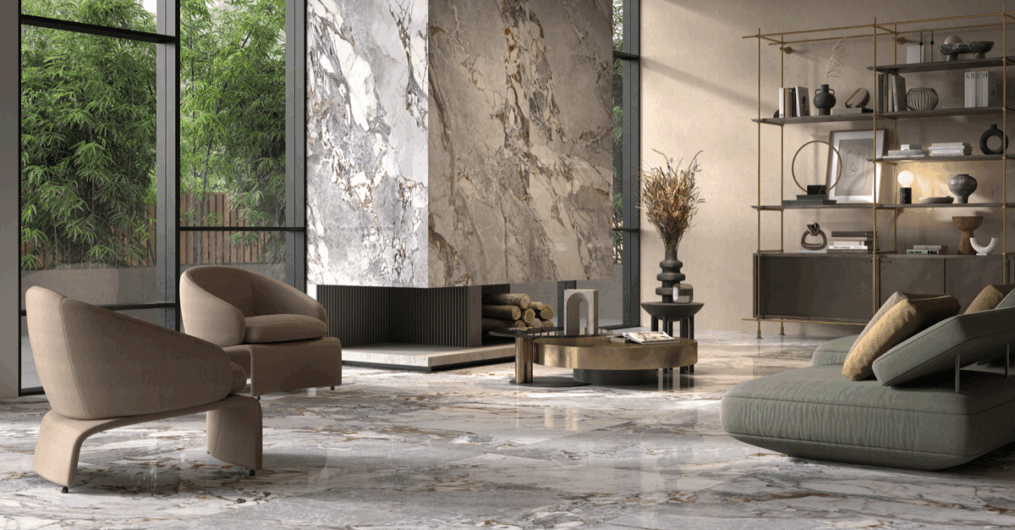
Walk into a high-end hotel lobby. Look down. The floor rarely looks like a floor made of many pieces. It looks like one calm, uninterrupted surface, as if a single block of stone had been poured across the room.
That effect is not an accident. It is the result of design logic that architects and interior designers have refined for years, and it rests on a simple idea: fewer visual breaks make a space feel larger, cleaner and more expensive.
Many homeowners and project managers feel this without being able to name it. They tour a showroom, see a wall of slab tile, and sense that something is different. Then they price a standard 30×۶۰ cm tile for their own project and wonder why the result feels busier, smaller and more ordinary.
The pain point is real. Traditional tiling cuts a surface into hundreds of small units. Each unit adds a joint, each joint adds a line, and each line adds visual noise. Over a whole floor, that noise adds up to a space that feels fragmented.
Large-format porcelain tile solves this at the source. By stretching each piece to 60×۱۲۰ cm, 120×۲۴۰ cm or even 160×۳۲۰ cm, it removes most of the joints that interrupt the eye.
In this guide you will learn how porcelain tile creates a luxurious look, what separates true slab tile from ordinary tile, where it performs best, how it behaves in daily use, and what installation and budget questions to settle before you buy. By the end, you will be able to judge a project with confidence.
۱. The Visual Science of Seamlessness: How Fewer Joints Create Luxury
Luxury in interior design is closely tied to calm. Expensive spaces tend to feel quiet, ordered and uncluttered. Large-format tile delivers that quality through a basic principle of perception: the human eye reads lines as boundaries.
Every grout line is a boundary. On a floor of small tiles, the eye keeps catching on these lines and has to process a grid. On a floor of porcelain tile slabs, there are far fewer lines to catch on, so the gaze glides across the surface.
Consider a simple comparison for a 20 m² room:
- ۳۰×۳۰ cm tiles: about 222 pieces and roughly 130 meters of grout line.
- ۶۰×۶۰ cm tiles: about 56 pieces and roughly 65 meters of grout line.
- ۱۲۰×۲۴۰ cm slabs: about 7 pieces and roughly 25 meters of grout line.
The numbers are approximate and depend on layout, but the trend is clear. Moving from small units to slab tile cuts the grid by more than 80 percent. That is a dramatic change in how the room reads.
Why Does Visual Continuity Feel Expensive?
Continuity signals craftsmanship and budget. Natural stone slabs, such as marble book-matched panels, have long been reserved for palaces, banks and luxury hotels. Porcelain tile in large formats reproduces that continuous look at a fraction of the cost, so the cue of wealth becomes accessible.
There is also a psychological layer. A surface without interruptions suggests that no compromise was made. People associate it with high-end hospitality, flagship stores and architect-designed homes.
The Role of Rectified Edges
Seamlessness depends on more than size. Quality large-format tile uses rectified edges, meaning each piece is cut after firing to achieve near-perfect straight sides. This allows installers to set very narrow joints, often 2 mm or less.
Narrow joints matter. With a 2 mm joint in a color matched to the tile, the grid almost disappears. With a wide, contrasting joint, even a big tile looks like a pattern of boxes. Joint color is therefore a design decision, not an afterthought.
Pattern Flow Across Slabs
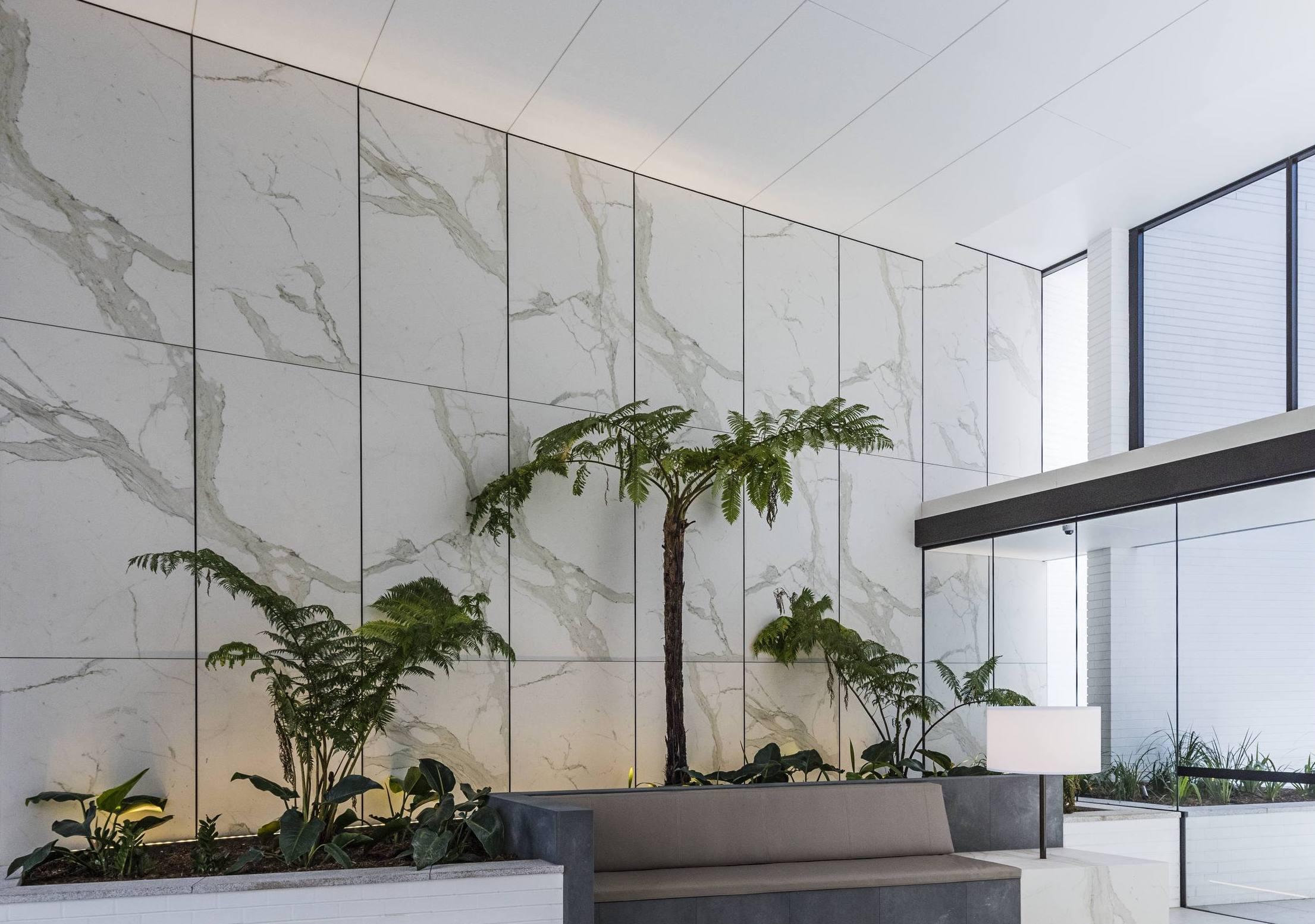
Modern printing technology adds another layer. Digital inkjet decoration lets manufacturers create veining that continues from one slab to the next. Some collections are designed so that adjacent pieces form a book-matched pattern, mirroring a natural stone quarry cut. The result is a single large artwork rather than a repeated motif.
Image 2: Close-up of a book-matched porcelain slab wall in a bathroom, showing continuous veining across two panels. File name:
book-matched-slab-tile-wall.jpgAlt text: “Book-matched slab tile wall with continuous marble-look veining”
۲. What Exactly Is Large-Format Porcelain Tile?
The market uses several terms loosely, so a clear definition helps. Large-format tile generally refers to any tile with at least one side longer than 60 cm. Slab tile usually refers to the biggest end of that range, often 120 cm or more on one side and sometimes much larger.
Porcelain tile is a dense ceramic product made from refined clays, feldspar and silica. It is pressed under very high force and fired at temperatures commonly above 1,200 °C. The result is a vitrified body with very low porosity.
Key Technical Characteristics
- Water absorption: Porcelain tile is defined in international standards, such as ISO 13006 and ASTM C373, by water absorption at or below 0.5 percent. This makes it highly resistant to moisture and frost.
- Hardness and abrasion resistance: Surfaces are rated with PEI classes for glazed products or tested by other methods for through-body ones. Higher classes suit heavier traffic.
- Thickness: Large slabs range from about 3 mm laminates to 6 mm, 9 mm and 12 mm panels. Thin versions suit walls and renovations. Thicker ones suit floors and countertops.
- Sizes: Common formats include 60×۱۲۰, ۸۰×۱۶۰, ۱۲۰×۱۲۰, ۱۲۰×۲۴۰, ۱۲۰×۲۶۰, ۱۶۰×۳۲۰ cm and larger.
- Body type: Through-body porcelain carries color and pattern through its thickness, while glazed porcelain carries them on the surface.
Porcelain Tile vs. Sintered Stone vs. Natural Stone
Buyers often confuse these categories. Sintered stone is produced from mineral powders compacted at extreme pressure and heat, and it is often sold in large slabs for countertops and façades. Many manufacturers place it in the same family as large-format porcelain.
Natural stone offers authenticity but brings higher cost, variability and maintenance needs. Marble can stain and etch. Granite is hard but heavy and costly. Porcelain slab tile offers consistency, stain resistance and predictable supply.
How Is Slab Tile Manufactured?
Production uses advanced lines with huge presses, sometimes compacting material into continuous sheets. Kilns are long and precisely controlled so that large pieces stay flat. Flatness is one of the hardest technical targets, because even a small warp becomes visible across 3 meters.
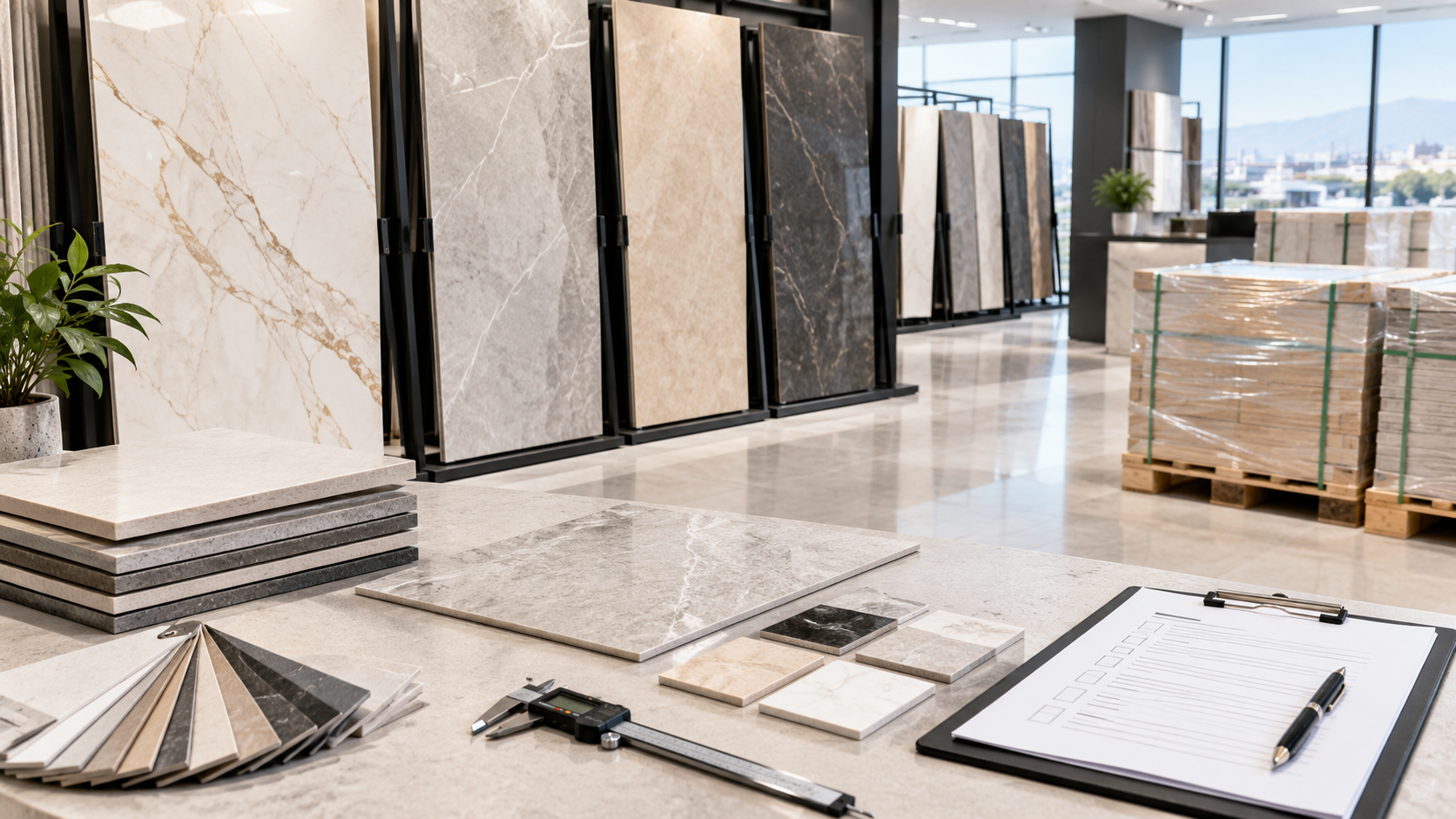
When you evaluate a product, ask for the flatness tolerance, the calibration of batches and the shade variation rating. These three details separate reliable slab tile from risky purchases.
People Also Ask: Is Large-Format Tile Only for Big Rooms?
No. Large pieces can work well in small rooms, including bathrooms and hallways, because fewer joints make the room feel less divided. The condition is that the substrate is flat and the layout is planned. In a compact space, a 60×۱۲۰ cm tile is often the practical choice over a very large slab.
۳. Light, Color and Surface: The Other Half of the Luxury Effect
Size creates continuity, but finish and color decide whether that continuity feels refined. Light plays the leading role here.
How Light Interacts With a Seamless Surface
A surface with few breaks reflects light evenly. On a polished or semi-polished porcelain tile, daylight spreads across the room instead of scattering off dozens of edges. Spaces appear brighter and more open.
Matte and honed finishes behave differently. They absorb a little more light and produce a soft, velvety look. Designers choose them for contemporary homes, spas and boutique hotels where a subtle, tactile feeling matters more than shine.
A practical rule: polished finishes amplify light and suit areas with controlled use, while matte or textured finishes protect against slipping and show fewer marks.
Color Strategies That Raise the Perceived Value
Some palettes consistently produce a high-end result with large-format tile:
- Warm neutrals: Sand, greige and soft taupe create a calm, spa-like background.
- Marble looks in white and grey: Statuario, Calacatta and Carrara designs signal classic luxury.
- Concrete and cement tones: These convey industrial minimalism and pair well with wood and metal.
- Deep charcoals and blacks: Dark slabs add drama and suit feature walls, bars and boutique interiors.
- Travertine and limestone looks: Soft veining and organic texture bring warmth.
A single color family across floor and wall is a powerful technique. When the floor and the wall use the same slab tile, the corner between them nearly vanishes, and the room reads as one volume.
The Continuity From Interior to Exterior
Because porcelain tile resists frost and moisture, the same design can flow from the living room to the terrace. Outdoor versions often come in 20 mm thick pavers that match indoor 9 mm or 12 mm panels. Matching the pattern at a glass door erases the threshold, so the garden becomes an extension of the interior.
People Also Ask: Does Large-Format Tile Make a Room Look Bigger?
In most cases, yes. Fewer joints, light colors and reflective finishes all support the impression of space. The effect is strongest when the joint color matches the tile and the layout follows the longest line of the room. It is not magic, though. A poorly lit room with dark slabs can still feel closed.
۴. Where Slab Tile Delivers the Strongest Impact
Large-format porcelain tile is flexible. Even so, some applications show its strengths more clearly than others.
Floors in Open-Plan Spaces
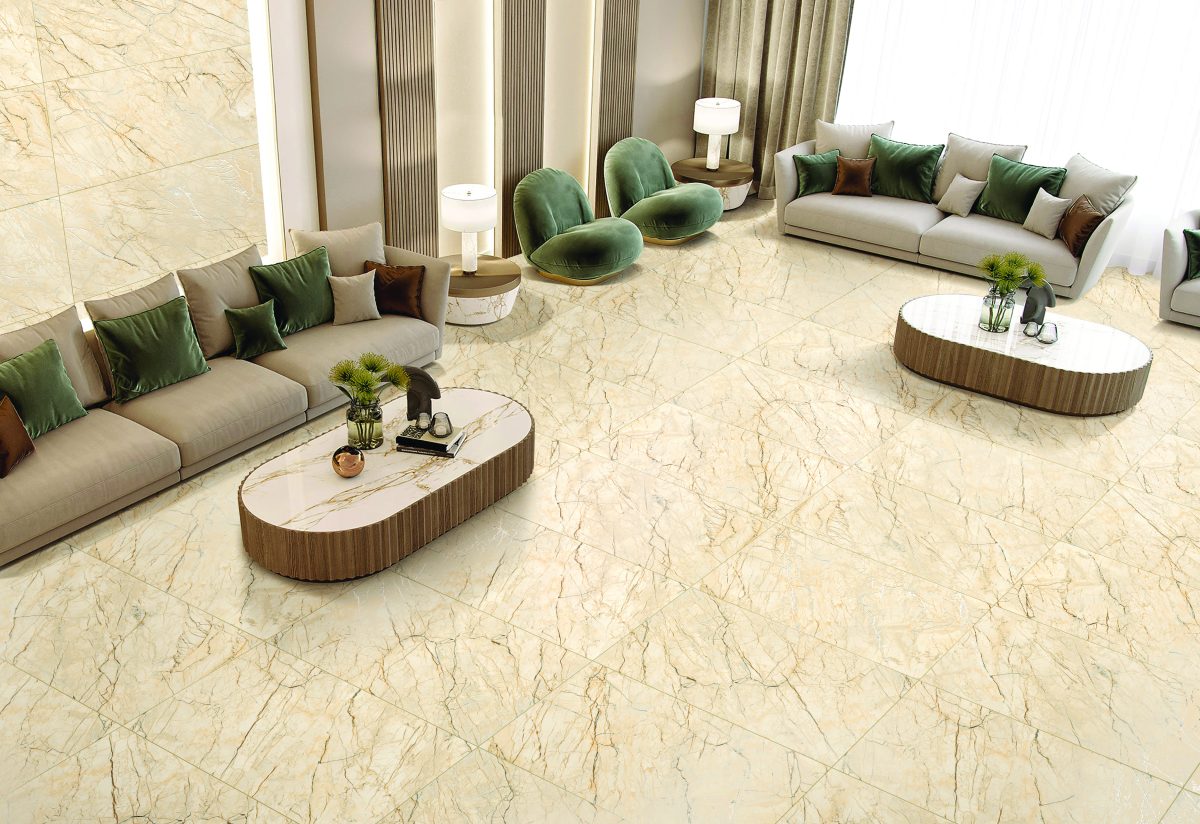
Open-plan living areas benefit most. A single continuous floor across the lounge, dining area and kitchen ties zones together. With underfloor heating, porcelain’s high thermal conductivity also helps heat move efficiently to the surface.
Feature Walls and Fireplaces
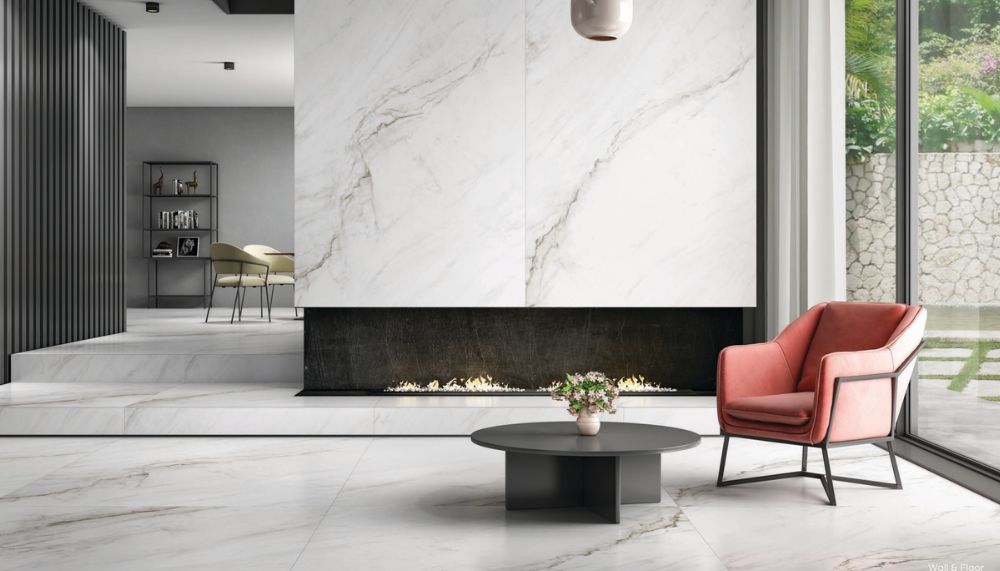
A single slab behind a television, a fireplace or a bed headboard creates a sculptural focal point. Because the pattern runs unbroken, it reads like a stone panel. Fireplace surrounds work well, as porcelain tolerates heat.
Bathrooms and Wet Rooms
Bathrooms show the hygiene and design advantages together. Fewer joints mean fewer lines where moisture and mold can settle. Wall-to-floor continuity in a shower produces a clean, spa-like enclosure. Thin 6 mm slabs often cover walls without adding heavy loads.
Kitchens: Countertops, Splashbacks and Islands
Porcelain slab tile now competes with quartz and natural stone in kitchens. It resists heat, scratches and stains. A waterfall island, where the slab wraps over the edge and down the side, becomes a defining design gesture. Fabricators should be experienced, as cutting and edge finishing demand proper tools.
Commercial and Hospitality Projects
Hotels, showrooms, offices and restaurants use slab tile for speed and durability. Larger pieces mean fewer joints to clean and fewer repairs. Brands also value the consistency of a manufactured product, because a flagship store in one city can match another across the world.
Façades and Ventilated Cladding
On exterior walls, thin porcelain panels fixed to a ventilated system provide a sleek, weather-resistant skin. They resist UV fading and do not absorb water, which makes them durable in demanding climates.
Renovation Over Existing Surfaces
Slim slabs of 3–۶ mm can sometimes be installed over existing tile, depending on the substrate and the manufacturer’s guidance. This reduces demolition, dust and time. Always confirm the method with the supplier before committing.
People Also Ask: Can Porcelain Slabs Be Used for Countertops?
Yes, with the right thickness and support. Slabs of 12 mm or more are commonly used for kitchen worktops, and thin panels require a rigid substrate. Check the manufacturer’s data on impact resistance and edge options before ordering.
۵. Performance in Daily Life: Durability, Hygiene and Maintenance
Luxury has to last. A beautiful floor that stains in the first year is not a luxury. Porcelain tile earns its position by combining looks with performance.
Durability
The dense body resists scratches, impact and wear. It does not fade under sunlight, and it withstands temperature swings. For homes with children, pets or heavy foot traffic, these qualities reduce long-term replacement.
Large slabs introduce one caution: they can be more vulnerable to point impact during handling and installation, especially at corners and in thin formats. Once installed on a proper bed, they perform strongly.
Hygiene and Stain Resistance
Because of its low porosity, porcelain does not absorb liquids. Wine, coffee, oil and household cleaners usually wipe away. Fewer grout lines also mean fewer places for dirt to collect. This is a clear benefit for kitchens, clinics, restaurants and bathrooms.
Maintenance Routine
A simple routine keeps the surface looking new:
- Sweep or vacuum regularly to remove abrasive grit.
- Mop with a pH-neutral cleaner and clean water.
- Avoid acidic or heavy abrasive products on polished surfaces.
- Use epoxy or high-quality grout in wet areas, and reseal cement-based grout if the manufacturer recommends it.
- Place felt pads under furniture legs.
Slip Resistance and Safety
Safety matters. Polished porcelain can be slippery when wet, so choose a rating suited to the location. In Europe, ramp and pendulum tests are common, while in North America the DCOF measure is widely referenced. Bathrooms, pool areas and entrances should use textured or anti-slip finishes.
Environmental Considerations
Sustainability has become a purchase factor. Porcelain is inert, long-lasting and free from volatile organic compounds. Many manufacturers now publish environmental product declarations, use recycled material in the body and invest in water recycling and energy-efficient kilns. When a product lasts decades, its lifetime footprint per year of use drops.
Because market data and certifications change quickly, ask suppliers for current documents rather than relying on general claims.
People Also Ask: Is Porcelain Tile Better Than Marble?
It depends on priorities. Marble offers unique natural beauty but needs sealing and careful care. Porcelain tile offers consistent quality, stain resistance and lower maintenance, with realistic marble-look designs. For busy households and commercial projects, porcelain often proves more practical.
۶. Installation, Budget and Common Mistakes
The visual promise of slab tile is only as good as the installation. This is where projects succeed or fail.
Substrate Preparation
Large tiles demand a flat surface. As a general guideline, many manufacturers and installers look for tolerances such as no more than 3 mm deviation under a 3 m straightedge, with tighter requirements for the biggest slabs. Self-leveling compounds, careful screeding and moisture checks are essential.
Adhesive and Technique
Use a high-quality, deformable adhesive rated for large formats. The back-buttering method, where adhesive is applied to both the substrate and the tile back, helps achieve full coverage and prevents hollow spots. Notched trowels with the right size and consistent combing make a difference.
Expansion joints are also needed in large areas and at changes in plane. Ignoring them is a common cause of cracking.
Handling and Tools
Slabs are heavy and fragile on edge. Professionals use suction lifters, A-frames, vacuum handling systems and leveling clips. Cutting requires wet saws with proper blades, or CNC equipment for custom cutouts. Planning the route into the building, including elevators and stairwells, avoids costly surprises.
Budget: What to Expect
Prices vary by country, brand and thickness, so any figure here is only a guide. Material costs for premium slab tile can be higher per square meter than for standard tile. Labor also increases because of the skills and equipment needed.
However, the total picture can be favorable:
- Fewer pieces reduce the time spent laying and grouting.
- Less grout lowers material use and long-term cleaning.
- Longer life reduces replacement costs.
- Higher perceived value can support property value and rental or resale appeal.
Obtain quotes from installers with documented slab experience, and request references for similar projects.
Common Mistakes to Avoid
- Skipping the layout plan. Draw the slab positions before ordering so cuts fall in sensible places.
- Ignoring shade variation. Mix pieces from different boxes and inspect before fixing.
- Choosing contrasting wide joints. This breaks the seamless effect.
- Underestimating transport. Confirm access and storage.
- Cheap adhesive or untrained labor. Savings here become expensive repairs.
- Forgetting the threshold. Plan transitions to other floor types in advance.
A Simple Pre-Purchase Checklist
- Confirm size, thickness and rectified edge quality.
- Request flatness and shade variation data.
- Check the slip resistance for the intended use.
- Verify adhesive and substrate guidance from the manufacturer.
- Order 10 percent extra for cuts and future repairs.
- Keep a spare box from the same batch.
People Also Ask: How Thick Should Large-Format Tile Be?
For floors in homes, 9–۱۲ mm is a common range. Walls often use 6 mm or thinner. Outdoor paving may use 20 mm. Always follow the manufacturer’s recommendations for the specific use.
People Also Ask: Does Large-Format Tile Crack Easily?
Not when it is installed correctly. Most failures trace back to uneven substrates, poor adhesive coverage, missing movement joints or impact during handling. Good preparation prevents nearly all of them.
Conclusion: Seamless Surfaces Are the New Standard of Luxury
Large-format porcelain tile makes spaces feel more luxurious for reasons that are both visual and practical. Fewer joints calm the eye. Continuous patterns mimic natural stone. Even light reflection makes rooms feel brighter and more open. And a dense, low-porosity body keeps the surface beautiful in daily life.
The key points are easy to remember. Choose rectified slab tile with strict flatness. Match joint color to the surface. Pick a finish suited to light and safety. Prepare the substrate properly. Use trained installers and the right adhesive. Follow those steps and the result will look like a custom stone installation without the demands that come with natural stone.
Looking ahead, expect the category to keep evolving. Thinner and lighter panels, larger formats, improved digital printing, better recycled content and more convincing stone and wood textures are all part of where manufacturers are heading. Designers are also pushing slabs into furniture, cladding and exteriors, so the border between architecture and product design keeps blurring. Specific market forecasts for the coming years vary by source, so check recent industry reports before using any figure in a business plan.
If you are planning a project, start with a clear brief: room size, traffic, light, budget and the mood you want. Then request samples, view them in your own lighting, and ask for technical data sheets.
Ready to turn your space into a seamless, high-end environment? Contact our specialists for a tailored porcelain tile and slab tile consultation, request samples, and get a layout plan before you buy.


نظرات ۰