


One Container, a Thousand Signatures: Tile Export Guide A real exporter’s account of tile export bureaucracy and customs, from factory to port — essential reading for European developers sourcing tile.
Every pallet of tile that arrives at a European construction site has already survived a journey most architects and developers never see: weeks of paperwork, inspections, and approvals that can make or break a project timeline. This article walks through tile export bureaucracy and customs exactly as it unfolds — from the factory floor to the loading dock — so that European builders and developers can understand what actually determines whether their shipment arrives on schedule, and why the price on the invoice is never the whole story.
Why European Developers Should Care About Tile Export Logistics
For a developer managing a mid-size residential project, tile is rarely the most expensive material on the bill of quantities — but it is often the one that causes the most scheduling headaches. Unlike steel or cement, which can frequently be sourced locally, high-quality porcelain and ceramic tile is frequently imported, and the supply chain behind it runs through customs regimes, port authorities, and freight forwarders that are largely invisible to the buyer.
Understanding this process isn’t just operational curiosity. It directly affects:
- Project scheduling — a single missing certificate can delay a shipment by two to four weeks.
- Landed cost accuracy — duties, inspection fees, and demurrage charges are often underestimated in early budgeting.
- Quality assurance — export documentation (batch numbers, shade certificates, PEI ratings) is the paper trail that protects the buyer if a claim arises later.
A developer who understands the export process asks better questions of suppliers, negotiates more realistic lead times, and avoids the costly surprise of a container sitting idle at a European port.
The Journey Begins: Inside the Factory
Production Planning and the First Signature
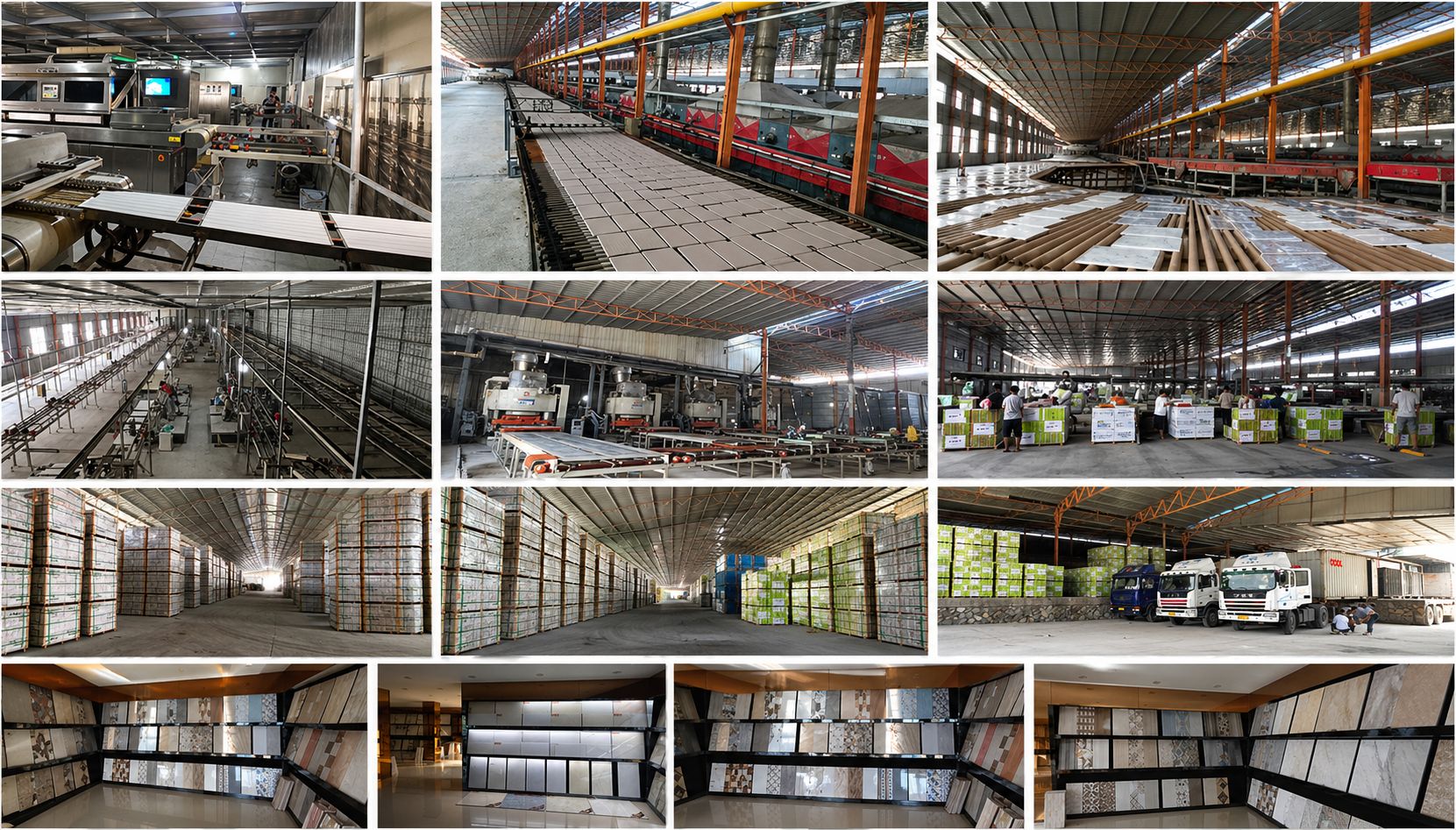
Before a single tile is boxed for export, the factory must reconcile the order against production capacity, raw material stock, and kiln scheduling. This is where the first layer of bureaucracy begins — internal, but critical:
- Production order confirmation — matched against the buyer’s technical specification (size, finish, PEI rating, shade batch).
- Quality control sign-off — each batch is inspected for calibration, warpage, and color consistency before packing.
- Packing list generation — every carton is logged with batch number, square meterage, and net/gross weight.
A single container of tile — often 20 to 24 tons — can represent hundreds of individual quality checkpoints before it ever leaves the factory gate.
Certification: The Paper Before the Product
For European buyers, certification is not optional. Tile entering the EU market generally requires:
- CE Marking under the Construction Products Regulation (CPR), confirming the product meets harmonized European standards (EN 14411 for ceramic tiles).
- Declaration of Performance (DoP), which must accompany CE-marked products and details technical characteristics such as slip resistance and water absorption.
- ISO certifications (commonly ISO 9001 for quality management, sometimes ISO 14001 for environmental management), which many developers require as part of procurement due diligence.
Without these documents in order, a shipment can clear the exporting country’s customs but still be refused entry — or worse, refused by the buyer’s own quality department — at the EU border.
From Factory Floor to Freight Forwarder
Choosing the Right Incoterm
One of the most consequential early decisions in any tile export deal is the Incoterm — the internationally recognized rule that defines who is responsible for what, and when.
- EXW (Ex Works) — the buyer takes on nearly all responsibility, including export clearance. Common for experienced importers with their own logistics network.
- FOB (Free on Board) — the exporter handles everything up to loading the goods onto the vessel; the buyer takes over from there. This is the most common arrangement in tile exports.
- CIF (Cost, Insurance, Freight) — the exporter arranges and pays for shipping and insurance to the destination port, simplifying logistics for the buyer but often at a premium.
For European developers new to direct sourcing, CIF or CFR terms are often the safer starting point, since they shift much of the coordination burden — and the associated paperwork risk — onto the exporter.
The Freight Forwarder’s Role
Once the Incoterm is agreed, a freight forwarder becomes the exporter’s logistics partner, and, indirectly, the buyer’s guarantee of a smooth handover. Their responsibilities typically include:
- Booking container space with the shipping line
- Coordinating container delivery to the factory for loading (or arranging a bonded warehouse for consolidation)
- Preparing the bill of lading, the single most important shipping document in the entire transaction
- Managing customs brokerage on the export side
A good forwarder is worth more than their fee suggests. A poor one can turn a routine shipment into a demurrage bill that erodes the developer’s margin before the tile even reaches European soil.
The Export Customs Process, Step by Step
- Export Declaration
Before goods can leave the country of origin, the exporter (or their customs broker) must file an export declaration, which typically includes:
- Commercial invoice
- Packing list
- HS code classification (ceramic tiles generally fall under HS heading 6907 or 6908)
- Certificate of origin
Misclassifying the HS code is one of the most common — and costly — mistakes in tile export. It can trigger incorrect duty assessments on the receiving end, delays, or even penalties.
- Inspection and Pre-Shipment Verification
Depending on the exporting country’s regulations and the buyer’s requirements, a shipment may be subject to:
- Pre-shipment inspection (PSI) by an independent third party, verifying quantity and quality against the purchase order
- Customs physical inspection, particularly for high-value or first-time shipments
- Fumigation certification for wooden pallets, required under ISPM 15 standards for entry into the EU
Any of these steps can add several days to the timeline, which is why experienced exporters build inspection windows directly into their production schedule rather than treating them as an afterthought.
- Container Loading and Sealing
Once cleared, the container is loaded — often by hand, tile being a weight-sensitive and breakage-prone cargo — and sealed with a unique security seal number, which is recorded on the bill of lading. From this point, the container’s chain of custody becomes a legal matter, not just a logistical one.
- Port Handling and Vessel Booking
The container moves to the port of departure, where it enters the terminal system, awaits vessel arrival, and is loaded according to the shipping line’s schedule. Port congestion — a recurring issue in several major exporting regions — is one of the least predictable variables in the entire process, and one that developers should factor into their contingency planning.
What Happens at the European Port of Entry
Import Declaration and EU Customs Clearance
On arrival at a European port, the importer (or their customs agent) files an import declaration through the relevant national customs system, which is now integrated with the EU’s harmonized framework. Key requirements include:
- Commercial invoice and packing list matching the original export documents
- Bill of lading (original or telex release, depending on payment terms)
- CE Declaration of Performance
- Certificate of origin, particularly relevant for preferential tariff treatment under trade agreements
Duties, VAT, and Hidden Costs
European developers budgeting for imported tile should account for:
- Import duty, which varies depending on the country of origin and any applicable trade agreements
- Import VAT, charged at the standard rate of the destination country
- Port handling and terminal fees
- Demurrage and detention charges if the container is not cleared and returned within the free time window — often the single largest unplanned cost in the entire chain
A container held at port for even five extra days due to a documentation discrepancy can generate charges that erase the savings from sourcing directly rather than through a local distributor.
Common Reasons for Customs Delays
From an exporter’s vantage point, the most frequent causes of delay at the European end are entirely preventable:
- Mismatched values between the commercial invoice and the declared customs value
- Missing or expired CE documentation
- Incomplete or incorrect HS code alignment between origin and destination declarations
- Discrepancies between the packing list and the actual container contents
Developers working with a supplier for the first time should request copies of all export documents in advance — not after the container has sailed — so that any inconsistency can be corrected before it becomes a costly delay at the destination port.
Practical Advice for European Developers Sourcing Tile Directly
Build Realistic Timelines
A commonly quoted “4-6 week” lead time often refers only to production and shipping — not the full door-to-site timeline once customs, inland transport, and site delivery windows are included. A more realistic planning figure is ۶ to 10 weeks from order confirmation to on-site delivery, depending on origin and destination.
Vet the Documentation, Not Just the Product Samples
A beautiful showroom sample means little if the accompanying paperwork isn’t in order. Before finalizing a supplier relationship, request:
- A sample CE Declaration of Performance for the specific product line
- Confirmation of ISO certification status
- A reference export shipment with documentation the developer’s own customs broker can review
Work With a Customs Broker on the European Side
Even developers who are confident in their supplier relationship benefit from an independent European customs broker who represents the buyer’s interests exclusively — catching discrepancies before they become delays, and advising on duty optimization where trade agreements apply.
Factor in Container Consolidation for Smaller Orders
For projects that don’t require a full 20- or 40-foot container, consolidation (LCL — Less than Container Load) shipping is an option, though it typically extends transit time and adds handling risk. For recurring, predictable demand across multiple projects, negotiating a standing full-container schedule with a supplier is usually more cost-effective in the long run.
Conclusion
Behind every pallet of tile on a European job site lies a process built from dozens of certificates, inspections, and signatures — a system that, when understood, becomes a source of leverage rather than frustration. For developers who take the time to learn how tile export bureaucracy and customs actually work, sourcing directly from the factory stops being a gamble and starts being a genuine competitive advantage in project cost and quality control.
If your development pipeline includes upcoming projects that depend on imported tile, now is the time to review your supplier’s documentation practices and confirm your customs broker relationship is in place — well before the container is sealed and on its way to port.


نظرات ۰