

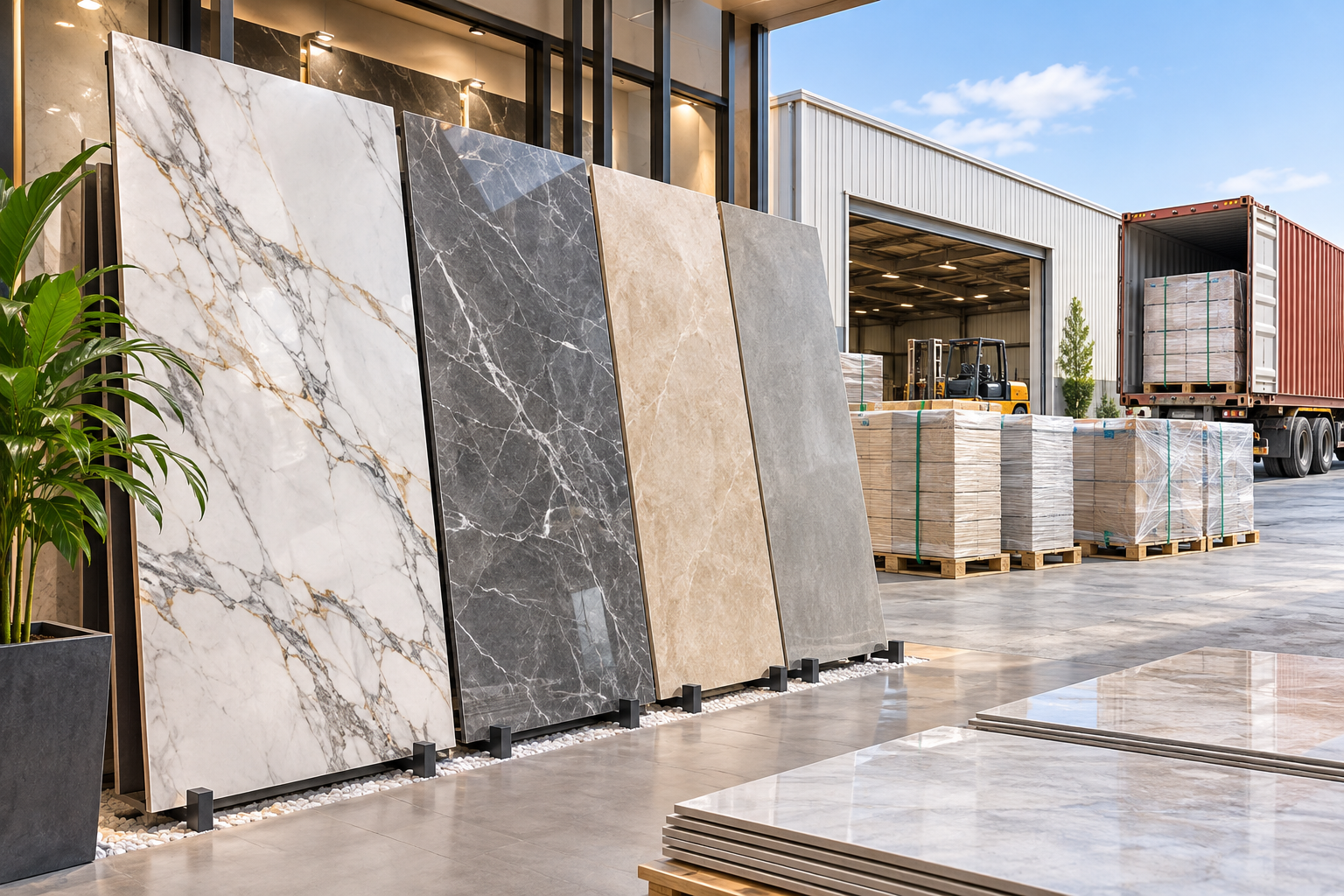


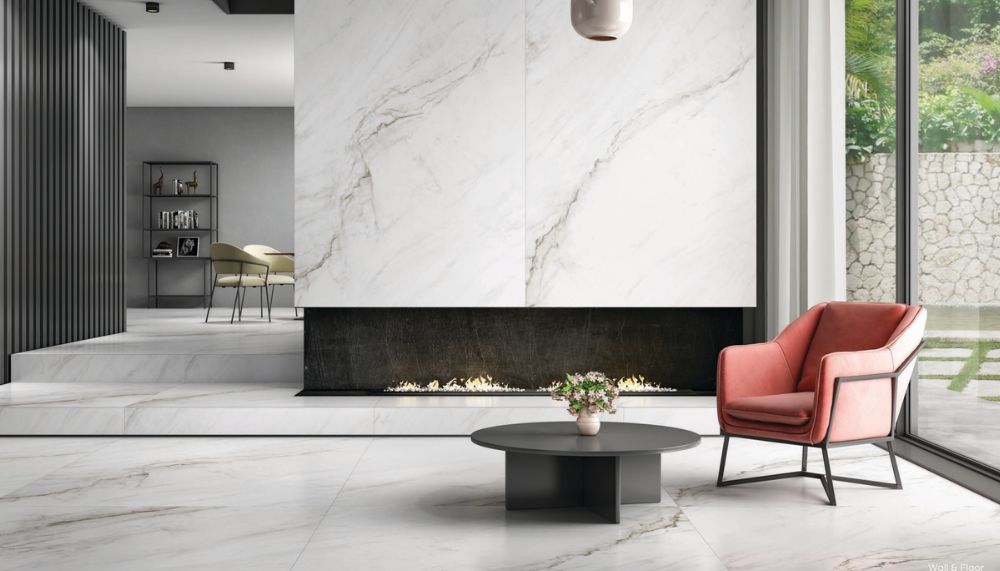

Not every porcelain tile meets international export standards. Discover how to evaluate porcelain tile quality, water absorption, dimensions, strength, certifications, surface finish, and slab tile performance before choosing a reliable supplier for European and global markets.
Why Is Not Every Porcelain Tile Suitable for Export?
Imagine ordering an entire container of porcelain tiles for a commercial project in Europe. The supplier offers competitive prices, attractive designs, and impressive product photographs. The samples look perfect, and the production schedule seems reasonable.
However, after the shipment arrives, problems begin to appear. Some tiles have inconsistent dimensions. Others show differences in shade, surface defects, or unexpected water absorption. Installation becomes more difficult, and the buyer faces additional costs, project delays, and potential complaints.
This situation highlights an important reality in the international ceramic industry: producing porcelain tiles and manufacturing export-ready porcelain tiles are two different things.
Porcelain tile is widely used in residential, commercial, and industrial construction because of its durability, low water absorption, and design flexibility. However, these characteristics alone do not guarantee that a product meets the technical requirements of international buyers.
European importers, distributors, architects, contractors, and construction companies evaluate much more than appearance and price. They consider dimensional accuracy, mechanical performance, technical documentation, production consistency, packaging quality, and compliance with applicable standards.
The same principle applies to slab tile products. Large-format porcelain slabs offer significant opportunities in modern architecture and interior design, but their production requires greater control over flatness, thickness, handling, transportation, and dimensional stability.
For manufacturers and exporters, understanding these requirements is essential to competing in international markets. For importers, knowing how to identify potential quality problems before placing an order can prevent expensive mistakes.
This guide explains how to distinguish ordinary porcelain products from genuinely export-ready materials. It covers the most important technical specifications, international standards, inspection procedures, documentation requirements, and supplier evaluation criteria.
Whether you are sourcing porcelain tile for a distribution business or selecting slab tile for a large architectural project, you will learn what to check before making a purchasing decision.

۱. What Does Export-Ready Porcelain Tile Really Mean?
The term export-ready porcelain tile is often used in international ceramic trade. However, not every manufacturer uses it with the same meaning.
Some suppliers consider a product export-ready when it has attractive packaging and meets the buyer’s requested dimensions. Others use the term to describe products that have undergone laboratory testing, comply with recognized technical standards, and maintain consistent quality during mass production.
For professional buyers, the second definition is much more important.
An export-ready product must satisfy three interconnected requirements:
-
Technical quality: The tile must achieve the physical and mechanical performance required for its intended application.
-
Regulatory compliance: The product must meet applicable standards and legal requirements in the destination market.
-
Commercial reliability: The manufacturer must consistently deliver the agreed specifications, quantities, packaging, and documentation.
A product can perform well in one category but fail in another. For example, a tile may have excellent water absorption results but inconsistent dimensions. Another product may pass laboratory tests but arrive with damaged corners because of inadequate packaging.
Both situations can create serious commercial problems.
Export Quality vs. Ordinary Commercial Quality
Understanding the difference between ordinary commercial quality and export-ready quality helps buyers evaluate suppliers more accurately.
| Evaluation factor | Ordinary commercial supply | Export-ready supply |
|---|---|---|
| Dimensions | May show wider variation | Controlled dimensional tolerances |
| Water absorption | May be unverified | Supported by test results |
| Surface quality | Visual inspection may be limited | Defined inspection criteria |
| Mechanical strength | Not always documented | Tested according to requirements |
| Shade consistency | May vary between batches | Controlled shade classification |
| Packaging | Basic domestic packaging | Designed for international transport |
| Documentation | Limited product information | Complete technical documentation |
| Quality control | May be inconsistent | Documented production controls |
These differences do not mean that every domestic product is inferior. A tile manufactured for a domestic market can also meet demanding international specifications.
The important point is that export suitability must be demonstrated rather than assumed.
Why Is Export Readiness Important for International Buyers?
International tile buyers often operate within complex supply chains. A distributor may purchase several containers and distribute them to different retailers. A contractor may need thousands of square metres of identical tiles for one construction project.
In both cases, product inconsistency creates financial risks.
Consider a distributor importing 10,000 square metres of porcelain flooring. If a small percentage of the shipment contains dimensional defects, shade differences, or damaged pieces, the consequences may extend beyond replacing individual tiles.
Potential costs include:
-
Additional sorting and inspection expenses.
-
Installation delays.
-
Increased transportation and replacement costs.
-
Customer complaints and reputational damage.
-
Disputes between manufacturers, importers, and distributors.
For this reason, professional importers should evaluate the complete manufacturing and export process, not simply the appearance of a sample.
What Makes Slab Tile Different?
Slab tile products require additional attention because of their large dimensions.
A conventional tile may be relatively easy to handle and inspect. A large porcelain slab, however, can be more vulnerable to bending stresses, edge damage, handling mistakes, and transportation problems.
A slab tile intended for countertops, wall cladding, or furniture applications must therefore be evaluated according to its thickness, dimensions, intended installation method, mechanical properties, and handling requirements.
A beautiful slab is not necessarily a technically suitable slab.
The difference between an attractive product and an export-ready product lies in measurable performance, reliable manufacturing, and documented quality.
۲. Water Absorption: The First Technical Test of Porcelain Tile Quality
Water absorption is one of the most important characteristics used to classify ceramic tiles.
It indicates how much water a tile can absorb relative to its dry mass. This characteristic provides useful information about the degree of vitrification and the internal structure of the ceramic body.
According to ISO 13006:2018, porcelain tiles are fully vitrified ceramic products with a water absorption coefficient of no more than 0.5% by mass. The standard classifies dry-pressed porcelain products in Group BIa.
Why Does Water Absorption Matter?
A ceramic tile with a more porous body can absorb more water. Depending on its intended application and environmental conditions, this may influence durability, moisture-related performance, and suitability for certain installations.
Low water absorption is particularly important when selecting porcelain products for demanding applications.
These include:
-
Bathroom and shower areas.
-
Kitchens and food preparation environments.
-
Outdoor flooring.
-
Commercial buildings.
-
Areas exposed to frequent cleaning.
-
Projects where moisture resistance is an important specification.
However, low water absorption does not automatically mean that a tile is suitable for every application. Slip resistance, chemical resistance, surface durability, and mechanical strength must also be considered.
How Is Water Absorption Measured?
The water absorption test is covered by ISO 10545-3:2018.
This standard describes procedures for determining water absorption, apparent porosity, apparent relative density, and bulk density. Its current edition was reviewed and confirmed by ISO in 2023.
The basic testing process involves:
-
Preparing and drying representative tile specimens.
-
Recording their dry mass.
-
Impregnating the specimens with water under controlled conditions.
-
Measuring the saturated mass.
-
Calculating the water absorption percentage.
For example, consider a dry tile specimen weighing 1,000 grams. If its water absorption is 0.4%, it absorbs approximately 4 grams of water relative to its dry mass.
This is an illustrative calculation, not a laboratory test result.
Understanding the BIa Classification
The following table provides a simplified overview of relevant water absorption classifications under ISO 13006.
| Classification | Water absorption | General description |
|---|---|---|
| BIa | E ≤ ۰.۵% | Dry-pressed porcelain tile |
| BIb | ۰.۵% < E ≤ ۳% | Low-absorption dry-pressed tile |
| BIIa | ۳% < E ≤ ۶% | Medium-absorption dry-pressed tile |
| BIIb | ۶% < E ≤ ۱۰% | Medium-absorption dry-pressed tile |
| BIII | E > 10% | High-absorption dry-pressed tile |
The distinction is important because the word porcelain should not be used simply as a marketing description.
A manufacturer claiming BIa classification should be able to provide test documentation supporting that claim.
What Should Buyers Ask Their Suppliers?
Before purchasing a container of porcelain tile, request:
-
The latest water absorption test report.
-
The testing standard and edition.
-
The laboratory’s identification and accreditation details.
-
The tested product name and production reference.
-
The date and identification of the tested sample.
One important point is often overlooked: a test report for one product does not automatically prove the performance of every product manufactured by the same factory.
Buyers should ensure that the report relates to the actual product, body composition, and production specification being purchased.
Is Low Water Absorption Enough to Guarantee Export Quality?
No.
A tile with 0.3% water absorption may still have poor dimensional accuracy, inadequate abrasion resistance, surface defects, or unsuitable slip performance.
Water absorption is a starting point, not a complete quality assessment.
Professional buyers should combine this test with other physical and mechanical evaluations before approving an order.
۳. Dimensional Accuracy and Flatness: Why Measurements Matter More Than Appearance
A porcelain tile can look flawless in a showroom but create installation problems when hundreds or thousands of pieces are placed together.
Dimensional accuracy is therefore one of the most important indicators of manufacturing consistency.
Even relatively small variations in length, width, thickness, or flatness can affect the final appearance of a tiled surface.
This issue becomes more important in contemporary architectural projects, where designers often prefer large formats, narrow grout joints, and continuous visual surfaces.
What Are the Main Dimensional Characteristics?
Professional inspection should consider several different measurements.
۱. Length and width
These measurements determine the actual dimensions of each tile.
A product sold as 60 × ۱۲۰ cm should be manufactured within the applicable dimensional tolerances for its declared work size.
۲. Thickness
Thickness variation can create uneven surfaces during installation.
This is particularly important for large commercial floors and applications where several materials meet.
۳. Straightness of sides
Straight edges are essential for consistent grout joints and accurate alignment.
۴. Rectangularity
A rectangular tile should maintain the correct relationship between its opposite sides and corners.
Poor rectangularity can make installation more difficult and produce visible alignment problems.
۵. Surface flatness
Flatness determines whether the tile surface remains within the permitted limits for its classification and dimensions.
Warping or excessive curvature can affect the final installation.
Which Standard Should Buyers Check?
ISO 10545-2:2018 specifies test methods for determining ceramic tile dimensions and surface quality.
Its measurement procedures cover:
-
Length and width.
-
Thickness.
-
Straightness of sides.
-
Rectangularity.
-
Surface flatness.
-
Surface quality.
ISO reviewed and confirmed this edition in 2024.
For buyers, this means that dimensional claims should be supported by measurements rather than visual inspection alone.
Why Is Calibration Important?
Modern tile factories use calibrated production equipment and inspection systems to maintain consistent product dimensions.
However, manufacturing equipment alone cannot guarantee quality.
The entire process must be controlled, including:
-
Pressing conditions.
-
Drying parameters.
-
Firing temperature.
-
Kiln operation.
-
Rectification.
-
Final sorting and grading.
For example, inconsistent firing conditions may cause variations in shrinkage. This can influence the final dimensions of the product.
Rectification is another important process.
A rectified tile undergoes mechanical edge finishing after firing. This process creates more precise edges and supports the use of narrower grout joints.
However, rectification does not eliminate the need for dimensional testing.
How Can Buyers Check Dimensional Quality?
A professional inspection should include samples selected from different boxes and, where possible, different parts of the production batch.
Useful equipment includes:
-
Digital calipers.
-
Precision measuring tools.
-
Straightedges.
-
Flatness measurement equipment.
-
A suitable reference surface.
The buyer should compare the measured results against the declared work size and the applicable product standard.
It is also important to check whether the manufacturer supplies calibrated products consistently across different production batches.
Why Is This Especially Important for Slab Tile?
Large-format slab tile requires greater attention to dimensional consistency.
A small deviation across a conventional tile may be relatively easy to manage. The same deviation across a large slab can become more noticeable.
For example, a large-format slab used for a kitchen island or continuous wall surface must meet the dimensional requirements of the fabrication and installation design.
Incorrect dimensions may lead to:
-
Additional cutting.
-
Material waste.
-
Uneven joints.
-
Difficult alignment.
-
Installation delays.
Therefore, slab manufacturers should provide clear dimensional specifications, thickness tolerances, and flatness information.
۴. Mechanical Strength and Durability: Can the Tile Handle Real-World Conditions?
One of the most common mistakes in tile purchasing is assuming that a hard surface is automatically a strong product.
Hardness, breaking strength, abrasion resistance, and impact performance are different characteristics.
A porcelain tile may resist scratching but still be vulnerable to fracture under concentrated loads or incorrect installation.
Export buyers should therefore understand which mechanical properties are relevant to the intended application.
Breaking Strength and Modulus of Rupture
Breaking strength measures the force required to break a tile under a specified test arrangement.
Modulus of rupture describes the tile’s resistance to bending stress.
These properties are particularly important for flooring applications, large-format tiles, and products that may experience mechanical loads.
ISO 10545-4:2019 specifies methods for determining the modulus of rupture and breaking strength of ceramic tiles. This edition was reviewed and confirmed in 2024.
For buyers, a laboratory report should identify the tested product, sample dimensions, measured results, and test method.
A supplier should not simply claim that a tile is strong without providing supporting information.
Abrasion Resistance: Important for Floor Tiles
Flooring products are exposed to repeated friction caused by footwear, furniture, cleaning equipment, and moving objects.
Over time, these activities can affect the appearance of a tile surface.
For glazed floor tiles, buyers commonly consider the applicable abrasion classification, including the PEI system.
For unglazed tiles, deep abrasion resistance is evaluated using ISO 10545-6.
This standard specifies a method for determining the resistance of unglazed ceramic tiles to deep abrasion. Its current edition was confirmed by ISO in 2026.
The correct evaluation depends on whether the product is glazed or unglazed.
Slip Resistance: A Critical Safety Consideration
A polished porcelain tile may look luxurious, but it is not automatically appropriate for every floor.
Slip resistance should be evaluated according to the intended environment and the relevant local requirements.
For example:
| Application | Important consideration |
|---|---|
| Residential living rooms | General floor performance and cleaning |
| Bathroom floors | Slip performance under wet conditions |
| Commercial entrances | Foot traffic and surface safety |
| Restaurant kitchens | Wet and contaminated conditions |
| Outdoor terraces | Weather exposure and slip performance |
| Public buildings | Application-specific safety requirements |
Different countries and project specifications may use different testing methods and classification systems.
Therefore, buyers should request the exact test method and results rather than relying on general descriptions such as anti-slip or non-slip.
Chemical and Stain Resistance
In commercial and industrial environments, tiles may come into contact with cleaning products, food substances, chemicals, and other contaminants.
Chemical resistance helps determine how well the surface maintains its properties after exposure to specified substances.
Stain resistance is also important, particularly for kitchens, restaurants, hospitals, and other high-use environments.
Relevant testing can be found within the ISO 10545 series, including:
-
ISO 10545-13 for chemical resistance.
-
ISO 10545-14 for resistance to stains.
The buyer should check which test levels are appropriate for the intended use.
Does Every Porcelain Tile Need the Same Mechanical Properties?
No.
A wall tile does not necessarily need the same mechanical performance as a heavy-duty commercial floor tile.
Likewise, a porcelain slab used for a decorative wall application has different performance priorities from one designed for a kitchen countertop.
The manufacturer should provide specifications that match the intended application.
This is why a technical data sheet must describe more than the product’s dimensions, colour, and thickness.
۵. Surface Quality, Shade Consistency, and Visual Inspection
Technical test results are essential, but appearance remains a major purchasing factor in the international porcelain tile market.
Distributors, architects, and construction companies expect products to maintain consistent visual characteristics throughout an order.
A single sample may look attractive, but the complete shipment must meet the same agreed appearance requirements.
This is particularly important for marble-look porcelain tiles, concrete-effect surfaces, stone-inspired designs, and large-format decorative products.
What Are the Most Common Surface Defects?
During quality inspection, buyers should look for several types of defects.
Pinholes: Small holes or imperfections on the glazed surface. They may affect the appearance of polished or glossy products.
Glaze defects: Uneven glaze distribution, bubbles, or visible irregularities that influence the final finish.
Surface scratches: Marks that may result from manufacturing, handling, or packaging.
Uneven polishing: Variations in gloss level or surface reflection across the tile.
Edge defects: Chipped corners, damaged edges, and irregular rectified sides.
Warping: Unwanted curvature that may influence installation and the visual continuity of the surface.
Printing defects: Incorrect digital patterns, blurred details, or inconsistencies in decorative printing.
Not every visible variation represents a manufacturing defect. Some products intentionally feature natural-looking variations to imitate marble, limestone, concrete, or other materials.
The important distinction is between the intended design variation and an uncontrolled production defect.
Why Are Shade and Tone Classification Important?
Ceramic manufacturers commonly organize products into shade groups or production batches.
These classifications help distributors identify tiles with similar visual characteristics.
For example, two boxes of the same marble-look porcelain tile may have slightly different tonal appearances because they were manufactured in different production batches.
This does not necessarily indicate poor quality. However, mixing different shade groups in one installation can create an undesirable result.
Professional exporters should provide clear information about:
-
Shade codes.
-
Calibre codes.
-
Production batch numbers.
-
Surface finish.
-
Visual variation classification.
-
Recommended installation procedures.
Buyers should ensure that the shipment contains the agreed shade and calibre wherever batch consistency is required.
Understanding V1, V2, V3, and V4 Visual Variation
Many tile manufacturers use a visual variation classification to communicate differences between individual pieces.
| Classification | General meaning |
|---|---|
| V1 | Very uniform appearance |
| V2 | Slight visual variation |
| V3 | Moderate visual variation |
| V4 | Substantial variation between pieces |
These categories help buyers understand the intended appearance of a collection.
For example, a marble-effect collection with V3 variation may contain noticeable differences in veining and colour between individual tiles.
This can create a more natural appearance.
However, buyers should always inspect the actual product samples because visual variation labels do not replace physical approval.
How Should Buyers Inspect Surface Quality?
A practical inspection procedure should include the following steps:
-
Select samples from several different boxes.
-
Clean the surface before inspection.
-
Examine the tiles under suitable lighting.
-
Compare colours and patterns with the approved reference sample.
-
Check edges and corners for visible damage.
-
Inspect the surface from different viewing angles.
-
Record acceptable and unacceptable defects.
-
Photograph representative samples for documentation.
Lighting conditions matter.
A polished tile may appear different under warm showroom lighting compared with natural daylight.
For this reason, final product approval should use agreed inspection conditions.
Why Is Visual Consistency Important for Large Slabs?
The importance of visual quality increases when dealing with large porcelain slabs.
A slab may contain continuous marble-inspired veins, large decorative patterns, or carefully designed surface textures.
If the digital printing process is inconsistent, the final installation may not achieve the intended architectural appearance.
For example, a project using several slabs for a continuous feature wall may require coordinated patterns and vein matching.
The buyer should therefore request:
-
Full-size product photographs.
-
Images of actual production slabs.
-
Available pattern variations.
-
Technical information about surface finishes.
-
Details of book-matching or vein-matching options, where offered.
A small sample cannot always communicate the complete appearance of a large slab.
For high-value projects, inspecting a full-size slab or an approved production sample is a safer approach.
۶. Slab Tile Quality: What Makes Large-Format Porcelain Different?
Large-format porcelain slabs have become an important product category in contemporary architecture and interior design.
They are used for kitchen countertops, bathroom walls, decorative panels, furniture surfaces, commercial interiors, and other architectural applications.
Their appeal comes from their ability to create large, visually continuous surfaces with fewer joints.
However, manufacturing export-ready slab tile products involves additional technical challenges.
A large slab is not simply a conventional tile manufactured in a bigger size.
Its dimensions, thickness, handling requirements, and intended application influence the entire quality-control process.
۶.۱. Thickness and Dimensional Stability
Thickness is one of the first characteristics buyers should examine when sourcing slab tile products.
Common large-format products are available in different thicknesses, depending on the manufacturer and application.
For example, some slabs are designed for vertical wall cladding, while others are manufactured for heavier-duty surfaces.
A thin slab may be appropriate for certain wall applications but unsuitable for a countertop without an appropriate support system and installation design.
Buyers should request:
-
Nominal thickness.
-
Actual measured thickness.
-
Thickness tolerance.
-
Maximum production dimensions.
-
Flatness specifications.
-
Intended application.
The same product should not automatically be recommended for every surface.
۶.۲. Resistance to Handling and Transportation
Large slabs require specialized handling equipment and suitable packaging.
Their dimensions make them more difficult to move than conventional porcelain tiles.
Even a high-quality slab can crack if it is incorrectly supported, lifted, or secured during transportation.
Potential causes of damage include:
-
Incorrect lifting points.
-
Uneven support.
-
Excessive vibration.
-
Poorly designed transport frames.
-
Inadequate protection at the edges.
-
Incorrect loading and unloading procedures.
A professional manufacturer should explain the recommended handling system and provide appropriate packaging specifications.
۶.۳. Edge Quality and Cutting Performance
Slab tile products are frequently cut into customized shapes and dimensions.
They may be fabricated for:
-
Kitchen countertops.
-
Bathroom vanities.
-
Staircases.
-
Wall panels.
-
Furniture components.
-
Decorative architectural elements.
For these applications, edge quality is particularly important.
Poorly controlled slab production may result in uneven thickness, internal weaknesses, or edge defects that become more visible during cutting.
Buyers should request information about recommended cutting tools, fabrication methods, minimum edge requirements, and suitable installation procedures.
It is also important to clarify whether the product is supplied with finished edges or requires additional fabrication.
۶.۴. Surface Finish and Functional Performance
Large slabs are available in several finishes, including:
-
Polished.
-
Matt.
-
Satin.
-
Honed.
-
Textured.
-
Structured.
Each finish offers different aesthetic and functional characteristics.
A polished slab may be attractive for a luxury kitchen island or decorative wall. A textured surface may be more appropriate for applications requiring specific slip characteristics.
The finish must therefore be selected according to the intended use.
Buyers should not assume that a product suitable for wall decoration is automatically appropriate for flooring or countertops.
۶.۵. Pattern Continuity and Digital Printing
Modern digital printing technologies allow manufacturers to reproduce detailed stone, marble, and concrete-inspired designs.
For large-format products, print quality becomes an important competitive advantage.
However, the design should remain consistent across different slabs.
Manufacturers should provide information about:
-
Number of available faces or patterns.
-
Digital printing technology.
-
Pattern repeat.
-
Vein direction.
-
Book-matching possibilities.
-
Surface texture coordination.
These characteristics influence the final appearance of architectural projects.
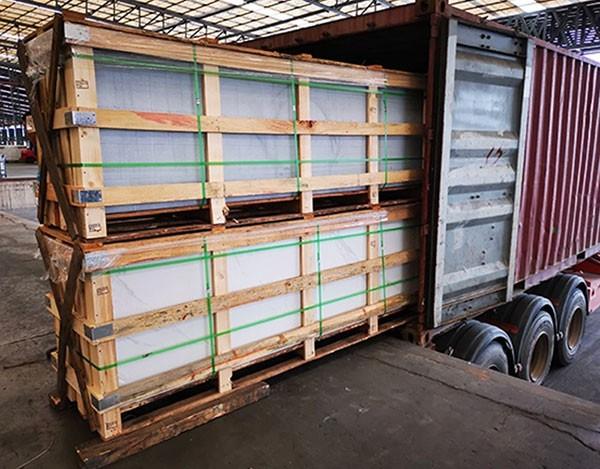
۶.۶. Packaging and Export Logistics for Slabs
Packaging is one of the most underestimated aspects of slab tile exports.
Large slabs cannot always be packed using conventional carton-based systems.
They often require reinforced frames, suitable protective materials, and secure positioning during transportation.
The packaging system should be designed to reduce movement and protect vulnerable edges.
Before approving an order, ask the supplier:
-
What type of slab frame is used?
-
How many slabs are packed in each frame?
-
How are the edges protected?
-
Is the packaging suitable for the intended transport route?
-
What loading equipment is required?
-
How is the shipment inspected before dispatch?
For international buyers, the answers are just as important as the slab’s technical specifications.
۷. International Standards and Certifications: What Should Exporters Know in 2026?
Compliance with technical standards is one of the most important factors when entering international ceramic tile markets.
However, buyers should understand that international standards, product certifications, laboratory reports, and regulatory approvals are not interchangeable.
Each serves a different purpose.
For companies exporting porcelain tile to Europe, understanding the applicable regulatory framework is especially important.
ISO 13006: The Main International Classification Reference
ISO 13006:2018 establishes definitions, classifications, characteristics, and marking requirements for ceramic tiles.
It provides a common technical framework for classifying products according to manufacturing methods and water absorption characteristics.
The standard also refers to the ISO 10545 series for testing procedures.
The current edition was reviewed and confirmed by ISO in 2024.
For manufacturers, this standard is useful when defining product specifications.
For importers, it provides a basis for comparing products from different suppliers.
Understanding the ISO 10545 Test Series
The ISO 10545 series contains several test methods used to evaluate ceramic tile characteristics.
Some of the most relevant parts include:
| Standard | Property evaluated |
|---|---|
| ISO 10545-2 | Dimensions and surface quality |
| ISO 10545-3 | Water absorption and density |
| ISO 10545-4 | Breaking strength and modulus of rupture |
| ISO 10545-6 | Deep abrasion resistance of unglazed tiles |
| ISO 10545-13 | Chemical resistance |
| ISO 10545-14 | Resistance to stains |
| ISO 10545-23:2025 | Elastic modulus |
An important recent development is ISO 10545-23:2025, published in July 2025.
It introduces a test method for determining the elastic modulus of glazed and unglazed ceramic tiles, including the substrate and glaze layer, using three-point bending tests.
This development reflects the continued expansion of technical testing methods for ceramic materials.
However, not every test is mandatory for every product. The appropriate tests depend on the product classification, application, and buyer’s specifications.
What Is EN 14411?
EN 14411 is an important European standard for ceramic tiles.
It provides classification, characteristics, and marking requirements for products within its applicable scope.
Manufacturers and exporters targeting European markets should verify the current harmonized technical specification and the relevant requirements for their specific product.
It is important to distinguish between a product meeting an ISO test requirement and fulfilling all applicable European regulatory obligations.
A laboratory report alone does not automatically establish regulatory compliance.
CE Marking: What Does It Actually Mean?
CE marking is particularly relevant to construction products placed on the European market.
It indicates that a product has been assessed under the applicable EU harmonized technical framework and that the manufacturer has taken responsibility for its declared performance and relevant conformity obligations.
The European Commission explains that CE marking is linked to the applicable harmonized technical specification or a European Technical Assessment, where relevant.
Buyers should therefore avoid assuming that every imported ceramic product needs exactly the same CE documentation.
The requirement depends on the applicable regulatory framework and product category.
Important Regulatory Changes: The New EU Construction Products Regulation
An important development for the European construction materials industry is Regulation (EU) 2024/3110.
The regulation entered into force on 7 January 2025, and its main provisions became applicable from 8 January 2026.
However, implementation is phased, and the transition depends on the availability and application of new harmonized technical specifications for individual product families.
Internal Market & SMEs+2
The new framework introduces changes involving:
-
Product performance and conformity information.
-
Environmental characteristics.
-
Digital product information.
-
Market surveillance.
-
Responsibilities of economic operators.
Under the new regulation, the Declaration of Performance and Conformity (DoPC) replaces the former Declaration of Performance (DoP) when the new framework applies to the relevant product.
Digital Product Passports are also part of the regulation’s longer-term direction, with implementation linked to the applicable delegated acts and product requirements.
For porcelain tile manufacturers, this means regulatory monitoring should become an ongoing business activity rather than a one-time certification exercise.
Important for exporters: The new regulation does not mean that every ceramic tile automatically needs a Digital Product Passport or a new DoPC on the same date. Manufacturers should verify the applicable harmonized specification, transition arrangements, and obligations for their particular product.
What Documentation Should an Exporter Prepare?
Depending on the destination market and product requirements, an export documentation package may include:
-
Product technical data sheet.
-
Relevant laboratory test reports.
-
Applicable Declaration of Performance or DoPC.
-
CE marking information, where legally required.
-
Product identification and batch information.
-
Safety and handling instructions, where applicable.
-
Packaging and transportation specifications.
-
Commercial invoice and packing list.
-
Country-of-origin and customs documentation.
For Iranian exporters targeting European customers, there may also be additional trade, customs, banking, and sanctions-related restrictions.
These issues should be checked separately with qualified customs and legal professionals before concluding a transaction.
Technical quality is necessary, but it does not by itself guarantee that a particular commercial transaction is legally or financially feasible.
۸. How to Evaluate a Porcelain Tile Manufacturer Before Placing an Export Order
Choosing the right manufacturer is just as important as selecting the right product.
A supplier may offer attractive prices and impressive catalogues, but buyers need evidence of manufacturing capability, quality control, and export experience.
This is particularly important when purchasing large quantities or developing a long-term distribution relationship.
A professional supplier should be able to explain how products are manufactured, tested, inspected, packaged, and prepared for shipment.
۸.۱. Examine the Manufacturer’s Production Capacity
Production capacity determines whether a supplier can meet the buyer’s quantity and delivery requirements.
However, the highest production capacity does not necessarily indicate the best supplier.
Buyers should examine:
-
Monthly and annual production capacity.
-
Available production lines.
-
Manufacturing technology.
-
Available tile dimensions.
-
Available thicknesses.
-
Digital printing capabilities.
-
Rectification and polishing facilities.
-
Production planning and lead times.
For example, a manufacturer may have sufficient capacity to produce conventional porcelain tiles but limited capabilities for large-format slab production.
The buyer should confirm that the factory can manufacture the exact product required.
۸.۲. Evaluate the Factory’s Quality Control System
A reliable manufacturer should have a documented quality management process.
Quality control should not begin only after production has finished.
It should cover the entire manufacturing process, from raw material preparation to final packaging.
A typical quality-control system includes:
| Production stage | Quality-control activity |
|---|---|
| Raw material preparation | Composition and material consistency |
| Powder preparation | Moisture and particle-size control |
| Pressing | Pressure and forming consistency |
| Drying | Moisture and dimensional control |
| Firing | Temperature and firing-cycle monitoring |
| Glazing and printing | Surface and decorative inspection |
| Rectification | Dimensional and edge inspection |
| Final sorting | Shade, calibre, and defect classification |
| Packaging | Quantity and physical protection checks |
This approach helps manufacturers identify potential problems before defective products reach the export warehouse.
۸.۳. Request Samples from Actual Production
A showroom sample is useful for understanding a product’s appearance.
However, it may not represent the quality of a large production order.
The best approach is to request samples from actual production batches whenever possible.
Buyers should compare the samples with the approved reference in terms of:
-
Dimensions.
-
Thickness.
-
Colour.
-
Surface finish.
-
Pattern.
-
Edge quality.
-
Technical specifications.
For large projects, an approved production sample should become part of the purchasing agreement.
۸.۴. Check Previous Export Experience
Previous export experience can provide useful information about a manufacturer’s ability to manage international orders.
Ask the supplier:
-
Which countries has the company supplied?
-
Does it have experience with European distributors?
-
Can it provide references from previous customers?
-
What types of packaging does it use?
-
How does it manage export inspections?
-
Can it provide the required technical documents?
Previous export experience does not automatically guarantee product quality.
Nevertheless, it can indicate whether the manufacturer understands international purchasing procedures and logistics requirements.
۸.۵. Evaluate Communication and Technical Support
Communication is often overlooked during supplier selection.
However, it becomes extremely important when technical problems or production changes occur.
A reliable supplier should be able to respond clearly to questions about product specifications, packaging, test results, production schedules, and claims procedures.
The sales team should also understand the products it offers.
If a supplier cannot explain the difference between water absorption, breaking strength, and surface abrasion, buyers should request clarification from its technical department.
۸.۶. Conduct a Pre-Shipment Inspection
A pre-shipment inspection provides an opportunity to verify the goods before they leave the factory.
It is particularly useful for large-volume orders and products with specific contractual requirements.
An inspection may cover:
-
Product dimensions.
-
Surface appearance.
-
Shade and calibre consistency.
-
Packaging condition.
-
Carton labels.
-
Product quantity.
-
Pallet or frame condition.
-
Loading arrangements.
For slab tile shipments, inspection should also consider frame stability, edge protection, and suitable loading equipment.
An independent inspection company may be useful when the buyer cannot visit the factory personally.
۸.۷. Use a Written Quality Agreement
One of the most effective ways to reduce disputes is to establish a written quality agreement before production begins.
The agreement should identify:
-
Product name and reference.
-
Dimensions and thickness.
-
Technical specifications.
-
Surface finish.
-
Shade and calibre requirements.
-
Applicable testing methods.
-
Acceptable visual defects.
-
Packaging specifications.
-
Inspection procedures.
-
Delivery schedule.
-
Procedures for handling non-conforming products.
This document creates a clear reference for both the manufacturer and the buyer.
It also reduces the risk of misunderstandings caused by vague descriptions such as premium quality or first-class porcelain.
۹. Common Mistakes Buyers Make When Sourcing Export-Ready Porcelain Tiles
Even experienced importers can make mistakes when evaluating porcelain tile suppliers.
Many problems occur because purchasing decisions are based on incomplete information.
Understanding these mistakes can help buyers protect their investment and establish more reliable supply relationships.
Mistake 1: Choosing a Supplier Based Only on Price
Price is an important factor in international trade.
However, the lowest quotation does not necessarily represent the lowest total purchasing cost.
A cheap tile may have inconsistent dimensions, insufficient packaging, or limited technical documentation.
These problems can generate additional expenses after arrival.
Buyers should compare the complete commercial offer, including product quality, freight arrangements, packaging, inspection, and potential replacement costs.
Mistake 2: Trusting Product Photographs Without Inspecting Samples
Professional product photography can make almost any tile collection look attractive.
However, photographs cannot demonstrate actual water absorption, mechanical strength, surface durability, or dimensional accuracy.
Always request physical samples and supporting technical documents.
For slab tile, consider requesting a full-size sample or production photographs showing the entire surface.
Mistake 3: Assuming All Porcelain Tiles Have the Same Performance
Two products may both be classified as porcelain tiles but have different characteristics.
Their suitability depends on several factors, including:
-
Thickness.
-
Breaking strength.
-
Surface finish.
-
Abrasion resistance.
-
Chemical resistance.
-
Slip performance.
-
Intended installation environment.
A porcelain product suitable for a residential wall may not be the best choice for a busy commercial floor.
Mistake 4: Ignoring Shade and Calibre Differences
Shade and calibre variation can create problems during installation.
Even when the product reference is identical, different production batches may have different visual or dimensional characteristics.
Buyers should specify the required shade and calibre in the purchase agreement and check them before shipment.
Mistake 5: Overlooking Packaging Quality
Packaging is not simply a way to make products look professional.
It is part of the product protection system.
Incorrect packaging may lead to broken tiles, damaged corners, and costly replacement claims.
This issue becomes particularly important when transporting large-format porcelain slabs.
Mistake 6: Accepting Incomplete Technical Documentation
A product catalogue is not a substitute for a technical data sheet or laboratory report.
Professional buyers should request the documents that demonstrate the product’s actual performance.
They should also check whether the documents identify the same product, dimensions, finish, and production specification being purchased.
Mistake 7: Failing to Define the Intended Application
Not every porcelain tile is designed for every environment.
Before selecting a product, buyers should explain whether it will be used for:
-
Interior flooring.
-
Exterior flooring.
-
Bathroom walls.
-
Shower areas.
-
Kitchen countertops.
-
Commercial spaces.
-
Decorative wall cladding.
This information helps the manufacturer recommend an appropriate product.
Mistake 8: Ignoring After-Sales Responsibilities
International shipments involve multiple parties.
When a problem occurs, the buyer needs a clear process for reporting defects, documenting damage, and requesting corrective action.
Before ordering, clarify:
-
The claim submission deadline.
-
Required photographs and inspection reports.
-
Responsibilities for transportation damage.
-
Replacement or credit procedures.
-
The manufacturer’s response time.
A reliable supplier should be willing to discuss these matters before receiving the order.
۱۰. The Future of Export-Ready Porcelain Tile: What Will Matter Between 2026 and 2028?
The international ceramic industry is evolving.
Manufacturers are facing increasing expectations concerning product quality, technological innovation, sustainability, and transparency.
Between 2026 and 2028, several developments are likely to influence how buyers evaluate export-ready porcelain tile products.
These are market and technology trends rather than guaranteed forecasts.
۱۰.۱. Greater Importance of Digital Quality Control
Digital inspection technologies are becoming increasingly relevant to modern ceramic manufacturing.
Automated systems can help identify surface defects, dimensional variations, and printing inconsistencies.
Machine vision and artificial intelligence can support quality inspection by analyzing product images and identifying irregularities that may be difficult to detect manually.
These systems can improve:
-
Surface defect identification.
-
Shade classification.
-
Production monitoring.
-
Sorting accuracy.
-
Quality reporting.
However, automated inspection should complement, not replace, appropriate laboratory testing.
۱۰.۲. Increasing Demand for Large-Format Porcelain Slabs
Architectural trends continue to create opportunities for large-format porcelain products.
Designers and developers use slabs to create continuous surfaces with fewer visible joints.
Applications include:
-
Kitchen islands.
-
Bathroom walls.
-
Large commercial interiors.
-
Reception areas.
-
Decorative furniture.
-
Architectural cladding.
For manufacturers, this creates opportunities to compete through advanced production technology, design quality, and specialized fabrication support.
However, large-format production also requires investment in quality control, handling equipment, and protective packaging.
۱۰.۳. Sustainability and Environmental Transparency
Environmental performance is becoming increasingly important in the European construction industry.
The revised Construction Products Regulation introduces a stronger framework for environmental product information and sustainability-related characteristics.
Manufacturers should therefore pay greater attention to:
-
Energy consumption.
-
Water management.
-
Raw material efficiency.
-
Production waste.
-
Recycled material use.
-
Carbon emissions.
-
Environmental documentation.
The new EU framework provides a direction for more transparent construction product information, although specific obligations depend on the relevant product requirements and implementation timetable.
For porcelain tile manufacturers, environmental performance may become an increasingly important competitive factor alongside conventional technical quality.
۱۰.۴. More Specialized Product Specifications
International buyers are becoming more focused on application-specific product performance.
Instead of simply purchasing a 60 × ۱۲۰ cm porcelain tile, they may require a product with defined abrasion resistance, slip characteristics, thickness, and technical documentation.
The same development applies to slab tile.
Countertop manufacturers, furniture producers, and architectural contractors may require different specifications even when purchasing products from the same factory.
This creates an opportunity for manufacturers that can offer flexible production and reliable technical support.
۱۰.۵. Documentation as a Competitive Advantage
In the past, some exporters focused mainly on price, appearance, and delivery.
However, professional buyers increasingly need accurate product information to support technical approvals, project specifications, and regulatory procedures.
A manufacturer that provides clear technical data sheets, reliable laboratory results, traceable production batches, and complete export documentation can establish greater confidence among international customers.
In this environment, documentation is no longer just administrative work.
It is part of the product’s commercial value.
What Should Manufacturers Do Now?
Companies that want to strengthen their position in international markets should consider five priorities:
-
Invest in consistent production and laboratory testing.
-
Develop application-specific porcelain and slab tile collections.
-
Improve digital inspection and production traceability.
-
Monitor changes in European product regulations.
-
Strengthen packaging, technical support, and export documentation.
Manufacturers that combine these capabilities will be better positioned to meet the expectations of demanding international buyers.
۱۱. Practical Export-Readiness Checklist: What to Verify Before Purchasing
After examining technical specifications, standards, and supplier capabilities, buyers need a practical method for evaluating a product.
The following checklist can be used when comparing different porcelain tile manufacturers.
Product and Technical Specifications
Appearance and Manufacturing Quality
Slab Tile Requirements
Export and Regulatory Documentation
Supplier Evaluation
A practical recommendation: Do not approve a large-volume purchase until the product specifications, approved sample, technical documentation, and inspection criteria are consistent with one another.
۱۲. Frequently Asked Questions About Export-Ready Porcelain Tiles
۱. How Can You Tell If a Porcelain Tile Is Suitable for Export?
Start by checking its technical specifications, water absorption, dimensional accuracy, mechanical performance, surface quality, and applicable regulatory requirements.
Request laboratory test reports and compare them with the actual product being purchased.
Also evaluate the manufacturer’s quality-control system and export packaging.
A product should be considered export-ready only when its technical performance, documentation, and commercial requirements match the destination market.
۲. What Is the Acceptable Water Absorption Rate for Porcelain Tiles?
According to ISO 13006:2018, porcelain tiles belong to the BIa or AIa classifications, with water absorption of no more than 0.5% by mass.
The water absorption test is performed according to ISO 10545-3.
However, water absorption alone does not determine whether a tile is suitable for every application.
۳. Are All Porcelain Slabs Suitable for Kitchen Countertops?
No.
Kitchen countertops require products with suitable mechanical performance, thickness, surface characteristics, and fabrication properties.
Buyers should also consider heat exposure, stain resistance, chemical resistance, edge fabrication, and the installation system.
A slab manufactured for decorative wall cladding should not automatically be considered suitable for countertop applications.
۴. What Documents Should a Porcelain Tile Exporter Provide?
Depending on the product and destination market, buyers may request:
-
Product technical data sheets.
-
ISO-related laboratory test reports.
-
Water absorption test results.
-
Dimensional inspection reports.
-
Mechanical performance reports.
-
Applicable CE and Declaration of Performance documentation.
-
Product identification and packaging information.
-
Commercial and customs documents.
The exact documentation depends on the destination country’s regulations and the intended product application.
۵. Is an ISO Certificate Enough to Guarantee Porcelain Tile Quality?
No.
An ISO certificate relating to a manufacturer’s management system does not automatically prove that every product meets the required technical specifications.
Product-specific laboratory testing and production inspection are also necessary.
Buyers should distinguish between a factory management-system certificate and a laboratory report demonstrating the performance of a particular tile.
۶. Why Is Pre-Shipment Inspection Important?
Pre-shipment inspection helps identify defects before products leave the factory.
It allows buyers to verify dimensions, surface quality, shade consistency, packaging, quantity, and product identification.
For large-format slab tile shipments, it is particularly important because transportation and handling damage can create significant financial losses.
Conclusion: Export Quality Is Proven Through Performance, Not Promises
Not every porcelain tile is export-ready, and not every attractive product is suitable for international construction projects.
The difference lies in the details that buyers cannot always identify through photographs or showroom samples.
Water absorption, dimensional accuracy, mechanical strength, surface quality, abrasion resistance, and production consistency are essential indicators of product performance. For large-format slab tile, additional attention must be given to thickness, flatness, edge quality, handling, fabrication, and transportation.
However, technical performance is only one part of export readiness.
Manufacturers must also understand international standards, prepare reliable technical documentation, maintain traceable production processes, and comply with applicable destination-market regulations.
The European construction products framework is also evolving. Regulation (EU) 2024/3110 and its phased implementation demonstrate why exporters must monitor regulatory developments and adapt their documentation an



نظرات ۰