


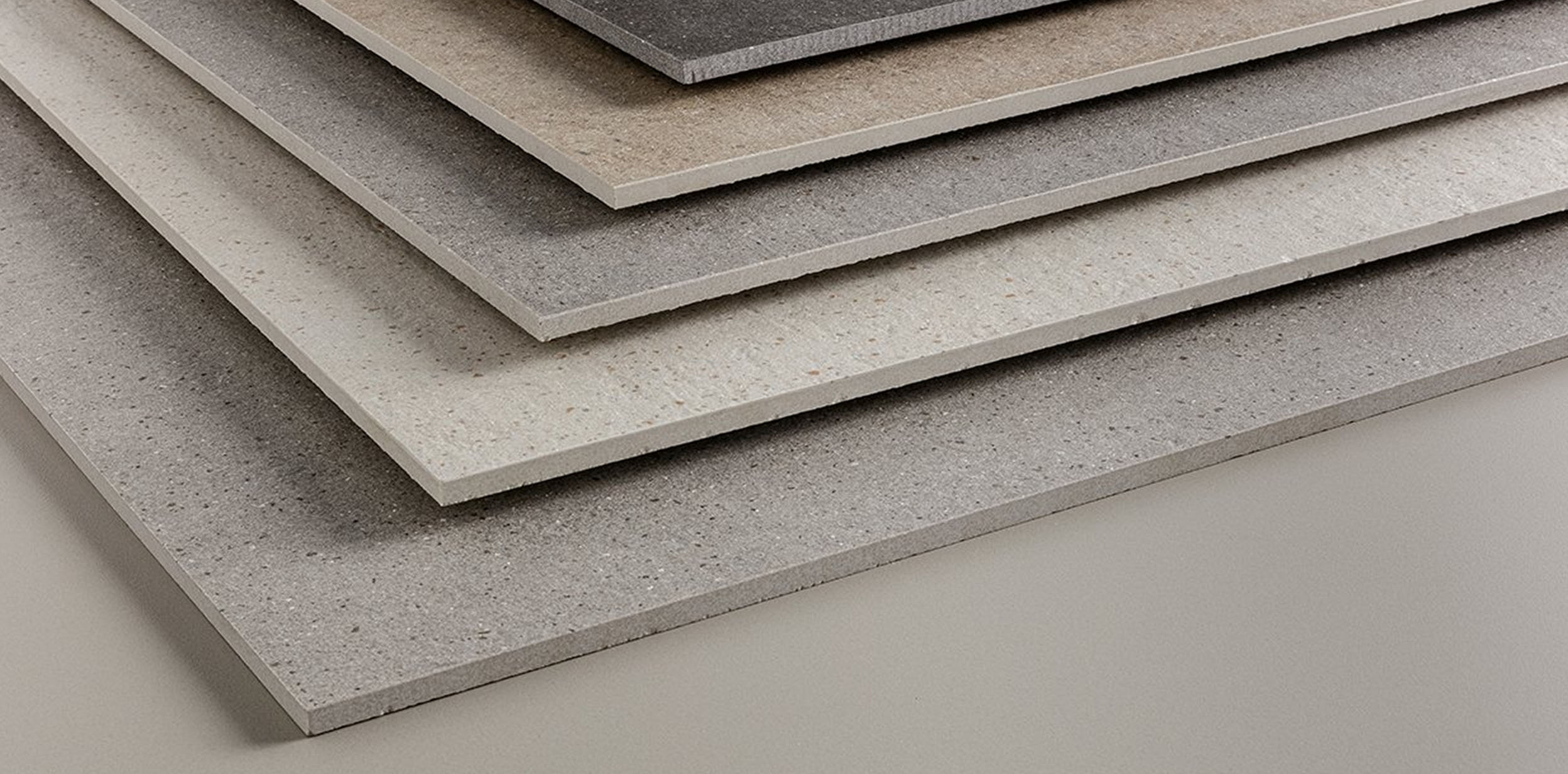

Discover how to source export-ready porcelain tiles from Iran to Europe. Learn about European quality standards, supplier verification, certifications, logistics, pricing, and export procedures to make informed purchasing decisions and build reliable international partnerships.


Introduction
Europe remains a sophisticated market for ceramic and porcelain tiles, where product quality, technical compliance, design innovation, and supply chain reliability play essential roles in purchasing decisions. For international importers, distributors, wholesalers, and construction companies, sourcing the right porcelain tiles is not simply about finding a competitive price. It is about identifying a manufacturer capable of delivering consistent quality, meeting regulatory requirements, and maintaining reliable export operations.
Iran has an established ceramic tile manufacturing industry, supported by access to raw materials, industrial production capacity, skilled labor, and competitive manufacturing costs. These advantages make Iranian porcelain tiles an option worth considering for European buyers seeking alternatives to traditional suppliers. However, entering the European market requires more than competitive production costs. Importers must carefully evaluate product specifications, verify supplier capabilities, understand applicable European regulations, and assess transportation and payment risks.
One of the most common challenges for European buyers is distinguishing between a factory that produces attractive porcelain tiles for the domestic market and a manufacturer that is genuinely prepared for international trade. A product may look excellent in a showroom but still fail to meet technical requirements, packaging expectations, or documentation standards for a European shipment.
So, how can European buyers source export-ready porcelain tiles from Iran while minimizing commercial and operational risks?
This guide explores the complete sourcing process, from identifying reliable Iranian manufacturers and assessing technical quality to understanding European compliance, negotiating export contracts, and arranging international logistics. It also explains the key questions buyers should ask before placing an order and how to establish long-term partnerships that create value for both parties.
Whether you are an experienced tile importer or a distributor entering a new market, understanding these factors can help you make better purchasing decisions and develop a more resilient supply chain.
۱. Understanding the European Porcelain Tile Market

The European porcelain tile market is highly competitive. Domestic manufacturers in Italy, Spain, and other European countries have established strong reputations for design, technical performance, and product innovation. At the same time, international sourcing continues to provide opportunities for distributors looking to diversify their product portfolios and manage purchasing costs.
According to EU trade data, imports of porcelain tiles from outside the EU increased from approximately €۲۵۷ million in 2017 to €۵۸۴ million in 2025. Import volumes also rose from around 926,000 tonnes to 1.8 million tonnes during this period. These figures demonstrate the growing importance of international sourcing, although European producers remain significant suppliers in their own market.
۱.۱. What European Buyers Expect from Porcelain Tiles
European buyers generally evaluate porcelain tiles through a combination of technical, commercial, and aesthetic criteria. The specific requirements depend on the target country, application, and customer segment.
The main purchasing considerations include:
- Technical performance: Water absorption, breaking strength, abrasion resistance, frost resistance, and dimensional accuracy.
- Design and aesthetics: Contemporary colors, natural stone effects, marble-inspired finishes, concrete textures, and modern surface treatments.
- Product consistency: Uniform color, calibrated dimensions, flatness, and consistent surface quality across production batches.
- Regulatory compliance: Applicable European standards, declarations, product documentation, and country-specific requirements.
- Commercial competitiveness: Competitive prices, manageable minimum order quantities, reliable lead times, and transparent payment terms.
- Packaging and logistics: Protective packaging, pallet stability, accurate labeling, and safe international transportation.
For Iranian manufacturers, meeting these expectations requires a strategic approach to product development and export management. Competitive production costs can create an opportunity, but quality assurance and reliable delivery are essential for retaining European customers.
۱.۲. Why Iranian Porcelain Tiles Can Be Competitive
Iran has several industrial advantages that may support its position as a porcelain tile supplier.
These include access to ceramic raw materials, established manufacturing infrastructure, experienced technical personnel, and a developed domestic tile industry. Manufacturers may also offer different product formats, including polished porcelain, matt porcelain, glazed porcelain, and large-format slabs.
Potential advantages include:
- Competitive manufacturing costs: Local production economics may allow manufacturers to offer attractive factory prices, depending on energy costs, exchange rates, and production efficiency.
- Product diversity: Iranian factories manufacture different styles, thicknesses, dimensions, and surface finishes to serve various market segments.
- Flexible production: Some manufacturers can accommodate customized designs, private-label orders, and specific packaging requirements.
- Access to regional logistics networks: Established transport routes to neighboring countries and regional ports may provide alternative shipping arrangements.
However, these advantages should be assessed on a factory-by-factory basis. Not every manufacturer has the same export experience, testing capabilities, production capacity, or access to compliant financial and transportation channels.
۱.۳. Identifying the Right European Market Segment
European countries do not have identical purchasing preferences. A successful sourcing strategy begins by identifying the specific market segment rather than treating Europe as one uniform destination.
| Market segment | Main product requirements | Commercial focus |
|---|---|---|
| Residential construction | Durable, attractive floor and wall tiles | Value and design |
| Luxury interiors | Premium porcelain and large slabs | Exclusivity and finish |
| Commercial buildings | Durable, consistent technical performance | Reliability and lifecycle cost |
| Retail distribution | Broad designs and dependable stock | Margin and availability |
| Outdoor construction | Frost-resistant, suitable slip performance | Safety and durability |
| Renovation projects | Practical sizes and versatile finishes | Availability and price |
For example, a distributor supplying premium residential developments may prioritize marble-effect porcelain slabs, sophisticated surface finishes, and consistent shade matching. A wholesaler supplying large residential projects may place greater emphasis on standardized dimensions, dependable production capacity, and predictable delivery schedules.
The most effective strategy is to match the manufacturer’s capabilities with the target customer’s actual needs.
۲. How to Identify Reliable Iranian Porcelain Tile Suppliers

Selecting a reliable manufacturer is one of the most important stages of sourcing export-ready porcelain tiles. A supplier may offer attractive prices and impressive product photographs, but these factors alone cannot demonstrate its ability to fulfill international orders.
European importers should establish a structured supplier evaluation process before negotiating a large shipment.
۲.۱. Verify the Manufacturer’s Business Credentials
The first step is to confirm that the supplier is a legitimate business with the operational capacity to manufacture or export porcelain tiles.
Request the following information:
- Official company name and registered business address.
- Valid business registration and relevant manufacturing licenses.
- Factory location and production facility details.
- Export experience and previous international markets served.
- Product catalogues and technical specifications.
- References from previous buyers, where available.
- Details of the company’s export department and responsible representatives.
If the supplier is a trading company rather than a manufacturer, clarify which factory will produce the goods and who will be responsible for quality assurance.
A factory visit, whether in person or through a live video inspection, can provide valuable information about production equipment, warehouse capacity, quality-control procedures, and packaging operations.
۲.۲. Evaluate Manufacturing Capacity
Production capacity is particularly important for buyers who intend to place recurring orders or supply major construction projects.
Ask the manufacturer about:
- Installed production capacity per year.
- Actual average monthly production.
- Number and type of production lines.
- Kiln technology and firing processes.
- Available tile dimensions and thicknesses.
- Monthly production allocation for export orders.
- Current production schedule and lead times.
- Ability to reproduce existing designs and specifications.
It is important to distinguish between theoretical capacity and actual available production capacity. A factory may advertise a high annual production figure but have limited capacity for a particular format or surface finish.
For example, a manufacturer producing large quantities of standard floor tiles may not be equally efficient at producing large-format porcelain slabs. Specialized equipment, different firing conditions, and additional handling requirements can influence production timelines and costs.
۲.۳. Review Previous Export Experience
A manufacturer with a proven export history may already understand the documentation, packaging, communication, and logistical requirements of international trade.
However, previous exports to neighboring countries do not automatically demonstrate readiness for European markets.
Ask potential suppliers:
- Have you supplied buyers in the EU or other markets with comparable technical requirements?
- Can you provide recent, verifiable examples of export documentation?
- Have you worked with international inspection agencies?
- Can you prepare technical files and product declarations where applicable?
- Do you have experience handling claims, replacement orders, and quality disputes?
Previous export performance should be independently verified wherever possible. Confidential commercial information can be protected, but a reputable supplier should still be able to demonstrate relevant experience.
۲.۴. Assess Communication and Commercial Transparency
Effective communication can prevent costly misunderstandings during production and shipment.
A professional export supplier should be able to provide:
- Clear quotations with defined product specifications.
- Accurate production and delivery schedules.
- Prompt responses to technical questions.
- Written confirmation of agreed quality parameters.
- Transparent explanations of additional costs.
- Clear procedures for handling defective or damaged goods.
Communication quality is not simply a customer service issue. It directly affects production coordination, order accuracy, shipping arrangements, and the resolution of unexpected problems.
۳. European Quality Standards and Technical Requirements

Technical compliance is a central part of sourcing export-ready porcelain tiles. European buyers need products that meet the applicable technical specifications and legal requirements for their intended use.
۳.۱. Understanding EN 14411
The European standard EN 14411 establishes definitions, classifications, characteristics, and marking requirements for ceramic tiles.
Porcelain tiles are commonly classified as Group BIa, which is associated with water absorption of no more than 0.5% by weight.
This low water absorption is one of the key characteristics of porcelain tiles and contributes to their suitability for a wide range of applications.
Buyers should request technical documentation that identifies:
- Product classification.
- Water absorption.
- Breaking strength and modulus of rupture, where applicable.
- Dimensions and dimensional tolerances.
- Surface quality and relevant appearance requirements.
- Relevant durability characteristics.
- Intended use and applicable performance characteristics.
The exact testing requirements depend on the product type and the applicable harmonized technical specifications. Importers should confirm the current standard references with a qualified conformity-assessment professional before placing an order.
۳.۲. Essential Laboratory Tests
A supplier’s technical claims should be supported by reliable testing rather than marketing descriptions alone.
| Test | Purpose | Importance |
|---|---|---|
| Water absorption | Measures water uptake | Classification and application suitability |
| Breaking strength | Assesses resistance to breaking under load | Floor applications |
| Modulus of rupture | Measures bending strength | Mechanical performance |
| Abrasion resistance | Evaluates surface wear | High-traffic applications |
| Chemical resistance | Assesses reaction to chemicals | Residential and commercial use |
| Stain resistance | Evaluates ease of cleaning | Kitchens and public spaces |
| Frost resistance | Assesses resistance to freeze-thaw conditions | Outdoor applications |
| Dimensional tolerance | Measures size consistency | Installation accuracy |
| Slip resistance | Evaluates slip performance using the relevant test method | Safety-sensitive applications |
Not every test is required for every product. The buyer should identify which characteristics are relevant to the intended installation and the target country’s regulations.
۳.۳. CE Marking and the Construction Products Regulation
For ceramic tiles covered by the relevant harmonized European specifications, CE marking and the associated declaration requirements are important elements of market access.
The EU’s revised Construction Products Regulation, Regulation (EU) 2024/3110, entered into force in January 2025, with its main provisions becoming applicable from January 2026. The previous and revised frameworks will coexist during the transition, with requirements changing as product families move to new harmonized specifications.
Importers should not assume that a supplier’s existing CE documents automatically satisfy every requirement under the applicable framework.
Before ordering, verify:
- Which harmonized standard or technical specification applies to the product.
- Whether the manufacturer has the required assessment and verification documentation.
- Whether a Declaration of Performance or, where applicable, a Declaration of Performance and Conformity is required.
- Whether the CE marking is valid for the specific product and declared characteristics.
- Whether the documentation and marking requirements have changed under the transition arrangements.
CE marking is not a general quality award, nor does it automatically prove that a tile is suitable for every application. It relates to declared performance and applicable regulatory obligations.
The European importer should work with a competent conformity-assessment specialist to confirm the manufacturer’s documents before the product is placed on the market.
۳.۴. Additional Environmental and Chemical Considerations
Environmental performance is becoming increasingly relevant to European construction and procurement.
Buyers may request information about:
- Energy consumption during production.
- Greenhouse gas emissions.
- Recycled material content.
- Water management.
- Environmental product declarations (EPDs), where available.
- Relevant chemical and material safety information.
An EPD can provide verified information about a product’s environmental impacts over its life cycle, but it is not universally mandatory for every porcelain tile.
Importers should also assess applicable chemical restrictions, including relevant REACH obligations where the product or its components fall within scope. Specific obligations should be confirmed according to the product’s composition, intended use, and role of each economic operator.
۴. How to Evaluate Porcelain Tile Samples Before Ordering

A sample evaluation is an essential step in international tile sourcing. It allows buyers to compare the manufacturer’s actual production quality with the specifications, catalogue images, and commercial promises presented during negotiations.
Photographs and digital catalogues are useful for initial screening, but they cannot fully demonstrate surface texture, color variation, dimensional accuracy, or the overall quality of a finished product.
۴.۱. Request Representative Samples
Ask the supplier to provide samples from current production rather than specially prepared showroom pieces whenever possible.
The samples should represent the exact product that will be supplied, including:
- Tile size and thickness.
- Surface finish, such as polished, matt, satin, or textured.
- Color, pattern, and shade.
- Edge finishing and rectification.
- Glazing and printing characteristics, where applicable.
- Product classification and technical performance.
For products with marble or natural stone designs, request several pieces to assess the variation in patterns and veining.
This is especially important for large-format slabs, where repeated patterns or inconsistent veining can become visually noticeable across large surfaces.
۴.۲. Conduct a Technical and Visual Inspection
Once samples arrive, evaluate them using a structured checklist.
Porcelain tile sample inspection checklist
۰ of 8 checks completed
Compare dimensions and thickness against the specification.
Check surface flatness and visible warping.
Inspect edges, corners, and rectification quality.
Compare color and shade consistency across samples.
Examine surface finish under natural and artificial lighting.
Look for visible cracks, pinholes, stains, and surface defects.
Review technical test reports and product identification.
Confirm that the sample matches the proposed production batch.
Reset checklist
Visual inspection should be combined with laboratory test results. Some technical characteristics, such as water absorption and breaking strength, cannot be reliably determined through a visual examination.
۴.۳. Approve a Reference Sample
Once the buyer is satisfied, the approved sample should become a contractual reference.
The purchase agreement should specify that mass production must conform to the approved sample and the agreed technical specifications, within clearly defined tolerances.
For repeat orders, it is also useful to maintain a reference sample from the first accepted shipment. This helps buyers identify changes in color, surface appearance, or other characteristics over time.
۴.۴. Arrange Pre-Shipment Inspection
For larger orders, an independent inspection can help reduce the risk of receiving defective, incorrectly packed, or incomplete goods.
An inspection agency can verify:
- Product dimensions and appearance.
- Packaging and pallet conditions.
- Quantity and carton labeling.
- Shade and caliber consistency.
- Compliance with agreed inspection criteria.
- Loading conditions and container security.
The inspection procedure should be agreed in advance, including sampling methods, acceptance criteria, and how defects will be classified.
Pre-shipment inspection cannot eliminate every risk, but it provides additional evidence that the goods are consistent with the purchase contract.
۵. Understanding European Import Documentation and Customs Procedures
Export-ready porcelain tiles require more than suitable technical performance. The manufacturer and importer must also prepare accurate commercial, customs, and shipping documents.
Documentation requirements can vary according to the destination country, product classification, transaction structure, and applicable regulations.
۵.۱. Essential Export Documents
The following documents are commonly relevant to international porcelain tile shipments.
| Document | Purpose |
|---|---|
| Commercial invoice | Declares product details, quantities, prices, and transaction information |
| Packing list | Identifies carton quantities, pallet details, weights, and dimensions |
| Bill of lading or CMR | Provides transport documentation according to the shipping method |
| Certificate of origin | Identifies the declared country of origin, where required |
| Technical data sheet | Describes product specifications and characteristics |
| Test reports | Supports declared technical performance |
| Declaration of Performance | Declares relevant performance characteristics where applicable |
| Insurance certificate | Evidences cargo insurance where arranged |
| Customs declaration | Supports export or import clearance |
| Inspection certificate | Records inspection results where contractually or legally required |
The precise documentation package should be checked with the relevant customs broker, freight forwarder, and conformity specialist.
۵.۲. Correct HS Code Classification
Ceramic tiles are generally classified under Chapter 69 of the Harmonized System. Porcelain tiles commonly fall under heading 6907, with the exact subheading depending on technical characteristics and the applicable customs nomenclature.
Incorrect classification may lead to customs delays, incorrect duties, or compliance issues.
Importers should verify the applicable CN or TARIC code for the destination market, based on the product’s water absorption, dimensions, composition, and other relevant characteristics.
The commercial invoice, packing list, and customs declarations should use consistent and accurate product descriptions.
۵.۳. Tariffs, Trade Restrictions, and Financial Compliance
Importers sourcing porcelain tiles from Iran must carefully assess applicable tariffs, trade restrictions, and payment-channel limitations before concluding a transaction.
The EU maintains specific sanctions and restrictive measures relating to Iran. These do not necessarily mean that every ceramic tile transaction is prohibited, but the legality of a particular transaction must be assessed against current EU sanctions, applicable national law, designated-party restrictions, and financial-sector requirements.
Before accepting an order, European buyers should:
- Conduct appropriate screening of the supplier, its owners, intermediaries, banks, and logistics providers.
- Confirm that the transaction and the goods are not subject to applicable prohibitions.
- Verify that the proposed payment method can legally and practically be used.
- Confirm applicable customs duties, taxes, and import formalities.
- Obtain professional legal or compliance advice when necessary.
Payment arrangements should be transparent, documented, and compliant with all applicable financial rules. Buyers should avoid any proposal involving concealed parties, misleading product descriptions, or inaccurate declarations of origin.
Because these requirements can change, importers should verify the current position before every transaction rather than relying on past shipments.
۶. Choosing the Right Shipping Method from Iran to Europe

International transportation is a major component of the final cost of porcelain tile imports. Because ceramic tiles are heavy and vulnerable to impact, shipping decisions should consider both freight costs and the risk of damage.
The optimal shipping method depends on the destination, shipment volume, available transport corridors, insurance arrangements, and customs procedures.
۶.۱. Road Transportation
Road freight may be suitable for deliveries to European destinations that can be reached through legally available and commercially practical land routes.
Potential advantages include:
- Door-to-door delivery.
- Flexible shipment scheduling.
- Fewer cargo-handling stages in some transport arrangements.
- Suitability for full truckloads and certain consolidated shipments.
However, road transportation can be affected by border procedures, transit restrictions, political conditions, insurance availability, and changes in fuel prices.
A freight forwarder with experience in the relevant corridors can help identify feasible routes and calculate realistic delivery times.
۶.۲. Sea Freight
Sea freight may be appropriate for larger orders when a legally available shipping route, suitable port arrangements, and compliant financial and insurance services can be secured.
Common container options include:
- ۲۰-foot containers: Often used for heavy cargo when weight limits are the primary constraint.
- ۴۰-foot containers: May be suitable for larger-volume shipments, subject to payload limits.
- Consolidated cargo: Can be considered for smaller shipments, although handling requirements and breakage risks should be assessed carefully.
The maximum cargo weight is determined by the container’s rated capacity, vehicle or vessel restrictions, road limits, and applicable regulations. Buyers should not rely on a standard square-metre estimate without obtaining a packing plan from the manufacturer.
۶.۳. Packaging Requirements for Export
Porcelain tiles are strong under many service conditions but can be vulnerable to edge impacts, concentrated loads, and inappropriate handling during transportation.
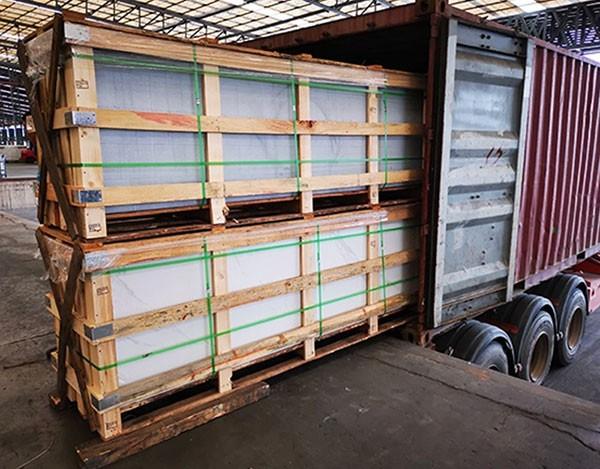
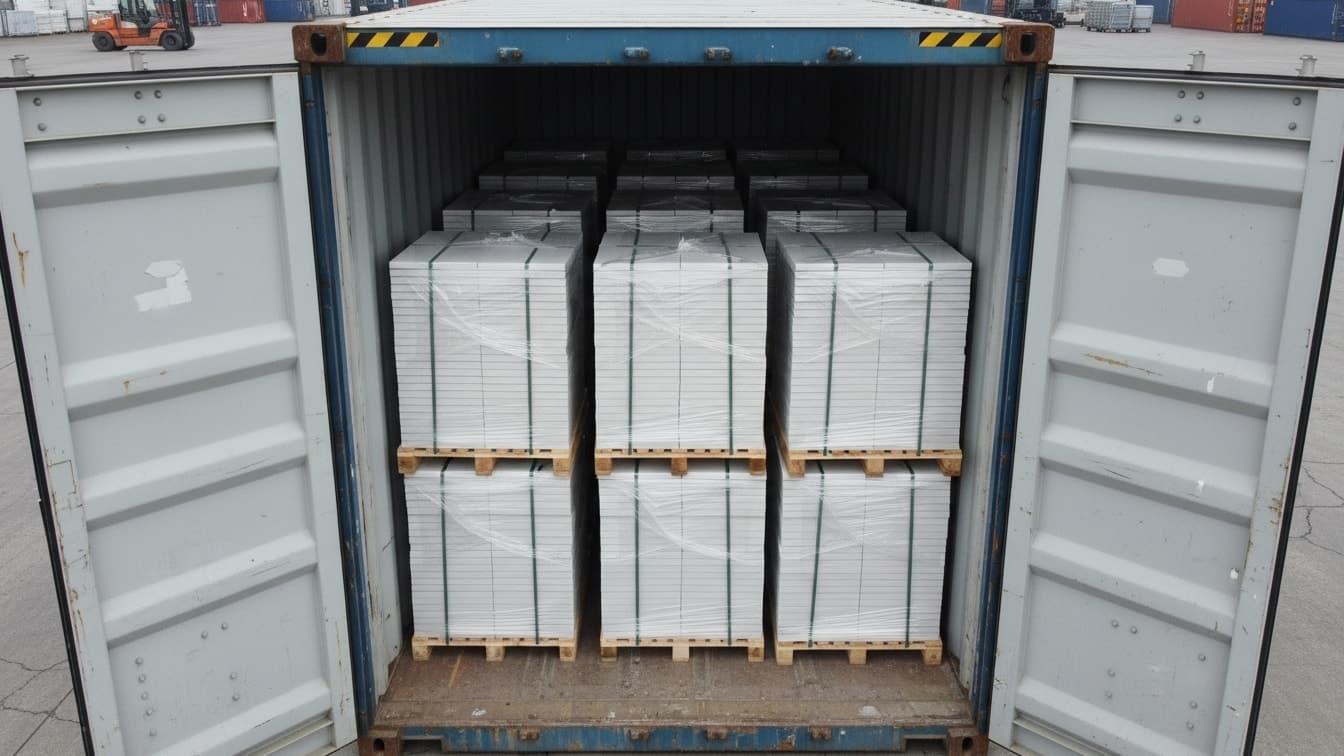
Professional export packaging should include:
- Strong and appropriately sized cartons.
- Suitable internal protection.
- Stable pallets designed for the product’s weight.
- Protective wrapping and strapping.
- Clear product, shade, caliber, and batch identification.
- Appropriate handling labels.
- Secure container loading and cargo bracing.
For large-format slabs, specialized frames, reinforced packaging, and appropriate handling equipment may be required.
۶.۴. Selecting the Appropriate Incoterm
Incoterms clarify the division of responsibilities, costs, and risks between the seller and buyer. The chosen term should be clearly identified in the contract with the relevant named place or port and the applicable Incoterms edition.
| Incoterm | Main commercial arrangement | Typical consideration |
|---|---|---|
| EXW | Buyer takes responsibility from the agreed seller’s premises | Buyer needs local collection and export-clearance arrangements |
| FCA | Seller delivers goods to the agreed carrier or place | Responsibilities are clearly divided at handover |
| FOB | Seller delivers goods on board a vessel at the named port | Intended for sea or inland-waterway transport |
| CFR | Seller pays freight to the destination port | Risk transfers earlier than the freight destination |
| CIF | Seller pays freight and specified insurance to the destination port | Insurance cover is subject to the agreed policy |
| DAP | Seller arranges delivery to the named destination | Buyer generally handles import clearance and duties |
FOB, CFR, and CIF are designed for sea and inland-waterway transport. FCA or another appropriate multimodal term is generally more suitable for containerized cargo handed to a carrier before vessel loading.
For Iranian porcelain tile exports, the availability and legality of the proposed transport, insurance, and payment arrangements should be verified before agreeing to any Incoterm.
۷. Calculating the Total Cost of Imported Porcelain Tiles

One of the most common mistakes in international sourcing is comparing suppliers exclusively by their factory prices. A low quotation may appear attractive but become less competitive after transportation, insurance, customs, inspection, and other expenses are included.
European buyers should calculate the total landed cost before making a purchasing decision.
۷.۱. Main Cost Components
The total cost of sourcing porcelain tiles from Iran may include:
- Factory price per square metre.
- Export packaging and palletization.
- Inland transportation from the factory.
- Export customs clearance.
- International freight.
- Cargo insurance.
- Customs duties, where applicable.
- Import VAT and related tax costs.
- Port handling and terminal charges.
- Customs brokerage and inspection fees.
- Warehousing and local distribution.
- Potential costs from breakage, shortages, and rejected goods.
Illustrative landed-cost example
Hypothetical figures for a shipment of 10,000 m². These are not current Iranian market quotations or verified freight rates.
| Cost component | Example cost |
|---|---|
| Factory price (€۵/m²) | €۵۰,۰۰۰ |
| Export packaging | €۱,۵۰۰ |
| Inland transportation | €۲,۰۰۰ |
| International freight | €۶,۰۰۰ |
| Insurance | €۵۰۰ |
| Customs and handling charges | €۱,۵۰۰ |
| Illustrative total before import duties and VAT | €۶۱,۵۰۰ |
| Landed cost per m² | €۶.۱۵ |
This example illustrates how additional expenses can change the final purchase price. Actual landed costs depend on the shipment route, product classification, destination, customs treatment, and applicable restrictions.
۷.۲. Compare Suppliers Using the Same Specifications
A meaningful price comparison requires identical product specifications.
For instance, comparing a polished porcelain tile with a matt tile of a different thickness or technical classification may produce a misleading result.
Ask all shortlisted suppliers to quote against the same specification sheet, including:
- Tile size and thickness.
- Surface finish.
- Technical classification.
- Packaging standard.
- Quantity and permitted tolerance.
- Delivery schedule.
- Incoterm and named place.
- Payment terms.
- Documentation and inspection requirements.
A standardized request for quotation (RFQ) allows importers to compare suppliers more accurately and identify hidden costs before signing a contract.
۸. Negotiating Contracts and Managing Export Risks
International porcelain tile sourcing involves commercial, technical, and logistical risks. A well-written purchase agreement can help reduce disputes and provide a clear basis for resolving problems.
۸.۱. Define Product Specifications in the Contract
The contract should describe the goods in sufficient detail to prevent uncertainty.
Include:
- Product code and commercial name.
- Dimensions and thickness.
- Surface finish and color.
- Approved reference sample.
- Applicable technical standards.
- Agreed quality tolerances.
- Packaging specifications.
- Quantity and acceptable variation.
- Inspection and acceptance procedures.
Attach the approved technical data sheet and relevant product documents to the agreement.
۸.۲. Agree on Quality and Claims Procedures
Quality claims can become difficult to resolve when the contract does not clearly define acceptable defects and inspection procedures.
Establish a written process covering:
- The time allowed for inspecting delivered goods.
- The evidence required to support a claim.
- How defects and breakage are categorized.
- Whether independent inspection is required.
- The supplier’s responsibility for replacement, credit, or another agreed remedy.
- The time frame for resolving disputes.
The contract should also distinguish manufacturing defects from damage caused by transportation, improper storage, or installation.
۸.۳. Manage Payment and Delivery Risks
Payment terms should reflect the buyer’s level of trust in the supplier, the shipment size, and the feasibility of legally compliant banking arrangements.
Before transferring funds, verify the supplier’s identity, the beneficiary details, the agreed payment method, and the legal permissibility of the transaction.
A production schedule should include milestones for raw material preparation, manufacturing, quality inspection, packaging, and dispatch.
Where practical, connect payment milestones to verifiable production or delivery stages. This can help both parties manage cash flow and reduce uncertainty.
۸.۴. Prepare for Supply Chain Disruptions
International shipments can be affected by delays, changes in freight availability, customs inspections, or unforeseen restrictions.
To minimize disruption:
- Maintain communication with the supplier throughout production.
- Request regular updates and production photographs.
- Confirm shipping arrangements before the goods are ready.
- Maintain a contingency plan for delayed shipments.
- Avoid relying on a single product or supplier for critical projects.
- Review insurance coverage and contractual remedies.
A risk-management approach is particularly important when sourcing from markets with more complicated payment and transportation conditions.
۹. Building Long-Term Partnerships with Iranian Tile Manufacturers

Successful sourcing should not end with the first shipment. For European importers, establishing long-term relationships with capable Iranian manufacturers can create opportunities for better product consistency, more efficient purchasing, and customized product development.
۹.۱. Start with a Trial Order
A trial order enables buyers to assess actual manufacturing and export performance before committing to a large purchase.
A practical approach is to:
- Select a limited range of products.
- Confirm technical specifications and samples.
- Agree on quality-control criteria.
- Place a manageable initial order.
- Monitor production and delivery.
- Evaluate the condition and consistency of the received goods.
The trial order should be commercially meaningful enough to assess the supplier’s actual processes while limiting financial exposure.
۹.۲. Develop Private-Label and Customized Products
Some Iranian manufacturers may be able to produce porcelain tiles under a buyer’s own brand, depending on their manufacturing capacity and commercial policies.
Private-label arrangements may include:
- Customized carton design.
- Exclusive product collections.
- Tailored color palettes.
- Specific surface finishes.
- Buyer-specific product codes.
- Customized marketing and technical documentation.
Any exclusive design or branding arrangement should clearly define ownership, permitted use, confidentiality, and restrictions on supplying similar products to competitors.
۹.۳. Establish Consistent Quality Monitoring
For recurring shipments, quality management should be continuous rather than limited to the first order.
Buyers can create a supplier scorecard covering:
| Performance indicator | Evaluation focus |
|---|---|
| Product quality | Conformity to approved specifications |
| Delivery reliability | Orders delivered within agreed schedules |
| Documentation | Accuracy and completeness |
| Packaging | Protection and identification |
| Communication | Responsiveness and transparency |
| Claims management | Speed and fairness of resolution |
| Commercial performance | Price consistency and cost transparency |
Periodic performance reviews help identify recurring issues and support continuous improvement.
۱۰. Future Opportunities for Iranian Porcelain Tiles in Europe, 2026–۲۰۲۸
The future of porcelain tile sourcing will be influenced by changing consumer preferences, environmental requirements, technological innovation, and international supply chain developments.
The European market’s growing reliance on external porcelain tile suppliers presents potential opportunities. Non-EU imports of porcelain tiles reached approximately €۵۸۴ million in 2025, indicating a substantial market for international manufacturers.
However, Iranian suppliers will need to compete not only on price but also on compliance, design, reliability, and transparency.
۱۰.۱. Growing Demand for Large-Format Porcelain Slabs
Large-format porcelain slabs are increasingly used in contemporary interiors, commercial spaces, countertops, and selected exterior applications.
These products can create a seamless visual appearance, reduce the number of visible joints, and support modern architectural concepts.
Iranian manufacturers with suitable pressing, firing, finishing, and handling capabilities may find opportunities in this segment.
However, producing export-ready slabs requires specialized machinery, accurate dimensional control, suitable packaging, and experienced installation support.
۱۰.۲. Design Innovation and Digital Printing
Digital printing technology enables manufacturers to produce detailed stone, marble, wood, and concrete-inspired surfaces.
Advanced digital decoration can also support more varied patterns and sophisticated collections.
For Iranian exporters, investing in design development and surface innovation may help differentiate their products from lower-cost alternatives.
European buyers may be particularly interested in collections that combine distinctive aesthetics with reliable technical performance.
۱۰.۳. Sustainability and Production Efficiency
Environmental performance is becoming increasingly relevant to construction procurement and product evaluation.
Manufacturers that invest in energy efficiency, water recycling, process optimization, and improved waste management may strengthen their commercial position.
Environmental documentation, including independently verified EPDs where available, can also help importers assess the sustainability profile of their products.
The EU’s revised Construction Products Regulation is part of a broader movement toward better product information, environmental transparency, and digital documentation. The exact obligations for each ceramic tile product will depend on the applicable harmonized specifications and transition arrangements.
۱۰.۴. Supply Chain Diversification
European importers may seek to diversify their sourcing strategies to reduce dependence on individual countries or manufacturers.
Iran could be considered as one potential sourcing market, provided that the commercial, legal, financial, and logistical requirements can be met.
For Iranian suppliers, long-term competitiveness will depend on demonstrating reliable manufacturing, consistent product performance, compliant transactions, and the ability to meet evolving customer expectations.
۱۱. Frequently Asked Questions About Sourcing Porcelain Tiles from Iran
Can Iranian porcelain tiles be imported into the European Union?
Importing Iranian porcelain tiles may be possible, but each transaction must be assessed against applicable EU sanctions, customs rules, financial restrictions, and product compliance requirements. Buyers should obtain current legal and customs advice before proceeding.
What certifications are required for Iranian porcelain tiles in Europe?
Requirements depend on the product and its intended application. Relevant documents may include applicable test reports, a Declaration of Performance or other required declaration, and CE marking where the applicable harmonized specification requires it. Importers should confirm the current regulatory framework for the specific product.
How can buyers verify the quality of Iranian porcelain tiles?
Buyers should request representative production samples, review technical data sheets and laboratory test reports, verify factory capabilities, and establish agreed acceptance criteria. Independent pre-shipment inspection can provide an additional level of assurance.
What is the minimum order quantity for porcelain tile exports from Iran?
Minimum order quantities vary by manufacturer, product type, dimensions, and production requirements. Some suppliers may accommodate smaller trial orders, while customized collections and large-format products may require higher quantities. Buyers should request a written quotation specifying minimum quantities for each product.
How much does it cost to import porcelain tiles from Iran to Europe?
The total cost depends on the factory price, shipment volume, packaging, transportation, insurance, applicable customs duties, taxes, and handling expenses. A reliable quotation should specify the Incoterm and provide a clear breakdown of the costs included and excluded.
How long does shipping from Iran to Europe take?
Transit times vary significantly depending on the destination, available transport corridor, customs procedures, freight schedules, and any applicable restrictions. Buyers should obtain a route-specific estimate from a freight forwarder rather than relying on a general delivery timeframe.
Are Iranian porcelain tiles suitable for European construction projects?
They can be suitable if the specific product meets the applicable technical requirements and is appropriate for the intended application. Buyers should verify performance characteristics, regulatory documentation, and installation requirements before specifying the product for a project.
What should European importers check before signing a purchase contract?
Importers should verify the supplier, product specifications, technical documents, sample approval, pricing, Incoterms, payment arrangements, packaging, inspection procedures, delivery schedule, and applicable legal restrictions. All critical agreements should be documented in the contract.
Conclusion: Turning Iranian Porcelain Tile Sourcing into a Competitive Advantage
Sourcing export-ready porcelain tiles from Iran can present commercial opportunities for European importers, distributors, wholesalers, and construction companies. However, success depends on more than identifying an attractive factory price or selecting products from a well-designed catalogue.
The most effective sourcing strategy begins with identifying manufacturers that can demonstrate genuine production capabilities, consistent quality, and transparent export operations. Technical evaluation, representative sample testing, and careful verification of relevant European regulatory requirements are essential before placing a commercial order.
Importers should also pay close attention to the total landed cost, shipping feasibility, packaging quality, customs classification, and compliant financial arrangements. These factors can have a significant impact on the commercial viability of a transaction.
In an increasingly competitive market, Iranian manufacturers have an opportunity to differentiate themselves through innovative designs, large-format porcelain slabs, advanced digital printing, and improved production efficiency. At the same time, European buyers are likely to continue placing importance on product traceability, environmental information, and dependable supply chains.
A successful partnership should therefore be built on measurable performance, clearly defined contractual responsibilities, and continuous quality improvement. Starting with a carefully managed trial order and expanding gradually can help buyers evaluate suppliers while limiting unnecessary commercial risks.
For European businesses considering Iranian porcelain tiles, the priority should be to identify a supplier that combines technical capability, commercial transparency, and legally compliant export operations.
Are you looking for a reliable Iranian porcelain tile supplier for the European market? Contact experienced export specialists to request product catalogues, technical specifications, representative samples, and a tailored quotation. A structured sourcing process can help you make informed purchasing decisions and build sustainable international trade relationships.

نظرات ۰