


Discover how Iranian ceramic tiles can meet European Union standards for quality, safety, performance, and sustainability. Explore EN 14411, CE marking, testing, documentation, and export requirements to access the European ceramic tile market.
Can Iranian ceramic tiles compete in one of the world’s most demanding construction markets? For manufacturers and exporters, entering the European Union (EU) is not simply a matter of offering attractive designs, competitive prices, or advanced production technology. It also requires compliance with technical standards, product safety requirements, environmental expectations, and strict documentation procedures.
The European ceramic tile market offers opportunities for international suppliers, but accessing it requires a clear understanding of the regulatory framework. European buyers, including importers, distributors, architects, and construction companies, expect products to meet defined performance criteria. These include water absorption, breaking strength, resistance to abrasion, slip resistance, dimensional accuracy, and durability, depending on the intended application.
Iran has an established ceramic tile manufacturing industry, supported by domestic raw materials, modern production facilities, and experience in exporting to international markets. However, meeting European requirements involves more than manufacturing high-quality products. Exporters must also understand applicable harmonized standards, conformity assessment procedures, CE marking obligations where applicable, environmental regulations, and the documentation required to demonstrate product performance.
For Iranian manufacturers, the key challenge is turning existing production capabilities into verifiable compliance that European buyers can trust. A product may perform well in its domestic market but still require additional testing, technical documentation, or changes to its manufacturing and quality-control processes before it can be marketed in the EU.
This article provides a comprehensive guide to the compatibility of Iranian ceramic tiles with European standards. It explains the main technical and regulatory requirements, the role of laboratory testing and certification, environmental considerations, common export barriers, and practical steps manufacturers can take to improve their competitiveness in Europe.
۱. Understanding European Standards for Ceramic Tiles
The European Union uses a harmonized regulatory framework to ensure that construction products meet defined performance and safety requirements. For Iranian manufacturers, understanding the distinction between a technical standard, a legal regulation, and a certification document is the first step toward successful market entry.
۱.۱. What Is EN 14411?
EN 14411 is the principal European product standard for ceramic tiles. It establishes definitions, classifications, characteristics, and marking requirements for ceramic tiles intended for use in construction.
It covers important technical properties and provides a framework for assessing products according to their manufacturing method, water absorption, and intended application.
The standard addresses characteristics such as:
- Water absorption
- Dimensions and dimensional tolerances
- Surface quality
- Breaking strength
- Modulus of rupture
- Resistance to thermal shock, where applicable
- Frost resistance, where applicable
- Chemical resistance
- Stain resistance
- Abrasion resistance for relevant glazed products
EN 14411 distinguishes ceramic tiles according to their forming methods and water absorption groups. This enables manufacturers and buyers to identify products with suitable technical characteristics for specific uses.
For example, a porcelain tile with water absorption of 0.5% or less belongs to Group BIa under the standard’s classification system. This low absorption level makes it suitable for a wide range of applications, subject to its other technical properties.
Compliance with EN 14411 helps Iranian exporters communicate product performance in a format familiar to European buyers. However, citing the standard alone does not demonstrate that a particular product has passed the required tests or meets every applicable legal obligation.
۱.۲. Understanding ISO 13006 and Its Relationship with EN 14411
ISO 13006 is an international standard that establishes definitions, classification, characteristics, and marking requirements for ceramic tiles.
EN 14411 and ISO 13006 are closely aligned in many technical areas. This can help manufacturers that already operate according to international ceramic tile specifications adapt their documentation for European customers.
However, manufacturers should not assume that compliance with ISO 13006 automatically satisfies all EU legal requirements. The exact edition of the standard, the applicable harmonized reference, product scope, and regulatory transition rules must be checked.
For Iranian factories, a practical approach is to map existing product specifications against the relevant European requirements and identify any gaps before beginning export preparations.
۱.۳. The Construction Products Regulation (CPR)
The Construction Products Regulation establishes the legal framework for placing covered construction products on the European market.
The revised Regulation (EU) 2024/3110 entered into force in 2025, with its main provisions applying from 8 January 2026. However, the previous CPR framework and the revised regulation will coexist during a transition period. Product families move to the new system as relevant harmonized technical specifications are adopted.
This distinction is important for Iranian ceramic exporters. The applicable requirements depend on the harmonized technical specification that covers the product at the time it is placed on the market.
The CPR framework addresses:
- Assessment of product performance
- Declaration of performance and conformity, where required
- Technical documentation
- CE marking obligations
- Responsibilities of manufacturers and other economic operators
- Environmental and safety performance requirements as applicable
The EU framework does not establish all national building-use rules. Individual EU countries maintain their own building regulations and may impose additional requirements relating to the use and installation of products.
Therefore, exporters must consider both EU-wide product rules and the specific requirements of their target country.
۲. CE Marking: What Iranian Ceramic Tile Exporters Need to Know

CE marking is one of the most important subjects for manufacturers seeking access to the European construction market. It indicates that a product has been assessed under the applicable EU harmonized framework and that the responsible economic operator declares the relevant performance and conformity.
However, CE marking is not a general quality award, a voluntary symbol of excellence, or a guarantee that a product is suitable for every construction project.
۲.۱. Is CE Marking Mandatory for Iranian Ceramic Tiles?
CE marking is required when a construction product falls within the scope of an applicable harmonized technical specification or European Technical Assessment and the relevant legal framework requires it.
For ceramic tiles, exporters must verify the current status of the applicable harmonized standard and its citation in the Official Journal of the European Union.
Where CE marking is required, the manufacturer must complete the applicable assessment and verification procedures, prepare technical documentation, and issue the required declaration before placing the product on the market.
The fact that a product is manufactured outside the EU does not automatically exempt it from these obligations.
۲.۲. How Does the CE Marking Process Work?
- Identify the applicable harmonized specification
Determine the relevant standard, product scope, and regulatory framework for the ceramic tile being exported.
- Determine the essential product characteristics
Identify the technical properties that must be assessed and declared for the intended application.
- Carry out the required assessment
Conduct the relevant testing and factory production control under the applicable assessment and verification system.
- Prepare technical documentation
Compile test results, product identification, manufacturing controls, and supporting technical records.
- Prepare the required declaration
Issue the applicable Declaration of Performance (DoP) or, under the revised CPR when applicable, the Declaration of Performance and Conformity (DoPC).
- Affix CE marking, where required
Apply the marking and provide the accompanying information in accordance with the applicable legislation.
The European Commission explains that CE marking must be supported by the relevant declaration and technical documentation. A product can only carry CE marking under the construction products framework when it is covered by the relevant harmonized technical specification or an applicable European Technical Assessment.
۲.۳. Does CE Marking Require a Notified Body?
Not every ceramic tile requires third-party certification by a notified body.
The applicable Assessment and Verification of Constancy of Performance (AVCP) system determines whether a manufacturer can undertake the relevant tasks itself or must involve an independent notified body.
For many conventional ceramic tiles covered by the relevant EN 14411 provisions, the applicable system has historically been AVCP System 4, under which the manufacturer performs the required assessment and factory production control without a notified body being responsible for the assessment of performance.
Nevertheless, exporters should verify the exact applicable harmonized specification, its current legal status, and any relevant transition provisions rather than applying this historical arrangement indiscriminately.
A notified body may be relevant for other construction products or under different applicable requirements. Engaging a laboratory for testing is also not the same as obtaining a notified body’s certification.
۲.۴. What Is the Difference Between CE Marking and a Quality Certificate?
CE marking relates to applicable legal requirements and declared product performance. A quality certificate, such as an ISO 9001 certificate, concerns the management system of an organization.
These documents serve different purposes:
| Document or marking | Main purpose |
|---|---|
| CE marking | Indicates compliance with applicable harmonized EU construction-product requirements |
| Declaration of Performance | States assessed product performance under the applicable framework |
| Declaration of Performance and Conformity | Combines relevant performance and conformity declarations under the revised CPR |
| ISO 9001 | Demonstrates a certified quality management system |
| Laboratory test report | Records the results of specific product tests |
| Environmental Product Declaration | Communicates verified environmental information over a defined lifecycle |
An ISO 9001 certificate or an independent laboratory report does not replace CE marking where CE marking is legally required.
۳. Essential Technical Requirements for Iranian Ceramic Tiles in Europe

Technical compliance is one of the most important factors determining whether Iranian ceramic tiles can compete in the European market. Importers and construction professionals require reliable evidence that products meet the specifications needed for their intended applications.
The following characteristics are among the most relevant when evaluating ceramic tiles under EN 14411 and associated testing methods.
۳.۱. Water Absorption
Water absorption measures the amount of water a ceramic tile absorbs under specified test conditions. It is an important indicator of the tile’s porosity and helps determine its classification.
The EN 14411 classification includes different water absorption groups, including:
| Group | Water absorption | General classification |
|---|---|---|
| BIa | E ≤ ۰.۵% | Very low absorption, including porcelain tiles |
| BIb | ۰.۵% < E ≤ ۳% | Low absorption |
| BIIa | ۳% < E ≤ ۶% | Medium absorption |
| BIIb | ۶% < E ≤ ۱۰% | Higher absorption |
| BIII | E > 10% | High absorption, generally associated with wall tiles |
Simplified classification for common pressed tile groups; the complete standard includes additional distinctions and requirements.
For example, porcelain tiles classified as BIa are often selected for floors, bathrooms, and other areas where low water absorption is desirable.
Iranian manufacturers should ensure that water absorption test results are representative of the actual product and production process. Testing should be performed according to the applicable method, such as EN ISO 10545-3.
۳.۲. Breaking Strength and Modulus of Rupture
Mechanical strength is essential for tiles exposed to loads, impacts, and stresses during use.
Two important properties are:
- Breaking strength: The force required to break a tile under specified test conditions.
- Modulus of rupture: A measure of the tile’s resistance to bending stress.
These characteristics are particularly relevant for floor tiles, large-format products, and installations subject to concentrated loads.
The EN ISO 10545-4 test method is commonly used to assess breaking strength and modulus of rupture.
Manufacturers should consider the relationship between tile thickness, dimensions, body composition, and intended application when interpreting test results. A single strength result cannot establish suitability for every floor or structural condition.
۳.۳. Abrasion Resistance
Abrasion resistance measures a surface’s ability to withstand wear caused by friction and repeated contact.
For glazed ceramic tiles, surface abrasion may be classified using the PEI system, where applicable. This classification is particularly relevant for selecting tiles for different levels of pedestrian traffic.
Typical considerations include:
- Residential bedrooms with light traffic
- Residential kitchens and hallways
- Retail spaces with regular pedestrian movement
- Commercial environments with intensive foot traffic
Glazed tiles are commonly tested according to EN ISO 10545-7.
Unglazed porcelain tiles are evaluated using different abrasion testing methods, such as EN ISO 10545-6. Manufacturers should use the correct test method for the relevant product type.
For Iranian exporters, abrasion performance should be clearly specified in product catalogues and technical data sheets to help European buyers choose suitable products.
۳.۴. Slip Resistance
Slip resistance is an important safety consideration for ceramic flooring, particularly in bathrooms, commercial kitchens, entrances, swimming pool surroundings, and outdoor walkways.
The required level depends on the intended application, surface condition, local regulations, and the risk of slipping.
Relevant test methods may include:
- Pendulum testing under EN 16165
- Ramp testing under EN 16165, Annex B
- Other applicable methods depending on the intended surface and market requirements
Different methods produce different results and should not be treated as directly interchangeable.
For example, a textured porcelain tile designed for an outdoor walkway may provide better slip resistance under wet conditions than a polished indoor tile.
Iranian manufacturers targeting European projects should provide appropriate slip-resistance data and clearly identify the conditions under which the tests were performed.
۳.۵. Frost Resistance and Thermal Shock
Frost resistance is particularly important for ceramic tiles intended for outdoor applications in regions exposed to freezing temperatures.
When water enters porous materials and freezes, it can create internal stresses that may cause cracking or surface damage.
Low water absorption can help reduce this risk, but frost resistance should be demonstrated using the appropriate test method rather than assumed from the product classification alone.
EN ISO 10545-12 is commonly used for frost-resistance testing.
Thermal shock resistance may also be relevant where tiles are exposed to sudden temperature changes. EN ISO 10545-9 provides a test method for this property.
These characteristics are important for exporters supplying products for European terraces, balconies, exterior façades, and other exposed environments.
۳.۶. Chemical and Stain Resistance
Ceramic tiles are widely used in areas where cleaning agents, household chemicals, food products, and other substances may come into contact with the surface.
Chemical resistance indicates how well the tile withstands exposure to specified chemical substances.
Stain resistance measures how effectively certain stains can be removed from the tile under defined test conditions.
Relevant testing methods include:
- EN ISO 10545-13 for chemical resistance
- EN ISO 10545-14 for stain resistance
Performance varies according to the glaze, surface treatment, porosity, and product type.
For example, ceramic tiles designed for laboratories or commercial kitchens may require particular chemical-resistance characteristics. Manufacturers should identify the specific chemicals and test conditions relevant to the intended application.
۴. Laboratory Testing and Quality Control for Iranian Manufacturers


Meeting European standards requires a consistent quality-control system that verifies product performance throughout manufacturing. A successful laboratory test on a single sample is not enough to guarantee that every production batch will meet the same specifications.
Iranian manufacturers should combine product testing, factory production control, documented procedures, and effective traceability to provide reliable evidence to European buyers.
۴.۱. Selecting an Appropriate Testing Laboratory
The selection of a laboratory is a critical step in preparing ceramic products for export.
Manufacturers should prioritize laboratories that have demonstrated competence in the relevant ceramic testing methods and maintain appropriate accreditation, such as ISO/IEC 17025 accreditation for the specific tests being performed.
An accredited laboratory can provide greater confidence in the reliability and traceability of test results. However, accreditation alone does not automatically establish that a report fulfills every legal or contractual requirement in the destination market.
Before commissioning tests, manufacturers should confirm:
- The laboratory’s accreditation scope
- The relevant European test methods
- Sample preparation requirements
- Product identification and traceability
- Reporting language and format
- Acceptance requirements of the intended importer or project
Where applicable, exporters should also confirm whether the assessment procedure requires involvement of a notified body.
۴.۲. Establishing Factory Production Control
Factory Production Control (FPC) is a documented system used to maintain consistency in manufacturing.
For ceramic tile producers, an effective FPC system should cover the full production process, from raw material preparation to finished product packaging.
Key control points may include:
- Raw material inspection and formulation control
- Body preparation and moisture monitoring
- Forming pressure and dimensional control
- Drying conditions and moisture content
- Kiln temperature and firing cycles
- Glaze and surface finish consistency
- Final inspection and product classification
- Packaging, labeling, and batch identification
Manufacturers should establish clear acceptance criteria, maintain production records, and document how nonconforming products are identified and managed.
For example, if a particular production batch shows dimensional variation outside the specified tolerance, the manufacturer should have a documented process for isolating the batch, investigating the cause, and deciding whether it can be reworked, downgraded, or rejected.
۴.۳. Maintaining Consistency Between Test Samples and Export Products
One of the most important challenges in international ceramic trade is ensuring that the tested sample accurately represents the product supplied to the buyer.
A laboratory report may be technically valid but commercially unreliable if the tested sample differs from the production product in body composition, thickness, glaze, or manufacturing conditions.
Iranian manufacturers should therefore maintain a clear connection between:
- Product codes
- Production batches
- Raw material formulations
- Technical test reports
- Quality inspection records
- Export packaging and shipment documentation
This traceability enables manufacturers to respond more effectively to buyer complaints, product failures, and market surveillance inquiries.
۴.۴. Using Testing to Improve Product Development
Laboratory testing should not be treated solely as a regulatory obligation. It can also support product innovation and commercial differentiation.
For example, a manufacturer developing a new porcelain tile collection can use testing to evaluate whether adjustments to body composition, firing temperature, or thickness improve relevant mechanical characteristics.
Similarly, testing can help identify opportunities to develop products for specific market segments, such as high-traffic commercial floors, wet-area applications, or outdoor paving.
By integrating testing into product development, manufacturers can reduce quality risks and build stronger technical relationships with European customers.
۵. Chemical Safety, REACH, and Environmental Requirements

Technical performance is only one aspect of European market access. Manufacturers must also consider chemical safety, environmental legislation, and product information requirements relevant to the materials and substances used in ceramic tile production.
۵.۱. Understanding REACH
REACH stands for Registration, Evaluation, Authorisation and Restriction of Chemicals. It is the EU’s principal chemicals regulation, established under Regulation (EC) No 1907/2006.
REACH applies to chemical substances and mixtures, including relevant substances used in industrial processes, glazes, pigments, surface treatments, and other ceramic manufacturing inputs.
For ceramic tiles, the precise obligations depend on the product’s composition, the substances present, their concentration, and the role of each economic operator in the supply chain.
Manufacturers and exporters should assess:
- Restricted substances under applicable REACH provisions
- Substances of Very High Concern (SVHCs), where relevant
- Applicable communication obligations
- Safety Data Sheet requirements for relevant substances and mixtures
- Relevant obligations for importers and downstream users
A finished ceramic tile is not automatically subject to every obligation that applies to the chemicals used in its production. Compliance should be evaluated according to the specific legal provisions applicable to the product and supply chain.
۵.۲. Substances of Very High Concern
Some substances are identified by the European Chemicals Agency (ECHA) as Substances of Very High Concern.
Depending on the circumstances, their presence in an article may trigger communication obligations under REACH Article 33. Additional obligations may apply where the relevant conditions are met.
For Iranian ceramic manufacturers, it is important to obtain reliable information from raw material and chemical suppliers.
Documentation may include:
- Material composition declarations
- Supplier compliance statements
- Relevant safety data sheets
- SVHC screening information
- Chemical test reports, where justified
Manufacturers should not rely on generic statements claiming that a product is completely free of all hazardous substances unless they have appropriate evidence supporting that claim.
۵.۳. Environmental Product Declarations
An Environmental Product Declaration (EPD) provides verified information about the environmental impacts associated with a product over a defined lifecycle.
For ceramic tiles, an EPD may report environmental indicators related to:
- Raw material extraction
- Manufacturing energy consumption
- Greenhouse gas emissions
- Water consumption
- Packaging
- Transportation scenarios
- Installation and end-of-life stages, where included in the assessment
EPDs are increasingly relevant in European construction projects, particularly where developers and architects use lifecycle assessment to evaluate building materials.
An EPD is not a universal legal requirement for every ceramic tile entering the EU. Nevertheless, it can improve transparency and help Iranian exporters respond to sustainability-related procurement criteria.
۵.۴. The Revised CPR and Environmental Transparency
The revised Construction Products Regulation, Regulation (EU) 2024/3110, introduces a stronger focus on environmental and lifecycle performance.
It establishes a framework for including environmental sustainability information in the Declaration of Performance and Conformity as the new product-specific harmonized technical specifications become applicable.
The regulation provides a phased approach to environmental performance information, with specified categories becoming relevant at different stages. The exact obligations depend on the product family, applicable harmonized specification, and transition arrangements.
Iranian exporters should monitor these developments and prepare reliable environmental data rather than waiting until a specific customer or regulatory requirement arises.
۵.۵. Waste Management and Sustainable Manufacturing
European buyers may also evaluate manufacturers’ wider environmental practices.
Relevant considerations can include:
- Efficient use of raw materials
- Recycling of suitable production waste
- Reduction of kiln emissions
- Energy efficiency
- Water reuse
- Responsible packaging
- Wastewater management
Although these practices may not all be mandatory product requirements, documented environmental performance can strengthen the commercial position of Iranian manufacturers.
۶. Common Challenges for Iranian Ceramic Tiles in the European Market
Even when Iranian ceramic tiles achieve the necessary technical performance, manufacturers may encounter commercial, regulatory, and logistical challenges when entering European markets.
Understanding these barriers early can help exporters develop realistic strategies and avoid costly delays.
۶.۱. Differences Between Domestic and European Requirements
One of the main challenges is the difference between domestic product specifications and European technical requirements.
A tile manufactured to meet local market expectations may have suitable physical characteristics but lack test reports or documentation in the format expected by European buyers.
Common gaps include:
- Incomplete technical data sheets
- Missing test results for relevant characteristics
- Inconsistent product identification
- Insufficient production traceability
- Unclear installation recommendations
- Inadequate environmental documentation
The solution is to conduct a structured compliance assessment before approaching European distributors.
Manufacturers should compare their existing technical specifications against the applicable European standard and identify the additional evidence needed for the intended product category.
۶.۲. Financial Costs of Compliance
Testing, quality-control improvements, technical documentation, and product development can require significant investment.
The total cost depends on the number of product types, the tests required, laboratory fees, factory readiness, and the complexity of the applicable regulatory framework.
Manufacturers can manage these costs by prioritizing products with the strongest export potential rather than testing every product in their catalogue simultaneously.
A practical strategy is to select a small number of representative product families, establish their compliance requirements, and expand the program as demand develops.
۶.۳. Trade Restrictions and Payment Challenges
International trade involving Iranian businesses may be affected by sanctions, banking restrictions, shipping limitations, and compliance obligations in the destination country.
These factors can create additional challenges for Iranian exporters targeting the EU, even when their products meet the relevant technical requirements.
Before accepting an order, exporters should assess:
- Applicable EU and national sanctions
- The legal status of the parties involved
- Banking and payment restrictions
- Shipping and insurance availability
- Customs documentation
- Importer obligations and due diligence
Technical compliance does not override trade restrictions. Iranian manufacturers should obtain qualified legal and trade-compliance advice before entering into European commercial arrangements.
۶.۴. Transportation and Supply Chain Reliability
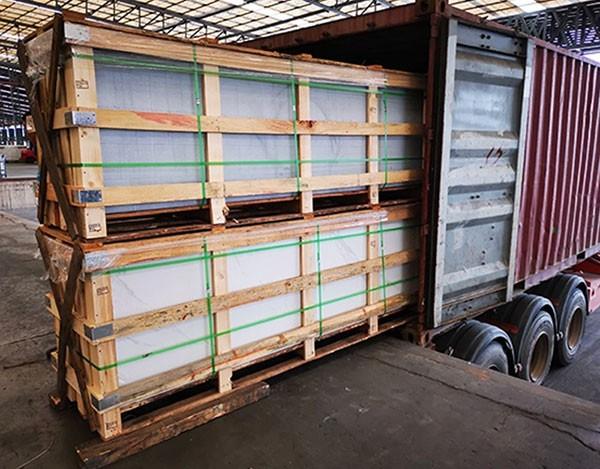
Ceramic tiles are heavy, fragile products that require careful packaging and transportation.
Exporters must ensure that products reach their destination without unacceptable damage and that shipment documentation is consistent with the goods supplied.
Large-format products may require specialized crates, handling equipment, and transport arrangements, while conventional tiles can generally use more standardized packaging.
Manufacturers should calculate the full landed cost, including packaging, inland transportation, freight, insurance where available, customs charges, and potential breakage.
Reliable delivery schedules and clear communication are essential for building trust with European distributors and construction companies.
۶.۵. Competition from Established European Producers
European ceramic markets include well-established manufacturers, particularly in Italy and Spain, with strong design identities, advanced production systems, and established distribution networks.
Iranian suppliers may face competition in:
- Product design and differentiation
- Consistency and quality assurance
- Brand recognition
- Technical documentation
- Distribution and customer support
- Delivery reliability
Competing exclusively through lower prices may not be sustainable.
Iranian manufacturers can strengthen their position by developing distinctive collections, improving production consistency, providing verifiable performance data, and focusing on specific product segments where they have a competitive advantage.
۷. A Practical Roadmap for Iranian Ceramic Manufacturers Seeking EU Compliance
For Iranian manufacturers, the most effective approach is to treat European compliance as a structured business-development process rather than a last-minute export requirement.
Recommended compliance roadmap
A practical sequence for preparing a ceramic tile product range for the European market.
- Conduct a product portfolio assessment
Identify the ceramic tile products with the strongest export potential. Record their dimensions, thickness, body type, intended application, and existing technical specifications.
- Identify applicable European standards and regulations
Verify the current harmonized specification, relevant edition of EN 14411, applicable CPR framework, and target-country requirements.
- Perform a technical gap analysis
Compare existing laboratory reports and product specifications against the required performance characteristics. Identify missing tests and areas needing improvement.
- Improve factory production control
Establish documented quality-control procedures, batch traceability, inspection criteria, and processes for managing nonconforming products.
- Complete laboratory testing
Arrange the required tests through competent laboratories, ensuring that samples are representative of commercial production.
- Prepare technical and environmental documentation
Develop technical data sheets, test reports, installation instructions, relevant chemical compliance information, and EPDs where commercially or legally appropriate.
- Complete the applicable conformity procedures
Establish whether CE marking and a declaration are required for the product, follow the applicable assessment and verification system, and complete the relevant procedures.
- Verify market access and commercial feasibility
Review sanctions, customs procedures, import requirements, logistics, payment arrangements, and the target buyer’s technical specifications.
- Build long-term relationships with European buyers
Provide reliable samples, accurate product information, consistent quality, and technical support to distributors, architects, and construction professionals.
۷.۱. Start with High-Potential Product Categories
Manufacturers should avoid spreading their resources across an excessively broad range of products at the beginning of their European compliance program.
Instead, they can prioritize products based on:
- Existing production capabilities
- Verified technical performance
- Market demand
- Design differentiation
- Manufacturing consistency
- Estimated compliance costs
- Transportation feasibility
For example, a manufacturer with an established porcelain production line may initially focus on selected porcelain floor tiles with documented low water absorption, suitable mechanical strength, and relevant surface characteristics.
Once the technical and commercial processes have been validated, the manufacturer can gradually expand its product range.
۷.۲. Develop a European-Ready Technical Catalogue
A professional technical catalogue can help European buyers evaluate products without repeatedly requesting basic information.
Each product entry should ideally include:
- Product name and identification code
- Dimensions and thickness
- Water absorption classification
- Relevant mechanical test results
- Surface finish
- Intended application
- Slip-resistance information, where applicable
- Installation and maintenance recommendations
- Applicable declarations and supporting documentation
Technical information should be accurate, consistent, and supported by evidence. Marketing claims should not exceed the performance demonstrated by testing.
۷.۳. Establish an Ongoing Compliance Management System
European requirements can change as regulations, harmonized standards, and environmental expectations evolve.
Manufacturers should regularly review regulatory updates and maintain current technical files for their export products.
An effective compliance management system should include:
- A designated person responsible for regulatory monitoring
- A register of applicable standards
- Updated laboratory reports
- Version-controlled technical documents
- Production and batch records
- Supplier compliance information
- Customer feedback and corrective-action records
This approach helps manufacturers respond more quickly to changing market requirements and provides greater confidence to international customers.
۸. Frequently Asked Questions About Iranian Ceramic Tiles and EU Standards
Do Iranian ceramic tiles meet European standards?
Some Iranian ceramic tiles may already meet the technical performance requirements of relevant European standards. However, compliance must be verified for each product based on its characteristics, intended use, applicable standard, and supporting documentation. The country of manufacture alone does not establish conformity.
Is CE marking compulsory for Iranian ceramic tiles exported to Europe?
CE marking is required when the product is covered by an applicable harmonized technical specification or European Technical Assessment and the relevant EU legislation requires it. Exporters must verify the current legal status and applicable requirements for their specific products.
Is EN 14411 sufficient for exporting ceramic tiles to the EU?
EN 14411 is a key product standard, but simply manufacturing according to it does not automatically fulfill all legal and commercial requirements. Exporters must also consider applicable CPR procedures, assessment and verification obligations, declarations, CE marking where required, and other relevant EU legislation.
Do Iranian manufacturers need an EU-based laboratory?
Not necessarily. Testing may be performed by a competent laboratory outside the EU, provided the test results and laboratory competence meet the applicable regulatory and commercial requirements. Where a notified body is required, the manufacturer must use an appropriately designated body for the relevant tasks.
Is ISO 9001 certification mandatory for exporting ceramic tiles to Europe?
ISO 9001 certification is not a universal legal requirement for ceramic tiles entering the EU. However, some European buyers may request it as part of their supplier qualification procedures. It can also support effective factory production control and quality management.
What tests are required for porcelain tiles in Europe?
Depending on the product and its intended application, relevant tests may include water absorption, dimensions, breaking strength, modulus of rupture, abrasion resistance, chemical resistance, stain resistance, frost resistance, and slip resistance. The exact requirements should be determined from the applicable standard and project specifications.
Do ceramic tiles require REACH compliance?
Relevant REACH obligations must be assessed based on the chemical substances present, the product’s classification, and the role of each business in the supply chain. Manufacturers should maintain reliable information about relevant substances and provide the required communication or documentation where applicable.
Can Iranian ceramic tiles be sold in Europe without an EPD?
An EPD is not a universal legal requirement for every ceramic tile placed on the European market. Nevertheless, environmental declarations can be commercially valuable for projects that require lifecycle information or apply sustainability-related procurement criteria. Specific requirements should be checked for the product and target project.
How long does it take to prepare Iranian ceramic tiles for European compliance?
There is no fixed timeframe. The process depends on existing factory capabilities, available test reports, product complexity, the applicable regulatory framework, laboratory schedules, and any required corrective actions. Manufacturers with established quality systems and complete technical records may be able to prepare more efficiently than factories starting from scratch.
۹. Conclusion: Turning European Compliance into a Competitive Advantage
The compatibility of Iranian ceramic tiles with European standards is an important factor in developing international export opportunities. However, successful access to the European Union requires more than manufacturing products with attractive designs and competitive prices. It requires verifiable technical performance, consistent production quality, appropriate documentation, and a clear understanding of applicable European regulations.
EN 14411 provides a central technical framework for ceramic tiles, while the Construction Products Regulation establishes the broader legal conditions for products covered by harmonized specifications. CE marking, where required, must be supported by the relevant conformity procedures and declarations. Additional considerations, including chemical safety, environmental transparency, and country-specific construction requirements, also play a role in market access.
For Iranian manufacturers, the most effective strategy is to develop a structured compliance program. This should begin with a product assessment, followed by technical gap analysis, laboratory testing, factory production control, and the preparation of accurate technical documentation. Exporters must also evaluate trade restrictions, logistics, and commercial requirements before entering into agreements with European buyers.
Looking toward 2027 and beyond, environmental transparency, traceability, and digital product information are expected to become increasingly important as the revised European construction products framework is implemented across product categories. Manufacturers that prepare early, invest in consistent quality, and develop technically differentiated products will be better equipped to respond to these changes.
European compliance should not be viewed solely as an administrative obligation. It can become a strategic advantage that builds buyer confidence, supports premium product positioning, and strengthens long-term international business relationships.
For Iranian ceramic manufacturers and exporters planning to enter the European market, working with experienced technical specialists, accredited testing laboratories, and qualified trade-compliance advisers is an important step toward building a reliable and sustainable export strategy.


نظرات ۰