


Discover the key differences between ceramic slabs and traditional ceramic tiles, from design flexibility and durability to installation costs and sustainability. Learn why European architects and developers are increasingly choosing large-format slabs for modern construction projects.
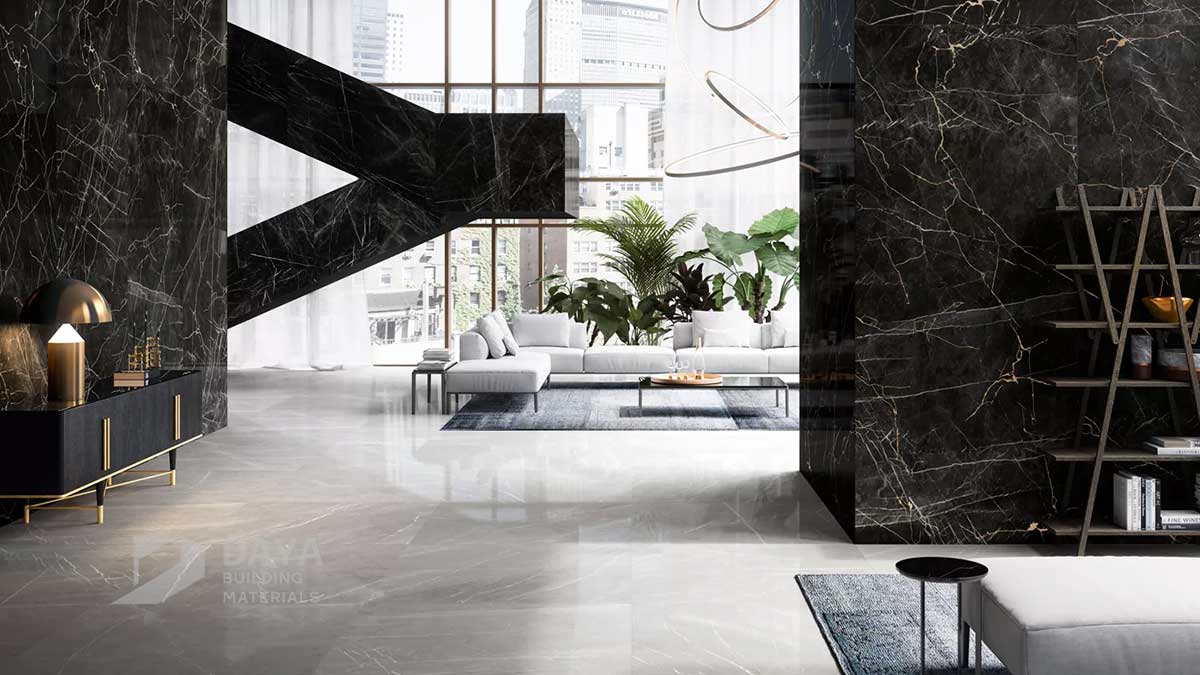
Imagine entering a modern European hotel where the floors, walls, reception desk, and bathroom surfaces share a seamless, elegant appearance. There are no distracting grout lines, no visual interruptions, and no unnecessary design elements. Instead, expansive surfaces create a sense of continuity, sophistication, and architectural harmony. This is one of the defining characteristics of large-format ceramic slabs, a product that is reshaping the way architects, designers, and developers approach contemporary construction.
For decades, traditional ceramic tiles have been the preferred choice for residential and commercial projects. Their affordability, versatility, ease of installation, and wide range of designs have made them an essential building material worldwide. However, changing architectural preferences, increasing demand for minimalist interiors, and advancements in ceramic manufacturing technology have created new opportunities for large-format surfaces.
Across European markets, where design innovation, material performance, and environmental considerations play important roles in construction, ceramic slabs are attracting growing attention. Architects and project developers are exploring alternatives to conventional tile formats to achieve uninterrupted surfaces, sophisticated aesthetics, and greater design flexibility.
But does a larger format automatically mean a better product? Not necessarily. Ceramic slabs and traditional tiles serve different purposes, and the right choice depends on project requirements, installation conditions, budget, and long-term performance expectations.
This article explores the fundamental differences between ceramic slabs and traditional ceramic tiles, examines the reasons behind the growing European interest in large-format surfaces, and evaluates their technical, economic, and environmental advantages. It also provides practical insights for manufacturers, exporters, importers, and construction professionals seeking to understand evolving market preferences and identify new business opportunities in the international ceramic industry.
۱. What Are Ceramic Slabs and Traditional Ceramic Tiles?
Although ceramic slabs and traditional ceramic tiles are manufactured from similar raw materials, they differ significantly in dimensions, thickness, manufacturing requirements, and architectural applications. Understanding these differences is essential for selecting the right material for residential, commercial, and large-scale construction projects.
What Are Ceramic Slabs?


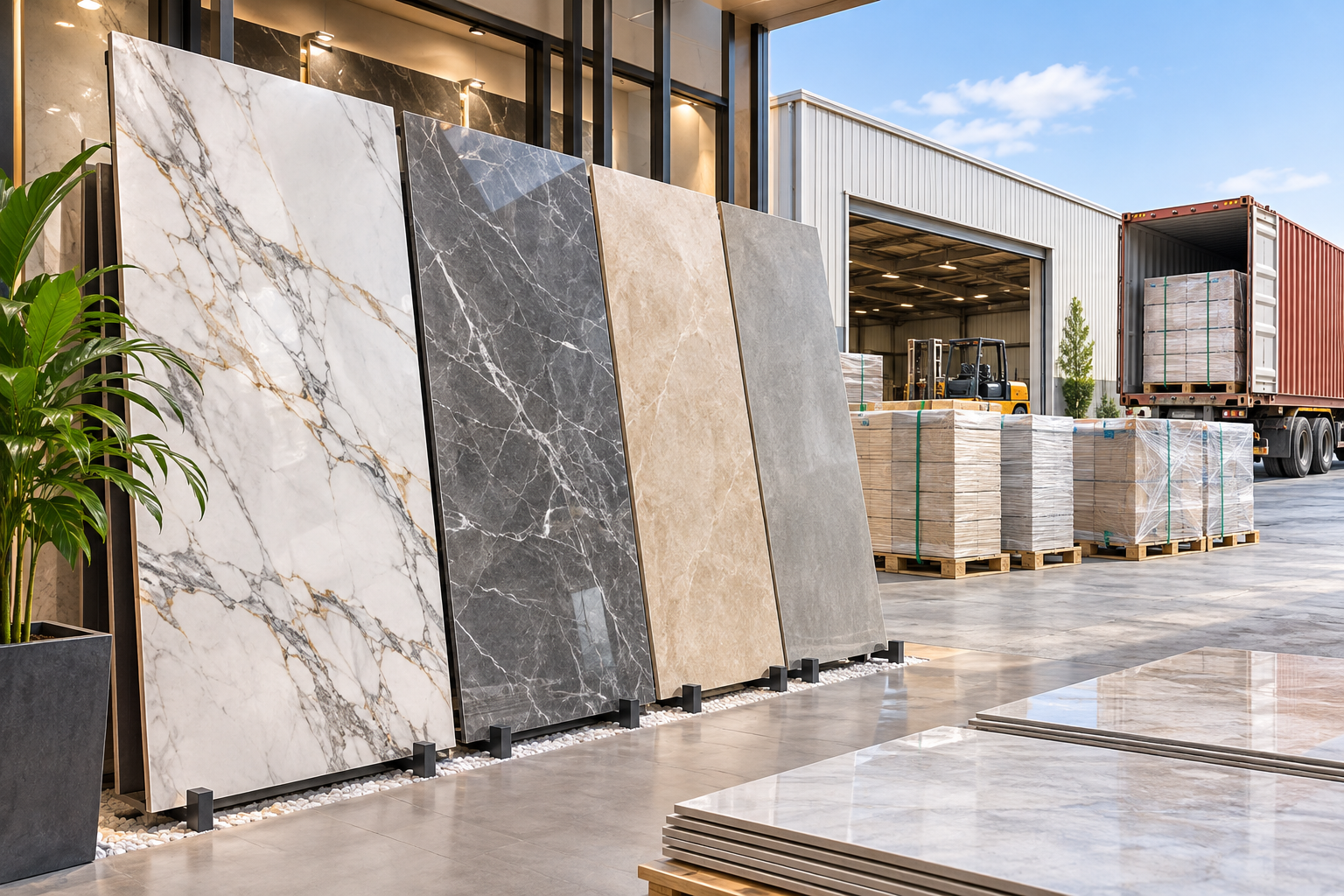
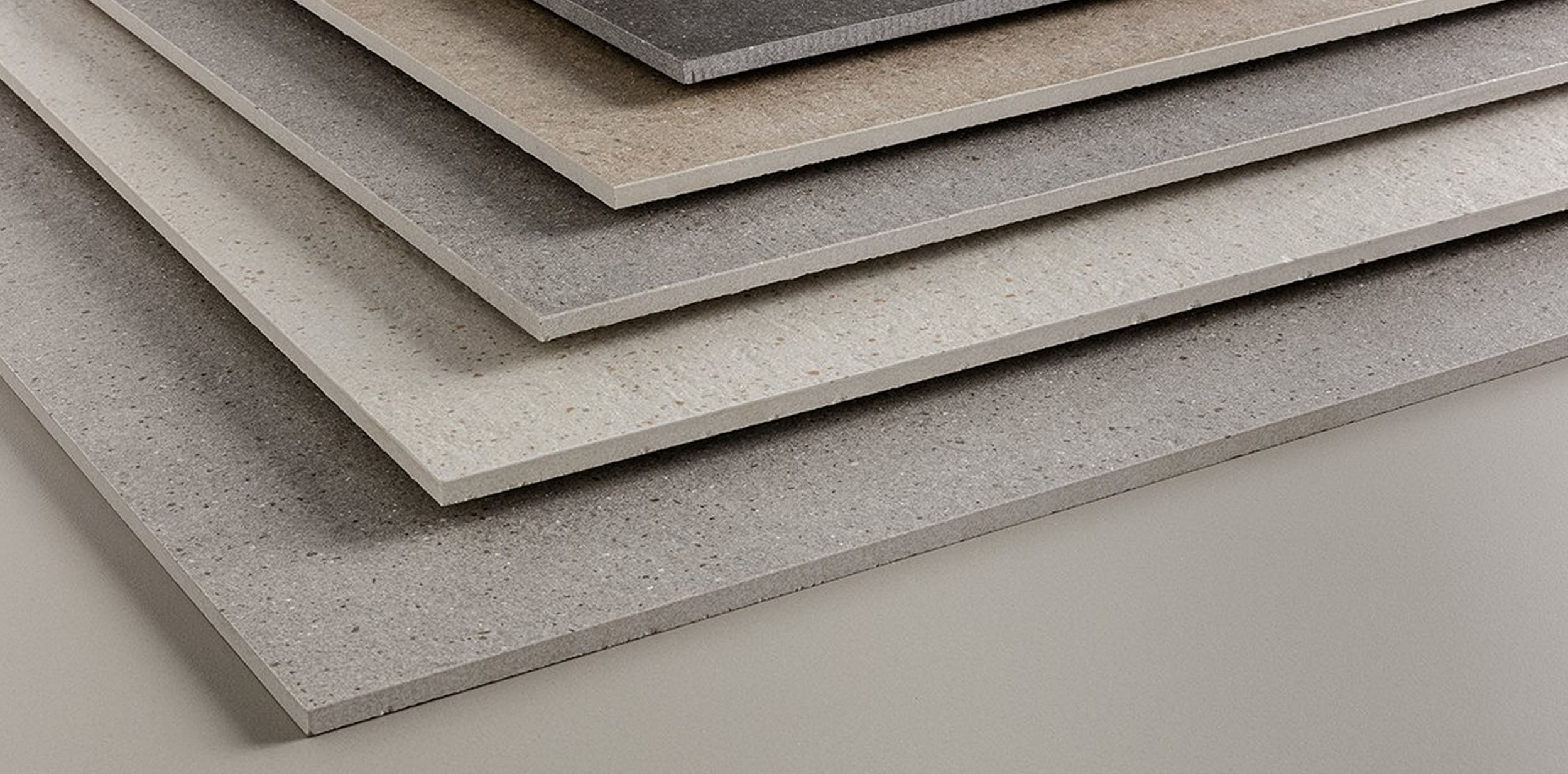
Ceramic slabs are large-format ceramic surfaces designed to cover extensive areas with fewer joints. They are typically manufactured using refined clay, feldspar, silica, mineral additives, and advanced ceramic production technologies. Many architectural slabs are made from porcelain stoneware, which is fired at high temperatures to achieve a dense, durable structure.
There is no single universal size that defines every ceramic slab. However, common large-format dimensions include:
- ۱۲۰ × ۲۴۰ cm
- ۱۲۰ × ۲۷۸ cm
- ۱۶۰ × ۳۲۰ cm
- ۱۰۰ × ۳۰۰ cm
Some manufacturers produce even larger panels for specialized architectural applications. Thickness also varies considerably, with products commonly available in ranges such as 3–۶ mm for certain lightweight panels and 6–۱۲ mm or more for other applications.
The main characteristic of ceramic slabs is their ability to create expansive surfaces with fewer visible joints. This makes them particularly suitable for modern architecture, where visual continuity and minimalist design are important.
Ceramic slabs can be used in various applications, including:
- Large residential floors and walls
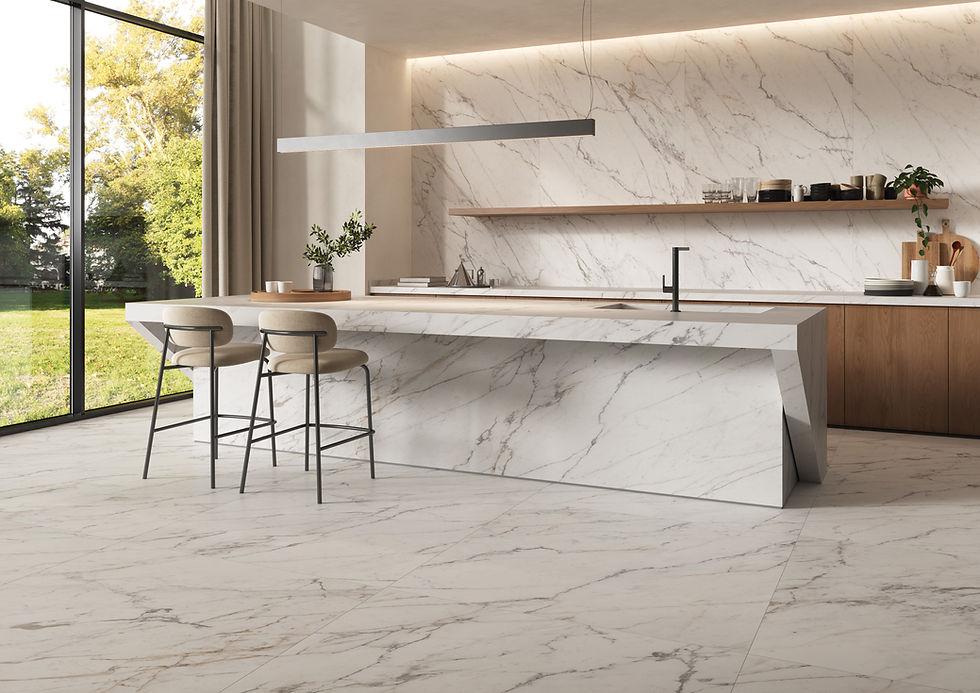
- Kitchen countertops and islands
- Bathroom walls and shower enclosures
- Hotel lobbies and reception desks
- Commercial façades
- Furniture and decorative architectural elements
Some ultra-thin slabs are engineered for wall cladding or furniture applications rather than direct installation as structural countertops. Reinforcement, edge finishing, and the manufacturer’s installation specifications are therefore essential considerations.
What Are Traditional Ceramic Tiles?


۸
Traditional ceramic tiles are smaller modular surfaces commonly used in residential, commercial, and industrial construction. They are produced through established ceramic manufacturing processes, including forming, drying, glazing where applicable, and firing.
Typical dimensions include:
- ۳۰ × ۳۰ cm
- ۳۰ × ۶۰ cm
- ۴۵ × ۴۵ cm
- ۶۰ × ۶۰ cm
- ۶۰ × ۱۲۰ cm
These products are available in a wide range of finishes, colors, patterns, thicknesses, and technical specifications. Traditional tiles can be made from standard ceramic bodies or high-performance porcelain, depending on the intended application.
Their modular dimensions provide flexibility in installation, particularly in rooms with complex layouts, multiple corners, narrow spaces, or irregular architectural features.
Traditional ceramic tiles remain widely used for:
- Residential floors and walls
- Kitchens and bathrooms
- Schools and healthcare facilities
- Retail stores and offices
- Outdoor walkways and terraces
- Industrial and utility spaces
One of their main advantages is accessibility. Smaller formats are generally easier to transport, cut, position, and replace. They also accommodate a wide variety of design patterns, including mosaics, decorative borders, and geometric arrangements.
Key Differences at a Glance
| Feature | Ceramic slabs | Traditional ceramic tiles |
|---|---|---|
| Dimensions | Large, often over 120 cm on one side | Generally smaller modular formats |
| Visual appearance | Continuous surfaces with fewer joints | More visible modular patterns |
| Thickness | Varies from ultra-thin to heavy-duty | Commonly around 6–۱۲ mm |
| Installation | Requires specialist handling | Usually simpler and more accessible |
| Cutting | Specialized equipment often required | Standard tile-cutting tools for many products |
| Design | Large-scale stone, marble and concrete effects | Broad range of colors, patterns and textures |
| Grout joints | Fewer joints per area | More joints per area |
| Initial material cost | Often higher for premium products | Wide range, including budget options |
| Replacement | May require specialist cutting and handling | Individual tiles are generally easier to replace |
| Applications | Premium interiors, façades, countertops and furniture | Residential, commercial and industrial surfaces |
The distinction is not simply about size. Ceramic slabs represent a broader shift toward integrated architectural surfaces, while traditional tiles offer modular flexibility and practical affordability. Both remain important in the international ceramic industry.
۲. Why Are European Architects Increasingly Choosing Ceramic Slabs?

European architecture has undergone considerable changes in recent years. Minimalist interiors, open-plan spaces, natural material aesthetics, and integrated design solutions have influenced how construction materials are selected.
Large-format ceramic slabs align with these preferences because they provide extensive design surfaces without the visual interruptions associated with conventional tile layouts.
According to a 2025 report published by Spain’s ceramic industry association, ASCER, the percentage of large-format porcelain slabs produced by surveyed Spanish manufacturers doubled between 2021 and 2023. The report defines large-format slabs as surfaces exceeding 1 m², with at least one side measuring over 120 cm.
portal.ascer.es
This provides a tangible indication of increasing manufacturing interest, although it does not mean every European project is moving away from traditional tiles.
۲.۱. The Growing Demand for Minimalist Architecture
Minimalism is an influential design approach in contemporary European residential and commercial construction. It emphasizes clean lines, simple geometries, natural colors, and functional spaces.
Traditional ceramic tiles can create beautiful interiors, but their repeated grout lines may interrupt the appearance of large, uninterrupted surfaces.
Ceramic slabs help architects achieve:
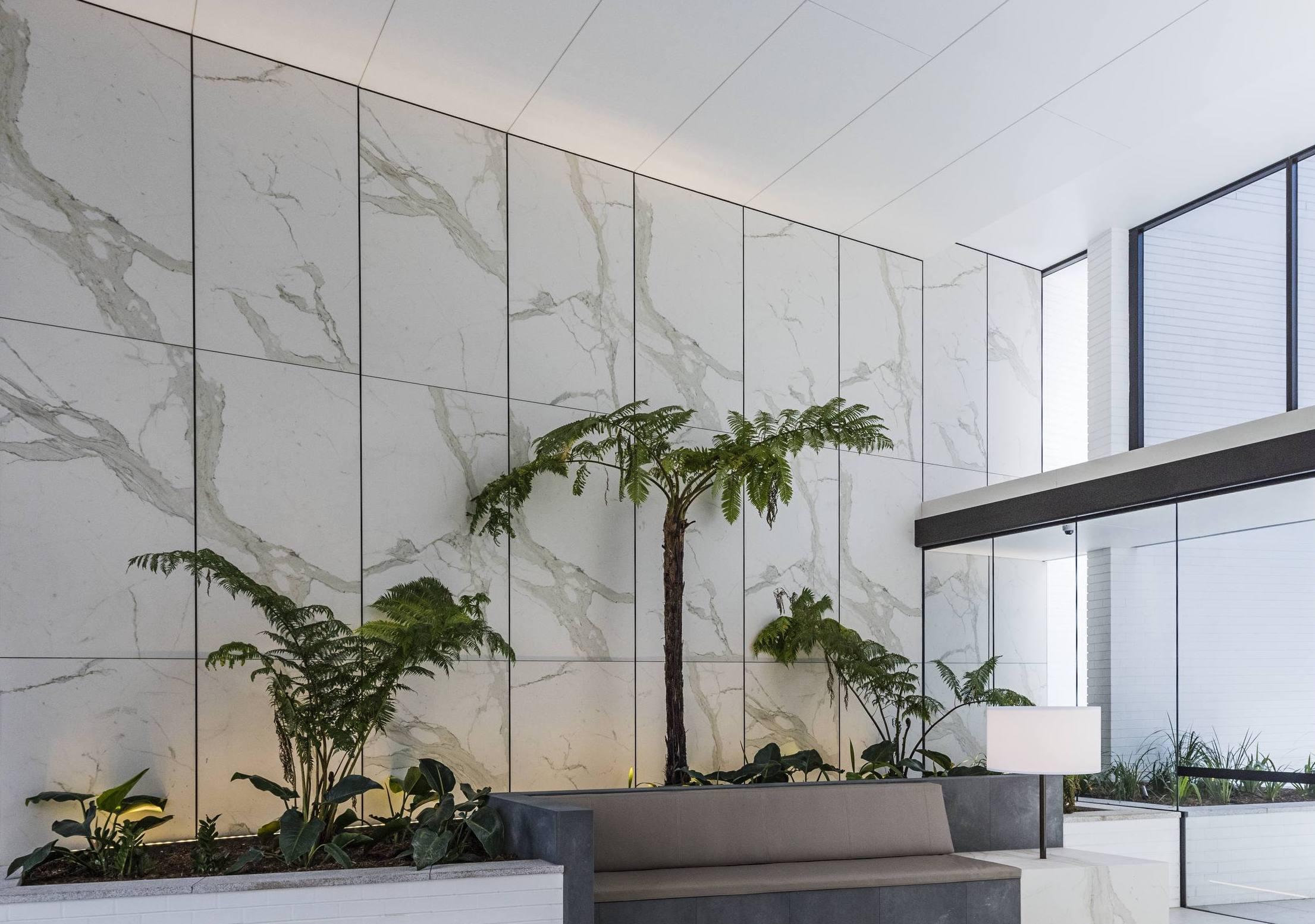
- Continuous marble-inspired walls
- Visually expansive flooring
- Minimalist bathroom interiors
- Integrated kitchen surfaces
- Consistent design across multiple rooms
For example, a luxury apartment in Germany may use large-format marble-effect porcelain slabs across the living room floor, kitchen island, and feature wall. Using a coordinated slab collection can create a unified appearance without relying on multiple decorative materials.
This approach is especially attractive in open-plan properties, where kitchens, dining rooms, and living areas connect without physical partitions.
۲.۲. Greater Visual Continuity and Fewer Grout Lines
One of the most recognizable advantages of ceramic slabs is the reduction in visible joints.
Traditional tiles require grout joints between individual pieces. While grout is necessary for many installations, it introduces additional lines into the overall design.
Large-format slabs reduce the number of joints, creating a cleaner appearance and making certain natural-stone-inspired patterns easier to appreciate.
For instance, a wall measuring 3 × ۲.۷ meters could be covered using a small number of large-format panels rather than dozens of conventional tiles. The exact number depends on the selected dimensions, layout, cutting allowances, and installation method.
Fewer grout lines can also reduce the number of grout surfaces that require routine cleaning. However, slabs still require properly designed movement joints, perimeter joints, and appropriate sealing or maintenance of any specified grout.
۲.۳. Premium Aesthetics for Luxury Residential Projects
European luxury residential developments increasingly use materials that combine sophisticated aesthetics with practical performance.
Large-format porcelain slabs can reproduce the appearance of marble, travertine, limestone, granite, and concrete using advanced digital printing and surface-texturing technologies.
Manufacturers can also coordinate veining patterns across multiple panels to create bookmatched effects, where adjacent surfaces appear as mirror images of one another.
This is particularly valuable in:
- Luxury apartments in Paris
- Contemporary villas in Italy
- High-end residential developments in Spain
- Premium bathrooms in Germany
- Modern waterfront properties in the Mediterranean
The appeal is not limited to visual elegance. Porcelain slabs can offer low water absorption, resistance to many household chemicals, and good surface durability when the appropriate product is selected.
۲.۴. A Shift Toward Integrated Architectural Surfaces
European designers increasingly consider floors, walls, furniture, and worktops as interconnected parts of one architectural composition.
Instead of choosing separate materials for each surface, architects may select a coordinated slab collection for several applications.
A hotel project, for example, might use the same design language across reception counters, bathroom walls, vanity tops, and selected flooring areas.
This creates a consistent identity throughout the building and can simplify the design process when products are available in coordinated finishes and sizes.
The trend is also reflected in European ceramic industry investments. In 2025, industry reporting highlighted significant expansion and modernization of slab production capacity, including investments in automated handling and advanced surface technologies.
For manufacturers and exporters, this shift creates opportunities to supply not only individual ceramic products but also complete surface solutions supported by technical documentation, design coordination, and installation guidance.
۳. Technical Differences: Durability, Thickness, Water Absorption, and Performance

Aesthetic differences are immediately visible, but the technical characteristics of ceramic slabs and traditional tiles are equally important. Architects, contractors, and importers must understand how manufacturing methods, thickness, body composition, and intended use influence product performance.
It is important to distinguish between size and material quality. A large slab is not automatically stronger, more durable, or more water-resistant than a smaller tile. Performance depends on the ceramic body, firing conditions, thickness, surface finish, reinforcement, and product testing.
۳.۱. Manufacturing Technology and Material Composition
Both ceramic slabs and traditional tiles are manufactured using mineral-based raw materials. However, producing large-format slabs requires greater control over material preparation, forming, drying, firing, and dimensional stability.
Large-format porcelain products may use advanced pressing or continuous forming technologies to create large surfaces with consistent density and controlled thickness.
During manufacturing, producers must carefully manage:
- Raw material particle size and consistency
- Moisture content
- Forming pressure and material distribution
- Drying conditions
- Kiln temperature and firing cycles
- Dimensional calibration and surface quality
The larger the product, the more demanding dimensional control becomes. Even minor variations in flatness, shrinkage, or internal stress can affect the final quality of a large panel.
Traditional tiles are also subject to strict quality requirements, but their smaller dimensions can make certain aspects of production and handling more manageable.
۳.۲. Thickness and Structural Performance
Thickness is a major factor in determining how a ceramic product can be used.
Traditional floor tiles are commonly manufactured at thicknesses suitable for their intended loading and installation conditions. Large-format slabs, by contrast, may be produced in several thickness categories to serve different architectural applications.
| Slab or tile type | Indicative thickness | Common applications |
|---|---|---|
| Ultra-thin ceramic panels | ۳–۴ mm | Wall cladding and selected furniture systems |
| Thin porcelain slabs | ۵–۶ mm | Walls, renovations and specified cladding systems |
| Standard large-format slabs | ۶–۱۲ mm | Floors, walls and selected worktops |
| Heavy-duty porcelain slabs | ۱۲–۲۰ mm or more | Countertops, outdoor paving and demanding applications |
| Traditional ceramic tiles | ۶–۱۲ mm | Residential and commercial floors and walls |
These are indicative ranges, not universal product standards.
Ultra-thin slabs are lighter and may be suitable for certain renovation projects where minimizing additional structural load is important. However, they often require a carefully specified support system, and some applications need reinforcement or backing materials.
Thicker slabs may provide greater resistance to certain mechanical stresses, but performance must be assessed through technical test data rather than thickness alone.
۳.۳. Water Absorption and Porosity
Water absorption is an important technical property, especially for bathrooms, kitchens, commercial facilities, and outdoor environments.
Porcelain stoneware is commonly classified by water absorption of 0.5% or less under the relevant ceramic tile standards, including ISO 13006 and EN 14411.
Its low porosity makes it suitable for many applications where moisture resistance is essential.
Traditional ceramic tiles may have higher water absorption, depending on whether they are wall tiles, floor tiles, or porcelain products. A conventional porcelain tile can have water absorption comparable to that of a large-format porcelain slab.
Therefore, when comparing products, buyers should evaluate the actual water absorption classification rather than assume that a slab always outperforms a traditional tile.
۳.۴. Resistance to Scratches, Stains, and Chemicals
Porcelain slabs are often selected for applications requiring a durable, hygienic, and easy-to-maintain surface.
Their performance may include:
- Resistance to many common household stains
- Good abrasion resistance, depending on the surface and application
- Resistance to many household chemicals
- Low moisture absorption
- Stability under normal indoor temperature variations
However, surface finish makes a difference. Polished surfaces may show scratches or wear differently from matte or textured surfaces. Glossy finishes can also make certain marks more visible.
Traditional ceramic tiles can provide comparable performance when manufactured to appropriate technical specifications. For example, a high-quality porcelain floor tile may be more suitable for a demanding commercial application than an ultra-thin slab designed exclusively for vertical cladding.
۳.۵. Mechanical Strength and Load Distribution
Large-format slabs require particular attention to substrate preparation and installation because their dimensions make them sensitive to uneven support and handling stresses.
A slab installed on an uneven substrate can experience localized stress, increasing the risk of cracking or failure. This is especially important for countertops, suspended applications, and areas subject to concentrated loads.
For European commercial projects, product selection should consider:
- Breaking strength and modulus of rupture
- Surface abrasion classification where relevant
- Slip resistance for floor applications
- Thermal and moisture conditions
- Intended mechanical loads
- Installation system and substrate compatibility
The best material is therefore not necessarily the largest or thickest one. It is the product whose tested performance and installation system match the project’s technical requirements.
۴. Design Flexibility: How Ceramic Slabs Transform Modern Interiors


Design flexibility is one of the most significant reasons architects are incorporating ceramic slabs into contemporary European projects. Beyond covering floors and walls, large-format ceramic surfaces can become central design elements that connect different architectural features.
Unlike traditional modular tiles, slabs offer extensive uninterrupted areas, allowing designers to work with large-scale patterns, continuous veining, and coordinated surface finishes.
۴.۱. Realistic Natural Stone and Marble Effects
Natural stone has traditionally been associated with luxury architecture. Marble, travertine, and granite remain popular in high-end European construction because of their distinctive textures and natural patterns.
However, natural stone can involve considerable costs, maintenance requirements, weight, and variations in quality.
Modern porcelain slabs provide an alternative by combining advanced digital printing with textured surface technologies. These methods reproduce the appearance of natural materials while offering the technical characteristics of porcelain.
Contemporary ceramic collections may include:
- Calacatta-inspired marble with dramatic veining
- Travertine-inspired surfaces with linear textures
- Limestone effects in warm neutral tones
- Industrial concrete appearances
- Natural stone patterns with three-dimensional structures
European ceramic design trends in 2025 continued to highlight large-format porcelain surfaces with sophisticated stone effects, including onyx and marble designs that interact with lighting.
For designers, these technologies create opportunities to achieve natural-looking interiors while maintaining greater consistency between production batches, subject to the manufacturer’s shade and pattern controls.
۴.۲. Bookmatching and Continuous Veining
Bookmatching is a decorative technique in which two adjacent panels display mirrored patterns, creating the appearance of an open book.
This approach is particularly popular for marble-inspired designs in luxury hotels, residential feature walls, and premium commercial spaces.
Large-format slabs are well suited to bookmatching because their dimensions allow more of the printed pattern to remain visible.
For example, a hotel reception area may feature two mirrored slabs behind the reception desk, creating a dramatic focal point without the visual interruptions of numerous smaller tiles.
Successful bookmatching requires coordinated production patterns, appropriate slab selection, and careful installation planning. Not every marble-effect slab collection is designed for this purpose, so pattern sequencing should be confirmed before ordering.
۴.۳. Indoor and Outdoor Design Continuity
Another important architectural trend is the integration of indoor and outdoor spaces.
European residential projects, particularly villas and properties with terraces, increasingly use coordinated floor finishes to visually connect interior living spaces with external environments.
Large-format porcelain products designed for both indoor and outdoor applications can support this approach.
For example, a living room may use a smooth porcelain slab, while a terrace uses a coordinating textured or thicker porcelain product with appropriate slip resistance and outdoor durability.
The key is to select products specifically tested and approved for their intended exposure conditions. Indoor polished surfaces should not automatically be used outdoors, where wet conditions, frost resistance, and slip performance require additional consideration.
۴.۴. Furniture and Customized Architectural Applications
Large-format ceramic slabs are no longer restricted to floors and walls. They are increasingly used in furniture manufacturing and customized architectural elements.
Potential applications include:
- Kitchen islands and worktops
- Bathroom vanity units
- Dining tables
- Reception desks
- Decorative shelving
- Cabinet fronts
- Wall-mounted furniture panels
This expansion creates opportunities for manufacturers to reach markets beyond conventional tile distribution.
For instance, a furniture manufacturer can use a porcelain slab to create a coordinated tabletop and matching wall panel. This helps establish a consistent visual identity across the interior.
However, fabrication requirements vary significantly. Cutouts for sinks and cooktops, edge profiling, bonding systems, and reinforcement must be designed for the selected product. Large-format ceramic slabs intended for furniture may require specialized fabricators and carefully engineered support.
۴.۵. Digital Printing and Surface Innovation
Digital inkjet printing has transformed the design possibilities of ceramic products.
Modern printing systems can apply highly detailed patterns to ceramic surfaces, while additional technologies introduce tactile structures, gloss variations, and realistic natural-material effects.
Some manufacturers combine digital decoration with three-dimensional surface texturing to create more convincing stone-like appearances.
These developments enable manufacturers to differentiate their products through:
- More realistic material reproduction
- Greater pattern variety
- Coordinated designs across multiple formats
- Specialized surface finishes
- Premium collections for architectural specifications
For ceramic exporters, this technological progress offers an opportunity to compete through design value rather than relying exclusively on low prices.
۵. Installation, Transportation, and Maintenance: Which Is More Practical?


۱۱
Although ceramic slabs offer substantial design advantages, their large dimensions introduce logistical and installation challenges. These factors can influence total project costs and determine whether slabs are suitable for a particular construction site.
۵.۱. Installation Complexity
Installing large-format ceramic slabs requires specialist knowledge, suitable equipment, and detailed preparation.
Depending on slab size and weight, installation may require multiple trained workers, mechanical lifting systems, vacuum suction equipment, and dedicated cutting tools.
The installation process generally involves:
- Assessing the substrate for strength, flatness, and suitability.
- Planning slab orientation, joints, and cutting requirements.
- Preparing the correct adhesive and application method.
- Handling and positioning the slab using suitable equipment.
- Checking coverage, alignment, and flatness.
- Completing the required joints, finishing, and curing procedures.
Large slabs can be particularly challenging in buildings with narrow staircases, small elevators, restricted corridors, or limited access.
Traditional tiles are generally easier to handle because of their smaller size and lower individual weight. Many standard formats can be installed using conventional tile-cutting equipment and established installation methods.
However, large traditional tiles can also require specialist installation. Format alone does not determine the level of difficulty.
۵.۲. Cutting and Fabrication Requirements
Ceramic slabs often require specialized machinery, such as bridge saws, waterjet cutters, and suitable diamond tooling.
Cutting must be carefully planned to minimize waste and prevent chipping or breakage, especially around corners, edges, and openings.
Fabrication requirements are particularly important for kitchen countertops, bathroom vanities, and furniture applications.
Traditional ceramic tiles generally require simpler cutting methods, such as manual scoring tools or conventional wet saws, depending on their composition and thickness.
This can reduce equipment costs for contractors working primarily with smaller formats.
۵.۳. Transportation and Handling
Large-format slabs present specific transportation challenges because their dimensions make them more vulnerable to bending stresses, impact, and improper handling.
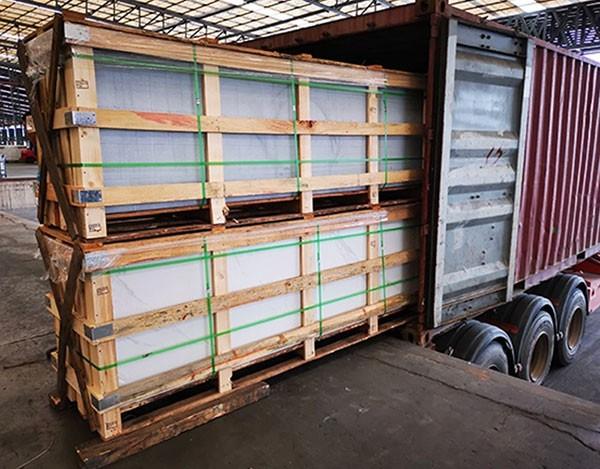
Manufacturers and exporters need suitable packaging systems, protective frames, secure loading methods, and clear handling instructions.
International shipments may require:
- Reinforced transport crates
- Custom-designed slab racks
- Specialized loading equipment
- Careful container loading plans
- Suitable unloading facilities at the destination
Traditional tiles are typically easier to package into standardized cartons and palletized shipments. Their modular dimensions also make them easier to store and distribute through conventional building-material supply chains.
For importers, transportation costs should therefore be calculated on the basis of packaging, weight, volume, handling, and potential breakage rather than simply comparing the product’s price per square meter.
۵.۴. Maintenance and Cleaning
One of the practical advantages of large-format slabs is the reduction in grout joints.
Fewer joints can mean fewer areas where dirt, soap residue, or other contaminants accumulate. This may be especially useful in hotels, modern bathrooms, and commercial environments where frequent cleaning is necessary.
Porcelain slabs are generally easy to maintain with suitable cleaning products and routine care.
Traditional tiles can also be easy to clean, but grout joints may require additional attention depending on the grout type, installation quality, and exposure conditions.
For both product categories, maintenance depends on the surface finish and manufacturer’s recommendations. Certain polished surfaces, textured finishes, and specialized coatings may require specific cleaning methods.
۵.۵. Repair and Replacement
Traditional tiles often have an advantage when localized repairs are needed.
If an individual tile becomes damaged, it may be possible to remove and replace that piece without disturbing a large surrounding area.
Replacing a damaged slab can be more complicated, particularly if the product has a distinctive pattern or forms part of a continuous design.
Repair options depend on the slab’s location, accessibility, installation system, and the availability of matching material.
For commercial projects where future maintenance is a priority, architects should consider spare-product availability, batch consistency, and the potential cost of replacement before selecting large-format surfaces.
۶. Cost Comparison: Are Ceramic Slabs More Expensive Than Traditional Tiles?
The cost of ceramic slabs is one of the most important considerations for developers, contractors, and importers. Although slabs often have a higher purchase price per square meter, the total cost of a completed installation depends on several additional factors.
Comparing products solely on their purchase price can therefore lead to inaccurate project budgets.
۶.۱. Initial Material Costs
Large-format ceramic slabs, particularly premium porcelain products, may have higher manufacturing costs because they require advanced production equipment, more demanding quality control, specialized packaging, and greater investment in handling systems.
Traditional ceramic tiles are available across a wider range of price categories, from economical residential products to premium porcelain collections.
The final price depends on several variables:
- Raw material quality
- Manufacturing technology
- Product dimensions and thickness
- Surface finish and design complexity
- Brand positioning
- Production volume
- Transportation and distribution costs
For example, a standard ceramic wall tile intended for a budget residential development will generally occupy a different price category from a premium marble-effect porcelain slab designed for a luxury hotel.
However, not all slabs are more expensive than all conventional tiles. Some premium traditional porcelain tiles can cost more than entry-level large-format products.
۶.۲. Installation and Labor Costs
Installation is another major factor in the overall project budget.
Large-format slabs may require specialist installers, additional workers, mechanical handling equipment, and more extensive preparation.
These requirements can increase labor costs, especially in locations where qualified slab installers are limited.
Traditional tiles are often more economical to install in projects where conventional contractors and readily available tools are sufficient.
However, larger slabs can reduce the number of individual pieces that must be positioned and aligned. In certain projects, this may offset part of the additional installation expense.
The final result depends on site accessibility, substrate conditions, the selected installation system, labor rates, and the experience of the installation team.
۶.۳. Grout, Cleaning, and Long-Term Costs
Large-format slabs typically require fewer grout joints across a given surface area. This can reduce the amount of grout required and may simplify certain maintenance operations.
Traditional tiles have more joints, which can increase the area requiring routine grout cleaning or occasional maintenance.
Nevertheless, grout quantities and costs are generally only one part of the overall project budget. They should not be treated as the decisive factor when selecting between the two products.
A lifecycle cost assessment should consider the expected service life, cleaning requirements, repair costs, replacement availability, and suitability of the installation system.
۶.۴. Example of a Project Cost Comparison
Consider a hypothetical 100-square-meter interior renovation. The following figures are illustrative only and are not current market quotations.
| Cost category | Traditional tiles | Ceramic slabs |
|---|---|---|
| Material cost per m² | €۲۵ | €۵۵ |
| Installation per m² | €۲۰ | €۳۵ |
| Additional handling per m² | €۲ | €۸ |
| Indicative total per m² | €۴۷ | €۹۸ |
| Total for 100 m² | €۴,۷۰۰ | €۹,۸۰۰ |
Illustrative figures only. Actual costs vary by country, supplier, product, project conditions, and installation method. Waste allowances and substrate preparation are excluded.
In this example, slabs have a higher initial installed cost. However, the slab option may be justified in projects where design continuity, premium positioning, or integrated architectural applications are central to the project’s value.
For a budget-sensitive residential development, traditional tiles may offer a more appropriate balance of cost and performance.
For a luxury hotel or premium commercial interior, slabs may provide design benefits that justify the additional expenditure.
The most effective approach is to compare the total installed cost against the functional and aesthetic value each material delivers.
۷. Sustainability and Environmental Performance in the European Market

Sustainability has become an increasingly important consideration in the European construction industry. Manufacturers, developers, architects, and building owners are under growing pressure to evaluate the environmental impact of building materials throughout their lifecycle.
Ceramic slabs and traditional ceramic tiles are both mineral-based products, but their environmental performance depends on how they are manufactured, transported, installed, maintained, and eventually managed at the end of their useful life.
۷.۱. Material Efficiency and Thin Slab Technology
One potential environmental advantage of certain ceramic slabs is their reduced thickness.
Thin porcelain panels can use less raw material per square meter than thicker ceramic products, depending on their composition and design.
This may reduce the quantity of mineral resources required during production and lower the weight of the finished product.
Some manufacturers have developed ultra-thin ceramic panels for architectural cladding and furniture applications. In 2025, European industry developments included the commercialization of 2 mm ceramic surface technologies, demonstrating how manufacturers are expanding into thinner and lighter architectural products.
HTF MI
However, thinner does not automatically mean more sustainable.
Additional reinforcement, backing materials, specialized adhesives, increased breakage, or complicated installation methods may affect the total environmental footprint.
A reliable comparison requires product-specific lifecycle data rather than assumptions based only on thickness.
۷.۲. Energy Consumption and Carbon Emissions
Ceramic manufacturing is energy-intensive, particularly during the firing process.
Kilns require high temperatures to produce ceramic bodies with the desired physical and technical properties. Energy consumption and emissions can vary depending on kiln technology, fuel sources, firing cycles, and production efficiency.
A 2025 study published in the International Journal of Applied Ceramic Technology estimated the global warming potential of ceramic tiles at 14.4 kg of CO₂ equivalent per square meter in its assessed context. It also highlighted the industry’s substantial energy-related emissions and
This figure should not be treated as a universal footprint for every tile or slab. Environmental impacts vary by production location, product specification, energy mix, and lifecycle assessment methodology.
Manufacturers are exploring several strategies to reduce environmental impacts:
- Improving kiln thermal efficiency
- Recovering waste heat
- Increasing renewable electricity use
- Optimizing raw material preparation
- Reducing production waste
- Improving process automation
- Developing lower-carbon manufacturing systems
These measures can benefit both large-format slabs and traditional ceramic tiles.
۷.۳. Transportation and Logistics
Transportation is another important part of the environmental assessment.
Large-format slabs may require reinforced packaging and specialized transport systems. Their weight and dimensions can influence shipping efficiency, particularly when products are exported over long distances.
Thin slabs may reduce the weight transported per square meter in certain applications, but the actual benefit depends on packaging, loading efficiency, and breakage rates.
Traditional tiles often benefit from standardized packaging and established distribution networks, which may provide logistical advantages for certain shipments.
For international exporters, optimizing packaging, container utilization, and shipment planning can reduce both freight costs and associated emissions.
۷.۴. Durability, Maintenance, and Lifecycle Value
Ceramic products can offer long service lives when correctly specified and installed.
Porcelain slabs and traditional porcelain tiles can resist moisture, staining, and everyday wear, making them suitable for many demanding environments.
A durable product may reduce the need for frequent replacement, helping to lower resource consumption over the building’s lifetime.
However, actual durability depends on the application, product characteristics, installation quality, maintenance practices, and exposure conditions.
For European construction projects, environmental product declarations (EPDs), verified lifecycle assessments, and documented material characteristics can help architects compare products more reliably.
۷.۵. European Environmental Requirements and Product Transparency
European buyers increasingly value clear environmental documentation alongside technical performance.
Manufacturers and exporters targeting Europe should be prepared to provide relevant product information, including:
- Environmental Product Declarations, where available
- Product technical data sheets
- Water absorption and strength test results
- Information on recycled content, if verified
- Manufacturing and quality-control documentation
- Applicable conformity and regulatory information
Sustainability claims should be specific, verifiable, and based on documented evidence.
For manufacturers competing in premium European markets, environmental transparency can strengthen buyer confidence and support specification by architects, developers, and construction consultants.
۸. Why Ceramic Slabs Create New Opportunities for European Construction and International Trade

The growing interest in large-format ceramic surfaces is creating opportunities throughout the ceramic supply chain. Manufacturers, distributors, importers, exporters, fabricators, and installation specialists can all benefit from understanding the changing requirements of architectural projects.
Europe remains a major center for ceramic manufacturing and design innovation, particularly in Italy and Spain. These markets combine established production capabilities with strong relationships among manufacturers, architects, designers, and distributors.
Industry reporting in 2025 and 2026 highlighted continued investment in slab manufacturing, production automation, and specialized logistics infrastructure.
These developments demonstrate that large-format products are an important area of strategic investment, although market adoption differs across countries and project categories.
۸.۱. Moving from Price Competition to Value-Based Competition
Traditional ceramic tile markets often involve intense price competition, particularly for standardized products with limited design differentiation.
Large-format slabs provide manufacturers with opportunities to compete through additional value propositions, including:
- Advanced digital printing
- Distinctive surface textures
- Premium marble and stone effects
- Specialized thicknesses
- Coordinated architectural collections
- Custom fabrication capabilities
- Technical support for installation
For manufacturers in emerging ceramic-producing countries, these features can create opportunities to enter higher-value market segments.
However, competing in the European premium market requires more than attractive product designs. Consistent quality, reliable delivery, technical documentation, professional packaging, and after-sales support are equally important.
۸.۲. Opportunities for Iranian Ceramic Manufacturers
Iran has an established ceramic tile manufacturing sector, supported by domestic raw material resources, production infrastructure, and experience in exporting ceramic products to regional markets.
For Iranian manufacturers and exporters, large-format porcelain slabs may offer a pathway toward product differentiation and higher-value international sales.
Potential opportunities include:
- Supplying marble-effect porcelain slabs to premium residential projects
- Developing large-format products for hotel and commercial interiors
- Producing coordinated slab collections for kitchen and bathroom applications
- Targeting regional distributors seeking alternatives to established European suppliers
- Building partnerships with international fabricators and architectural material companies
To compete successfully in Europe, Iranian suppliers would need to address technical conformity, import requirements, transportation constraints, market access, and customer expectations.
Product consistency and proven technical performance are particularly important because large-format products can be more vulnerable to handling and installation errors.
Exporters should also evaluate the commercial implications of applicable tariffs, trade restrictions, payment arrangements, and shipping routes before entering a target market.
۸.۳. The Importance of Technical Documentation and Product Certification
European construction projects often require detailed product specifications before materials can be approved.
Exporters should prepare clear technical documentation covering:
- Product dimensions and thickness tolerances
- Water absorption
- Breaking strength
- Surface abrasion characteristics, where applicable
- Slip resistance for floor applications
- Chemical resistance
- Frost resistance for relevant outdoor applications
- Installation and maintenance instructions
Depending on the product and its intended use, applicable European standards and regulatory requirements must be assessed.
Reliable technical documentation helps distributors, architects, and contractors evaluate products and reduces uncertainty during specification and installation.
۸.۴. Developing Stronger Relationships with Architects and Distributors
Unlike conventional commodity products, premium ceramic slabs often require more direct engagement with design professionals and specialist fabricators.
Architects need accurate samples, realistic surface representations, dimensional information, and reliable technical support.
Distributors need dependable supply, appropriate storage solutions, clear product identification, and access to trained installation partners.
Manufacturers can strengthen their market position by providing:
- High-quality physical samples and coordinated design collections.
- Digital catalogues, technical drawings, and product visualization resources.
- Training for installers and fabricators.
- Reliable production schedules and inventory management.
- Responsive after-sales service.
These capabilities can help exporters build lasting business relationships instead of competing exclusively on unit price.
۸.۵. Market Positioning for the Future
The future of ceramic exports is likely to involve a wider range of products and services rather than a single preferred format.
Traditional tiles will remain relevant for cost-sensitive housing, renovation, and modular applications. Large-format slabs will offer opportunities in premium architecture, integrated surfaces, and specialized furniture and façade markets.
For international suppliers, a balanced product portfolio can provide greater resilience.
Companies that combine conventional ceramic tiles with differentiated porcelain slabs, technical support, and dependable logistics may be better positioned to serve different customer segments as architectural preferences evolve.
۹. Frequently Asked Questions About Ceramic Slabs and Traditional Tiles
Are ceramic slabs better than traditional ceramic tiles?
Neither product is universally better. Ceramic slabs are particularly suitable for projects requiring large, visually continuous surfaces and fewer grout joints. Traditional tiles are often more practical for budget-sensitive developments, complex layouts, and installations where ease of handling and replacement are priorities.
The best option depends on the project’s design, technical requirements, budget, and installation conditions.
Are porcelain slabs stronger than ordinary ceramic tiles?
Not necessarily. Porcelain slabs often have low water absorption and good mechanical properties, but strength depends on the product’s composition, thickness, manufacturing quality, and intended use.
A high-quality traditional porcelain tile may outperform an ultra-thin slab in certain mechanical applications. Always compare the technical specifications of the actual products.
Why are large-format ceramic slabs popular in European architecture?
Large-format slabs support minimalist design, reduce the number of visible joints, and allow coordinated surfaces across floors, walls, countertops, and furniture.
Their popularity is also supported by advancements in digital printing, realistic natural-stone effects, and production technologies. European manufacturers have expanded their large-format production capabilities in response to architectural demand.
Are ceramic slabs more expensive to install?
They can be. Large-format slabs may require specialist installers, additional handling equipment, more careful substrate preparation, and specialized cutting tools.
However, the final cost depends on the product, installation conditions, labor rates, and project layout. A detailed installed-cost comparison is more useful than comparing material prices alone.
Can ceramic slabs be used for kitchen countertops?
Yes, provided the selected product is specifically designed and approved for countertop applications.
Important considerations include thickness, mechanical strength, support, edge fabrication, cutouts, heat exposure, and installation methods. Ultra-thin wall panels should not automatically be used as unsupported countertops.
Are large-format porcelain slabs environmentally friendly?
They can offer environmental benefits in certain applications, particularly when thinner panels reduce raw material use and transportation weight.
However, the total environmental impact depends on manufacturing energy, packaging, transport, breakage, installation materials, maintenance, and service life. Product-specific environmental documentation is needed to make a reliable comparison.
Will traditional ceramic tiles disappear from the European market?
No. Traditional ceramic tiles continue to offer practical advantages in residential construction, renovation, commercial projects, and applications requiring modular layouts.
Large-format slabs are expanding the available product range rather than eliminating the need for conventional tile formats. Both product categories are likely to remain important in the European ceramic industry.
What is the ideal size for a ceramic slab?
There is no single ideal size. Common large-format dimensions include 120 × ۲۴۰ cm, 120 × ۲۷۸ cm, and 160 × ۳۲۰ cm.
The right size depends on the architectural design, handling requirements, transportation access, installation system, and the amount of cutting required.
Are large-format slabs suitable for outdoor applications?
Certain porcelain slabs are specifically designed for outdoor use, including façades, terraces, and exterior paving.
The selected product must meet the relevant requirements for slip resistance, frost resistance, mechanical loading, weather exposure, and the intended installation system. Not every indoor slab is suitable for outdoor environments.
۱۰. Conclusion: Are Ceramic Slabs the Future of European Architecture?
The growing interest in ceramic slabs reflects a broader transformation in the international construction industry. Architects and developers are increasingly looking for materials that combine sophisticated design, reliable technical performance, and greater flexibility across architectural applications.
Compared with traditional ceramic tiles, large-format slabs offer fewer visible joints, extensive design continuity, and new possibilities for integrated surfaces. Their ability to reproduce natural stone, marble, and concrete, combined with advanced digital printing and surface technologies, makes them attractive for premium residential, hospitality, and commercial projects.
However, ceramic slabs also introduce challenges. Higher initial costs, specialist installation requirements, transportation complexity, and careful handling can make them less suitable for certain construction projects. Traditional ceramic tiles continue to offer important advantages in affordability, modular flexibility, ease of installation, and localized replacement.
For European architects, the decision should be based on the project’s design objectives, technical specifications, lifecycle costs, and installation conditions rather than format alone.
For manufacturers and international exporters, the expanding interest in large-format surfaces represents an opportunity to move beyond conventional price-based competition. Investment in advanced production technologies, distinctive designs, consistent quality, environmental transparency, and technical support can help businesses establish stronger positions in higher-value market segments.
Looking toward 2027 and beyond, large-format porcelain slabs are well positioned to remain an important part of architectural innovation, particularly in premium interiors, furniture, façades, and integrated surface applications. Nevertheless, traditional ceramic tiles will continue to serve a broad range of construction needs.
For ceramic manufacturers, exporters, importers, and construction professionals, understanding the differences between these products is essential for making informed investment and purchasing decisions. Selecting the right format, matching product performance to project requirements, and working with reliable suppliers can create lasting value in an increasingly design-driven global ceramic market.
If you are exploring opportunities in the international ceramic tile industry, contact our specialists for guidance on product selection, large-format ceramic slabs, and export solutions tailored to your project’s requirements.



نظرات ۰